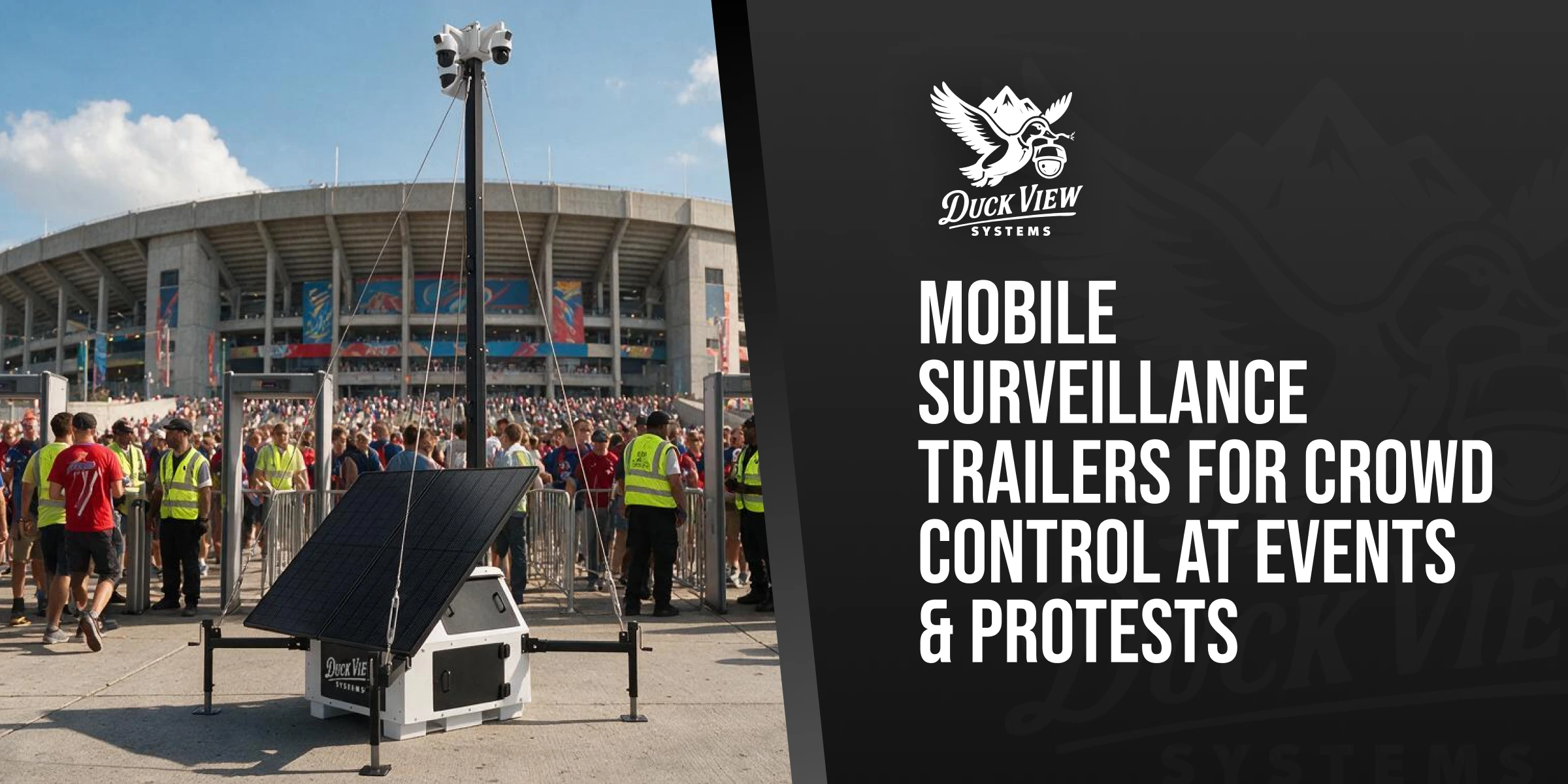
Surveillance trailers for crowd control give event commanders and municipal planners a way to watch an entire venue footprint, not just the gate a single officer is standing at, without waiting for permanent infrastructure to go in first. Parades, festivals, protests, and stadium overflow lots all share the same planning problem: crowds are unpredictable, staffing is finite, and a single blind spot can turn a manageable situation into an incident report. Departments that rely only on foot patrols and fixed cameras are choosing between full coverage and full mobility, and most events need both. A solar-powered, AI-equipped trailer closes that gap by adding continuous, elevated visibility to whatever perimeter or plaza a department is already staffing.
Mobile surveillance trailers support crowd control at events by pairing a 20-foot PTZ camera mast with AI that detects crowd surges, fighting behavior, and perimeter breaches, then triggers audio deterrents and real-time alerts so officers can respond before a situation escalates. Deployed on solar power and LTE, a unit covers a chokepoint, stage area, or protest perimeter within an hour, with no wiring or Wi-Fi required.
Key Takeaways
- Deploys in under an hour on solar power and LTE, so coverage can go live before permanent utilities exist on an event site.
- One unit’s 360-degree PTZ mast covers 2 to 3 acres, extending visibility across a perimeter that would otherwise take several officers to walk.
- AI Patrol and Focus Mode flag surges, fighting behavior, and loitering in real time, instead of waiting for a post-event footage review.
- Built-in audio deterrents let a dispatch or command center respond immediately, without pulling an officer off the line.
- Units are fully mobile and redeploy the same day, so one trailer can cover a parade route in the morning and a stadium lot that night.
How Surveillance Trailers for Crowd Control Work
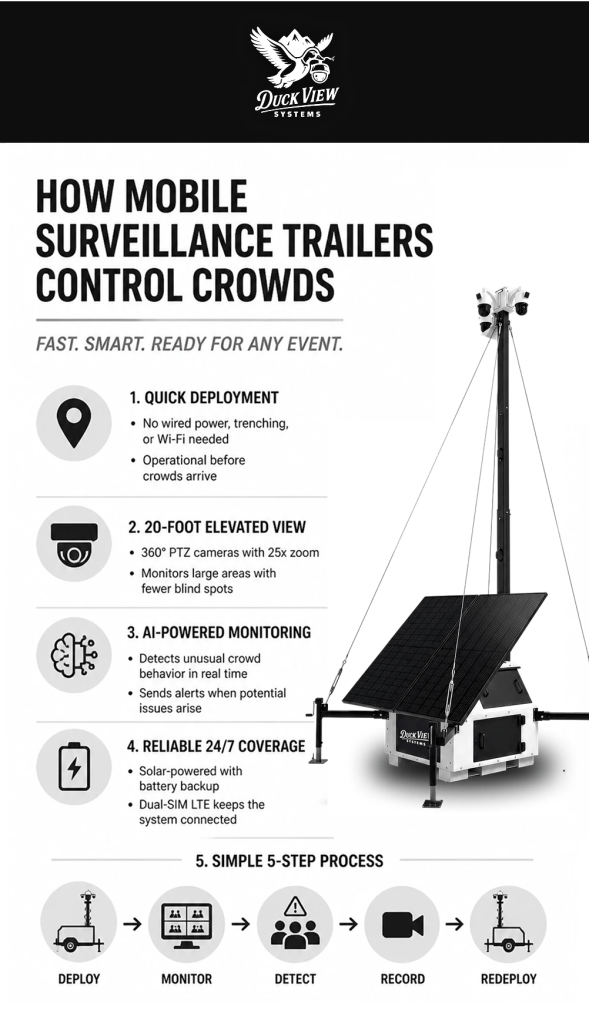
Surveillance trailers for crowd control work by combining an elevated PTZ camera platform with AI analytics that interpret crowd behavior in real time, rather than simply recording it for later review. Each Duck View Systems unit ships field-ready with a 5-by-5-foot base, a 20-foot mast, and four camera feeds built around three 360-degree PTZ cameras with 25x zoom, all running on solar power with battery backup and a dual-SIM LTE modem. That combination means a unit can be positioned at a parade staging area, a protest perimeter, or a stadium overflow lot on the morning of the event and be fully operational before the first attendee arrives, with no trenching, wired power, or venue Wi-Fi required.
Once deployed, the AI platform continuously scans the assigned zone, distinguishing normal crowd movement from the specific behaviors that precede an incident. Instead of a static camera feed that an officer has to actively watch, the system does the watching and only surfaces what matters.
The mast height is what separates a trailer from a ground-level camera or a hand-held device. At 20 feet, the PTZ cameras see over barricades, parked vehicles, and standing crowds, giving a command center a sightline that a fixed gate camera or an officer’s body-worn camera cannot match. Because the unit runs on battery backup charged by solar, coverage doesn’t drop off after dark or during an overcast multi-day deployment, which matters for events that run past sunset or extend across a weekend.
Every deployment follows the same five-stage process regardless of event type, covered in full on the How It Works page: deliver and deploy, activate smart monitoring, detect and alert and deter, capture and store and share, then stay covered until closeout. For an event, that last stage matters more than it does on a fixed site, since the same unit that covers a Friday parade route can redeploy to a Saturday stadium lot without a new installation.
AI Crowd Detection: What the System Sees

AI crowd detection identifies the behaviors that typically precede a crowd-control incident, then flags them to command staff before they escalate. The detection set relevant to events and gatherings includes:
- Loitering: individuals lingering beyond a configurable time threshold near a restricted zone, staging area, or barricade line.
- Intrusion and perimeter breach: unauthorized entry into a restricted zone, backstage area, or barricaded street segment.
- Vehicle type and color: tracking vehicles moving through or parked near a controlled perimeter, useful for staging-area and vendor-lot management.
- Suspicious pacing: repetitive movement patterns that differ from normal foot traffic through a venue or corridor.
- Fire and smoke: early detection near stages, generators, or vendor booths where open flame or equipment failure is a risk.
- Crowd surges: rapid density buildup in a confined area, such as a barricade line, gate, or stage front, flagged before the crowd becomes unmanageable.
- Fighting behavior: physical altercations flagged in real time, so command staff can direct a response to the exact zone instead of relying on a bystander report.
Detection thresholds are configurable per zone, so a department can set tighter loitering windows near a stage entrance and looser ones along an open parade route. A fixed camera records the same footage whether or not anything is happening, and a Duck View Systems unit instead interprets behavior as it happens, triggers an audio deterrent through AI Patrol‘s scheduled zone sweeps, and pushes an alert before a situation has fully developed. For an event commander managing a crowd that could shift from calm to dense in a matter of minutes, that gap between record-and-review and detect-and-respond is the difference between catching an early warning sign and reading about it in an after-action report.
Deploying Trailers at Different Event Types
Deploying trailers at different event types comes down to matching unit placement and configuration to the specific risk profile of the gathering. A single-day parade, a multi-day protest, and a stadium lot each call for a different perimeter strategy, even though the underlying hardware and detection set stay the same. That variation in risk is worth planning around: according to CISA guidance on securing public gatherings, public gatherings carry elevated risk simply because of their size and accessibility, which makes visible, continuous coverage a practical protective measure rather than an optional one, regardless of which event type is on the calendar.
| Event Type | Key Risk | Trailer Configuration |
| Parades and festivals | Route-length dispersal, choke points at intersections, vendor/crowd overlap | Multiple units staged along the route, mast raised for full-block sightlines, AI Patrol sweeping cross-streets |
| Protests and demonstrations | Rapid density shifts, perimeter pushes, need for a documented, neutral record | Fixed placement at the assigned perimeter, Focus Mode on flashpoint zones, footage retained for after-action review |
| Sporting and concert venues | Entry/exit surges, lot-wide monitoring, overnight coverage before and after gates open | Perimeter and lot placement, Virtual Guard active overnight, solar and battery covering extended hours |
Parades and Festivals
Parades and festivals spread risk across a route rather than concentrating it in one location, which is why departments typically stage multiple units at intersections and staging areas rather than relying on a single trailer. Because each unit deploys independently on solar and LTE, a department can add coverage at a newly identified choke point the morning of the event without running new cabling or coordinating with a venue’s electrical contractor.
Crowd Control at Protests and Demonstrations
Crowd control at protests and demonstrations calls for the most conservative deployment posture, since the goal is documentation and de-escalation support, not confrontation. This section is general information, not legal advice, and it does not replace a department’s own legal counsel or policy on First Amendment-protected assembly. Federal and state law both apply to recording in public spaces, and departments should confirm their own jurisdiction’s rules on audio recording, retention, and public disclosure, covered in more detail in the mobile surveillance trailer legal and privacy compliance guide, before relying on trailer footage in an official capacity. Research from the National Institute of Justice indicates that protests are more likely to remain peaceful when agencies use transparent, well-defined crowd management principles rather than reactive control, and a fixed, visible surveillance trailer supports that transparency by giving both officers and the public a consistent, neutral record of the perimeter.
Sporting and Concert Venues
Sporting and concert venues generate their sharpest risk windows at entry and exit, when thousands of attendees move through a small number of gates in a short span of time. A trailer positioned at a lot entrance or overflow area extends visibility past what fixed venue cameras typically cover, particularly in temporary lots that don’t have permanent camera infrastructure at all.
Because units are fully mobile, one trailer can reposition between an afternoon load-in period, when vendor and equipment traffic dominates the lot, and an evening entry surge, when attendee volume peaks. Departments running a multi-event venue over a season often move the same one or two units between game days rather than staffing each event separately, since the trailer redeploys the same day rather than requiring a new installation. Overnight, Sentry Mode keeps the mast on autonomous PTZ patrol across the lot between events, so a venue isn’t relying on a fixed camera angle or an empty parking lot going unwatched between game days.
Real-Time Alerts and Escalation Paths
Real-time alerts and escalation paths move a flagged event from detection to officer response in a matter of seconds, following a consistent sequence regardless of event type:
- AI detection: The system identifies a flagged behavior, such as a perimeter breach, a crowd surge, or fighting behavior, within its assigned zone.
- Automated deterrence: An IP bullhorn speaker and white or blue LED strobe engage automatically, calling out the behavior in real time through Virtual Guard.
- Live verification: A command center operator can use Focus Mode to zoom in, confirm the threat, and decide whether the automated response is sufficient or officers need to be dispatched.
- Alert and dispatch: Designated contacts receive a real-time alert with location and footage, and the integrator or command center controls the escalation path from there.
- Documentation: Every flagged event is logged with time-stamped footage through Case Reporting, building a shareable record that supports after-action review without requiring anyone to scrub hours of raw video.
The full sequence, from detection to a logged, reviewable record, typically completes in seconds rather than the minutes it takes a foot patrol to notice a developing situation, walk to it, and radio a status update. That speed compounds across a multi-hour event: a unit that catches a perimeter breach at minute one gives command staff far more room to respond calmly than one that surfaces the same breach only after it has already spread.
The same record pays off after the event closes. Instead of a supervisor scrubbing hours of footage to build an after-action report, Natural Language Search lets a command center type a plain description, such as “person in vest near stage entrance” or “white pickup truck at north gate,” and pull matching clips with map pins and instant playback. For a multi-day protest deployment or a season-long stadium rotation, that turns hours of raw video into a searchable record instead of a backlog nobody has time to review.
Why Event Commanders Choose Duck View Systems
Event commanders choose Duck View Systems because every unit is manufactured in Kaysville, Utah, and deploys the same verified hardware and AI platform whether it’s covering a parade route, a protest perimeter, or a stadium lot. Nate Salazar, Senior Director of Asset Protection and Safety at Sportsman’s Warehouse, has described Duck View Systems as a trusted partner with industry-leading AI expertise that has exceeded expectations, the same platform event commanders get when they request a unit for a weekend festival or a multi-day security detail.
The off-grid design matters most for events that don’t have permanent infrastructure. A unit goes live on a bare festival field or an unlit parking lot the same day, on solar power and LTE, closing the gap between when a department needs coverage and when a venue can provide wired power. For departments already relying on officer overtime or a contracted guard to extend coverage, the trailer is a way to right-size that spend rather than remove it.
As a manufacturer, Duck View Systems sells through a network of integrator and dealer partners rather than competing with the security vendors departments already use. Every unit still comes off the same mobile surveillance trailer platform, so an agency standing up coverage for a single weekend festival gets the same verified hardware and AI software as one building a season-long rotation across multiple venues.
| Coverage Option | Published Monthly Cost |
| Unarmed guard, 24/7 rotation (before overtime and admin) | $16,500 to $20,400 |
| Duck View Systems trailer with monitoring | Roughly $1,800 to $2,800 |
| Duck View Systems trailer or tower (base) | $1,400 to $2,300 (most departments pay $1,650 to $2,000) |
These figures show why a trailer typically extends an event security plan rather than replacing the officers assigned to it: one unit covers a zone continuously at a fraction of round-the-clock staffing cost, freeing officers to handle the interactions that require a human presence, like gate checks and crowd interaction. Exact per-event pricing depends on unit count and duration, so departments should request a quote from Duck View Systems for a deployment plan sized to their event footprint.
Frequently Asked Questions About Event Crowd Monitoring
How many surveillance trailers do I need for a large event?
Most departments plan on one unit per major choke point, stage area, or perimeter segment rather than one unit for the entire footprint. A single trailer’s 360-degree PTZ mast covers roughly 2 to 3 acres, so a multi-block parade route or a large festival grounds typically needs several units staged along the route or perimeter.
Can trailers monitor a protest without violating rights?
Departments can deploy trailers at a protest perimeter within the bounds of federal and state recording law, and this is general information, not legal advice. Video recording of public assembly on public property is generally permitted, but audio recording rules vary by state, and departments should confirm their own jurisdiction’s requirements and internal policy before relying on trailer footage in an official capacity.
How fast can a unit be deployed for a one-day event?
A Duck View Systems unit deploys in under an hour once it arrives on site, since it runs on solar power and LTE with no trenching, wiring, or venue Wi-Fi required. For a one-day event, that means a unit can arrive the morning of and be fully operational well before doors or gates open.
Do crowd detection alerts reach officers in real time?
Yes. When the AI flags a behavior such as a crowd surge or a perimeter breach, an automated audio deterrent engages immediately through Virtual Guard, and designated contacts receive a real-time alert with location and footage so officers can respond without waiting for a manual review of the feed.
Can a surveillance trailer replace officers assigned to an event?
No. A trailer extends visibility across zones that a limited number of officers can’t watch continuously, but it doesn’t replace the officers needed for physical intervention, crowd interaction, or arrests. Most departments pair a trailer with existing staffing to cover blind spots and reduce the officer-hours spent on pure surveillance, rather than using it to cut staffing outright.
Does the trailer stay powered through a multi-day event without a generator?
For most deployments, yes. The solar array and battery backup are built to sustain normal day and night cycles on their own, and we also offer generator backup as an add-on for extended low-sun stretches or continuous multi-day events where solar recharge alone may not be enough.
Improve Event Crowd Control with Duck View Surveillance Trailers
Surveillance trailers for crowd control give event commanders a way to extend visibility across an entire route, perimeter, or lot without waiting on permanent infrastructure or adding officer overtime hour for hour. A Duck View Systems unit deploys in under an hour on solar and LTE, covers 2 to 3 acres per trailer, and pairs AI detection with audio deterrence so command staff sees a flagged event as it happens, not after the fact. For a broader look at how agencies use this technology beyond single events, including patrol and hot-spot use cases, see how law enforcement agencies use mobile surveillance trailers. Whether the deployment is a weekend festival, a multi-day protest perimeter, or a stadium overflow lot, request a quote from us to build a coverage plan sized to your event, or book a demo to see the detection and alert workflow before your next deployment.