What Is a Mobile Surveillance Trailer?
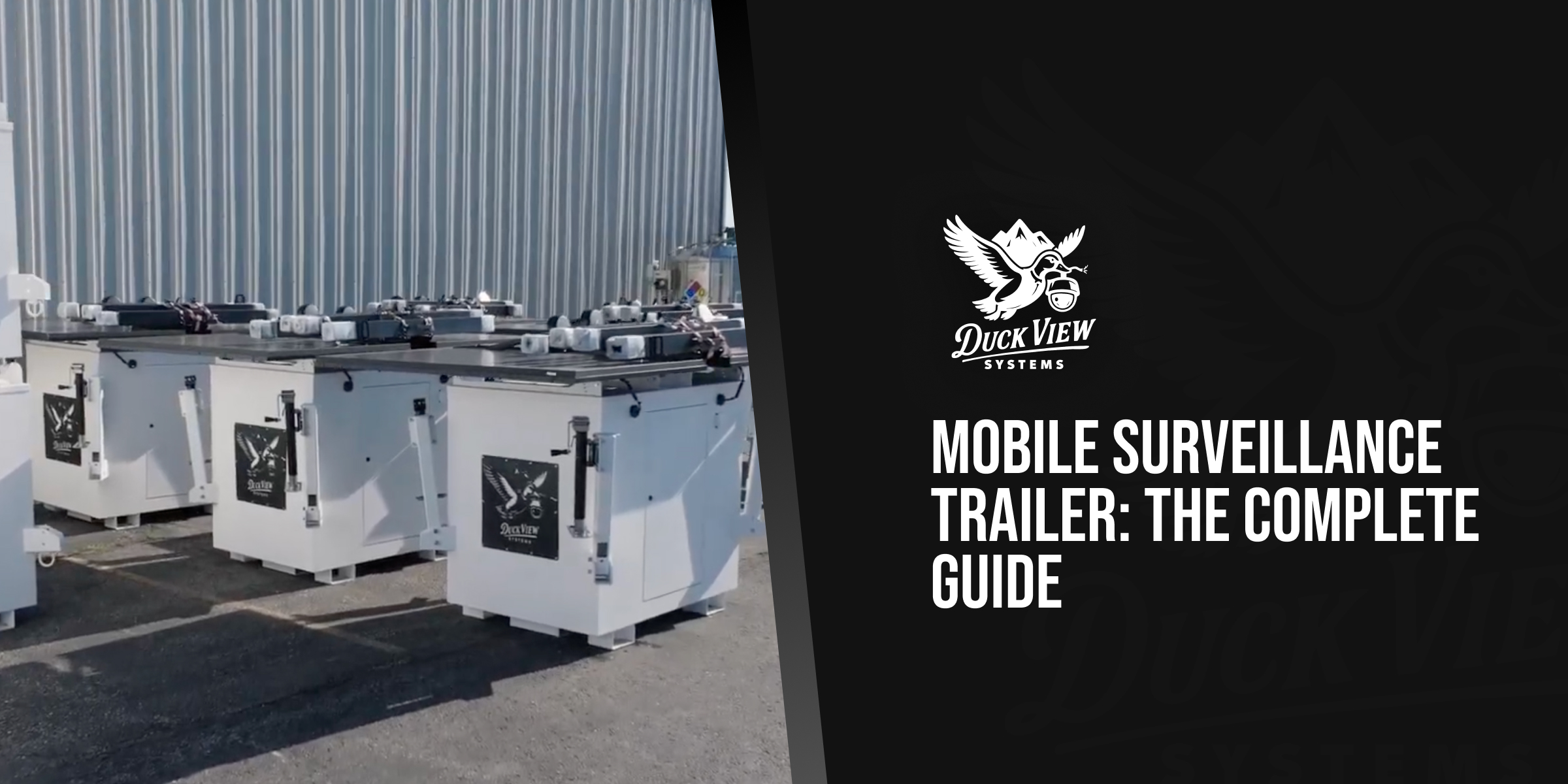
A mobile surveillance trailer is a self-contained, towable monitoring unit that delivers continuous 24/7 visibility across outdoor job sites, remote properties, and locations without permanent infrastructure. Unlike fixed installations, these units combine solar power, LTE connectivity, AI-enabled cameras, and active deterrence tools into a single deploy-ready platform.
Here is what this guide covers:
- Core components and how the hardware works together
- Key specs: mast height, solar power, LTE/5G, and AI software
- Step-by-step deployment process and AI detection capabilities
- Industries that rely on mobile surveillance units most
- How to choose between rental and purchase options
- A deep dive into Duck View Systems’ trailer capabilities
- FAQ and answers to the most common buyer questions
Whether you manage a construction site, a parking facility, or a multi-location retail operation, this guide gives you the technical grounding to make a confident decision.
How a Mobile Surveillance Trailer Works
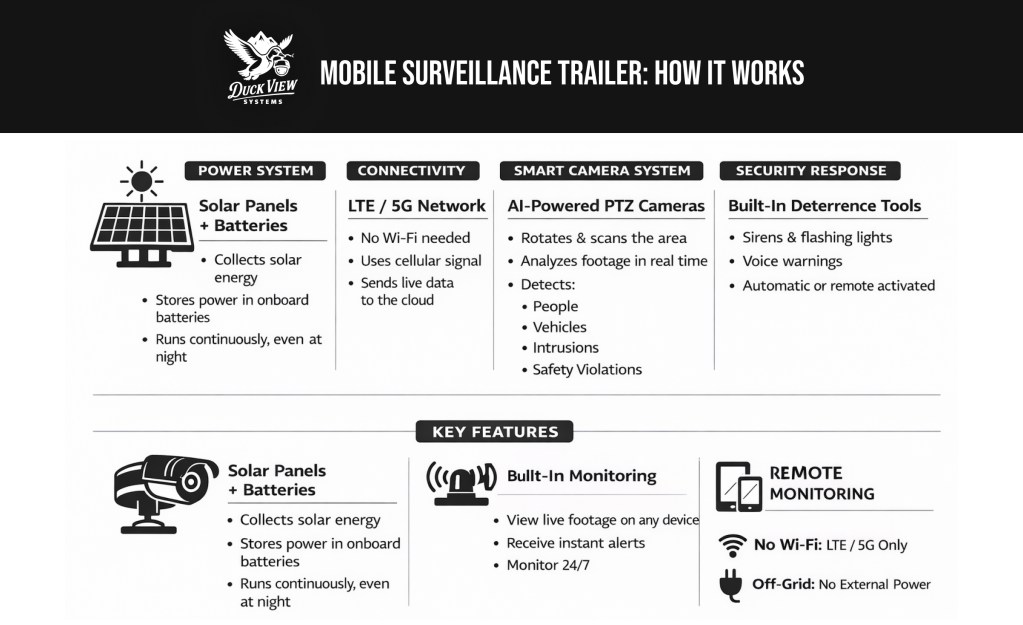
Every mobile surveillance trailer operates as three integrated systems working in parallel: power, connectivity, and detection.
The Power System
Solar panels mounted on the trailer capture energy throughout daylight hours. High-capacity battery banks store that energy to sustain operations overnight and during extended overcast periods. No generator, no fuel costs, and no external power hookup required.
For sites in lower-light climates or high-demand configurations, battery capacity and panel sizing become critical selection criteria. Ask vendors about rated battery autonomy in hours, not just panel wattage, since panels only produce their rated output under ideal conditions.
Pro Tip: When evaluating solar-powered units, request the battery autonomy rating under 50% solar input conditions. A trailer rated for 72 hours of full autonomy at half-sun performs more consistently on real-world sites than one rated only at peak output.
The Connectivity System
An onboard LTE or 5G modem transmits video streams, event clips, and alert notifications to a cloud platform. This means the trailer functions as a fully independent monitoring node without any site Wi-Fi. Remote access to live feeds, event logs, and alert dashboards is available from any device with an internet connection.
Duck View Systems units use LTE connectivity, allowing teams to monitor every trailer on a single cloud command center regardless of site location. According to Omdia research, AI-enabled camera systems are projected to account for over 60% of professional surveillance camera shipments in the coming years, reflecting the rapid shift toward intelligent remote monitoring.
The Smart Detection System
Cameras monitor the site continuously, using AI analytics to distinguish between routine activity and genuine threats. When the system flags an event, it responds automatically through push alerts, onboard sirens, strobe lights, and two-way audio. The AI does not simply detect motion. It classifies what it detects, identifying people, vehicles, PPE violations, loitering patterns, and perimeter breaches with enough specificity to generate actionable intelligence rather than false alarms.
Most setups on the Duck View platform complete initial deployment in under one hour. Technicians position the trailer, optimize camera angles, and activate remote access before leaving the site.
Key Specs: Mast Height, Solar Power, LTE, and AI Software
Understanding the hardware specs helps you match a trailer configuration to your actual coverage requirements.

Telescoping Mast Height
The mast elevates cameras above ground obstructions such as equipment, fencing, and construction staging. Higher mast positions extend the effective viewing radius significantly. Most commercial-grade trailers offer adjustable mast heights to accommodate different terrain and coverage needs. Confirm that the mast locks are securely set at your desired elevation, particularly on sites with high wind exposure.
Solar Panel Array and Battery Storage
Panel arrays collect energy throughout the day and feed it into onboard battery systems. Battery storage capacity determines how long the trailer runs without sunlight. For 24/7 operation in cloudy or winter climates, prioritize units with higher battery capacity over raw panel wattage.
Duck View trailers include both a solar panel array and a battery storage system engineered for continuous outdoor operation, allowing the platform to run day and night without external power.
LTE/5G Connectivity
LTE modems provide reliable cloud connectivity without relying on site networks. Some configurations support 5G for higher-bandwidth video transmission. For remote or rural sites, verify carrier coverage at your specific location before finalizing your trailer selection. Carriers vary significantly by region, and a unit that performs well in one geography may have a limited signal in another.
AI Software Capabilities
The AI software layer is what separates a modern mobile surveillance unit from a simple pole-mounted camera. The key capabilities to evaluate include:
- Person and vehicle classification: Does the system distinguish people from animals and vehicles from equipment?
- Behavioral analysis: Can it detect loitering, directional line crossing, and perimeter intrusion?
- PPE detection: Does it flag workers missing hard hats or safety vests?
- Search functionality: Can operators search recorded footage using natural language queries rather than manual scrubbing?
- Audit trail integrity: Are video logs tamper-proof with chain-of-custody metadata?
Duck View Systems’ AI surveillance trailer platform covers all of these categories and adds automated case reporting, license plate recognition, and facial comparison against pre-approved watchlists.
Deployment in Under One Hour: How AI Detection and Deterrence Work in the Field
One of the most practical advantages of a mobile surveillance unit is speed. Traditional infrastructure projects require trenching, conduit installation, power runs, and configuration work that can take days. A mobile trailer eliminates every one of those steps.
Step 1: Site Assessment and Positioning
Before delivery, share your site layout, access points, and coverage priorities with your provider. Duck View Systems’ team uses this information to pre-configure camera angles and AI detection zones specific to your property.
Step 2: Delivery and Activation
Technicians tow the trailer to its designated position and raise the mast. No trenching, no wiring, and no utility coordination required. The LTE modem connects to the cloud platform automatically. AI detection activates immediately once the system is powered.
Step 3: Remote Access and Monitoring
Your team receives login credentials for the cloud dashboard. From that point forward, live feeds, event alerts, and AI-generated reports are accessible from any internet-connected device. Alerts arrive as push notifications with event clips attached.
Pro Tip: Position your trailer so the mast camera has an unobstructed sightline across the highest-risk zone first, typically the equipment staging area or material storage zone on a construction site. You can always expand coverage with additional trailers as the project grows.
How AI Detection Works in Practice
When activity enters a monitored zone, the AI classifies the event in real time. Sentry Mode enables the system to rotate, zoom, and scan autonomously even when no operator is watching. Focus Mode locks the active camera onto the detected subject and tracks its movement automatically. Virtual Guard issues an immediate voice-down warning through the onboard speakers, which can deter a trespasser without requiring any operator intervention.
Natural Language Search allows investigators to retrieve relevant footage using plain-language queries. Instead of scrubbing through hours of footage, a manager can type “worker without a hard hat near the north fence” and receive matching clips with GPS-mapped timestamps instantly. This is a significant operational advantage during OSHA audits, insurance claims, or incident investigations.
Industries That Rely on Mobile Surveillance Trailers
Mobile surveillance trailers serve any environment where permanent infrastructure is unavailable, access patterns change frequently, or coverage needs shift over time.
Construction Sites
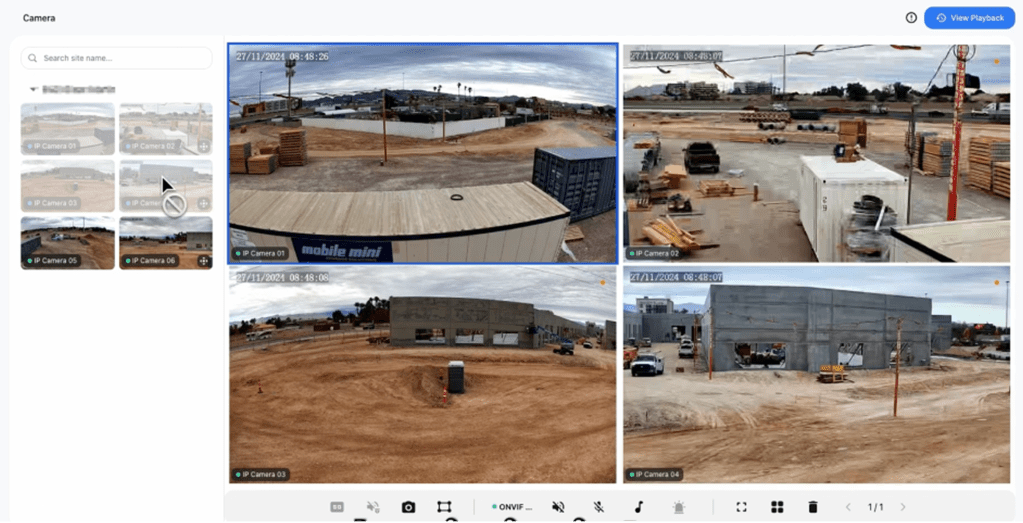
Construction is the most common deployment environment for mobile surveillance trailers, and with good reason. The construction industry loses between$300 million and $1 billion annually to theft in the United States, with recovery rates below 25% for most stolen equipment. Notably, over 80% of construction site thefts occur on weekends or holidays, precisely when sites are unstaffed and most vulnerable.
A mobile surveillance unit addresses this directly. Duck View trailers positioned on active construction sites monitor material storage zones, equipment yards, and perimeter access points around the clock. AI detection flags unauthorized entry after hours and triggers audio deterrents before theft can occur.
Beyond loss prevention, Duck View’s construction site surveillance capabilities include automated PPE compliance detection, hard hat and safety vest recognition, and construction progress monitoring through AI-assisted time-lapse documentation. Furthermore, case reporting tools generate OSHA-ready documentation automatically, reducing the administrative burden on site supervisors.
Parking Lots and Retail Properties
Parking facilities and retail properties face persistent challenges with loitering, vandalism, vehicle tampering, and unauthorized after-hours activity. A mobile surveillance unit provides wide-area coverage that adapts as the operational footprint changes.
Duck View’s retail surveillance platform covers storefronts, loading docks, and parking zones with AI detection tuned to retail-specific threat patterns. License plate recognition logs every vehicle entering and exiting the property. AI loitering detection flags individuals lingering beyond a configurable threshold, triggering a live audio warning before an incident escalates.
Automotive Dealerships
Vehicle lots present a unique coverage challenge: high-value assets spread across large open areas with limited natural sight lines. Duck View’s automotive dealership security solution uses AI vehicle detection to track specific cars, trucks, and motorcycles across the lot. After-hours events trigger automatic recording and alert escalation, giving dealership managers clear documentation for any insurance or law enforcement interaction.
Utilities, Events, and Law Enforcement
Mobile surveillance trailers serve utility infrastructure sites, public events, festivals, and municipal operations where temporary coverage is needed without permanent installation. Duck View Systems also works with police and law enforcement agencies that deploy trailers in high-activity zones, event corridors, and areas where fixed infrastructure does not exist.
The portability of the trailer means coverage moves with the operational need, whether that is a three-day festival or a six-month utility maintenance project.
Choosing the Right Mobile Surveillance Trailer: Coverage, Connectivity, AI, and Power
Selecting the wrong trailer configuration for your site leads to coverage gaps, connectivity failures, and unplanned costs. Evaluate these four criteria before committing.
1. Coverage Area Requirements
Estimate the total area you need to monitor, then identify the positions that provide the broadest unobstructed sight lines. Larger sites or sites with complex layouts typically require multiple trailer units rather than a single unit at maximum mast height. Ask vendors for coverage radius data at specific mast heights, not just general claims about “wide-area monitoring.”
2. Connectivity Reliability
LTE performance varies significantly by carrier and geography. Before deploying to a remote or rural site, verify signal strength at the specific location using the carrier your provider supports. For sites where the LTE signal is marginal, ask about multi-carrier configurations that automatically select the strongest available network.
3. AI Feature Depth
Not all AI surveillance trailer platforms offer the same detection capabilities. Basic platforms detect motion and trigger alerts. Advanced platforms, like Duck View’s, classify subjects, track behavioral patterns, support natural language search, and generate automated compliance and incident reports. Match the AI feature set to your actual operational use case.
4. Power Autonomy for Your Climate and Usage Pattern
Solar output varies by season, latitude, and cloud cover. For 24/7 reliability, prioritize battery autonomy over raw panel capacity. Verify that the trailer’s battery bank can sustain full camera and AI operation through extended periods of limited sunlight.
Surveillance Trailer Rental vs. Purchase: A Decision Framework
The choice between renting and purchasing a mobile surveillance unit depends on project duration, budget structure, and operational flexibility requirements.
| Factor | Rental | Purchase |
|---|---|---|
| Upfront Cost | Low | Higher |
| Long-Term Cost | Higher over time | Lowest at scale |
| Flexibility | High | Moderate |
| Ideal Project Length | Short-term or temporary | Long-term or permanent |
| Scalability | Add or remove units easily | Add units as needed |
| Maintenance | Often included | Owner responsibility |
| Ownership | No | Yes |
When Rental Makes More Sense
Surveillance trailer rental works best for construction projects with defined end dates, temporary event coverage, or situations where your coverage needs shift from site to site on a rolling basis. The predictable monthly cost and included maintenance reduce your operational overhead.
Most mobile surveillance trailer rental programs include delivery, configuration, and technical support. Additionally, you can scale the number of units up or down as project phases change without carrying idle equipment.
When Purchase Makes More Sense
Purchasing delivers the strongest return on investment for facilities, utilities, logistics yards, and commercial properties that require consistent 24/7 monitoring over multiple years. The absence of recurring rental fees means the total cost of ownership drops substantially after the first year. Duck View Systems offers both leasing and purchasing options to match your timeline and budget.
Pro Tip: If you are evaluating purchase versus rental for a construction project, calculate the total rental cost across your projected project duration and compare it to the purchase price plus estimated resale value at project completion. For projects longer than 18 months, ownership frequently comes out ahead.
Duck View Systems Mobile Surveillance Trailer: Product Deep-Dive
Duck View Systems is a US-based manufacturer headquartered in Kaysville, Utah. Every trailer is built for demanding outdoor environments with a focus on AI performance, deployment speed, and remote monitoring capability.
Hardware Components
Each Duck View mobile surveillance trailer includes:
- Solar Panel Array that captures energy throughout daylight hours
- High-Capacity Battery Storage System for nighttime and low-sun operation
- Telescoping Mast that elevates cameras for long-range, wide-area visibility
- High-Resolution PTZ and Multi-Sensor Cameras for both wide coverage and detailed zoom
- LTE/Wireless Modem for cloud-connected access without site Wi-Fi
- Heavy-Duty Weatherproof Trailer Chassis engineered for year-round outdoor use
- Onboard Deterrence Tools, including speakers, sirens, strobe lights, and floodlights
AI Software Suite
Duck View trailers run on a comprehensive AI platform built in partnership with Alpha Vision. The software suite includes six primary capability modules:
Virtual Guard provides proactive deterrence. It detects loitering, perimeter intrusion, and unauthorized zone entry, then responds instantly with voice-down warnings, strobes, or sirens. Sub-features include AI loitering detection, audio event detection (gunshots, glass breaking), intrusion zone mapping, directional line crossing, and AI tripwire alerts.
Sentry Mode enables autonomous PTZ camera patrol. Cameras rotate, zoom, and scan on automated schedules, visualizing all incidents on a live GPS-based activity map without requiring an operator to be watching.
Focus Mode locks the active camera onto a detected subject automatically and tracks movement in real time. It also identifies unattended objects, specific vehicle types, and known individuals through facial comparison against approved watchlists.
Natural Language Search allows users to retrieve footage using plain-language queries rather than manual timestamp scrubbing. An operator can type “person in blue vest near gate” and receive matching event clips within seconds.
Case Reporting transforms logged events into shareable, time-stamped incident reports ready for insurance carriers, compliance auditors, or law enforcement. The AI Compliance Tracker supports OSHA readiness through continuous detection logging.
AI Patrol creates automated camera routes across multiple zones to maintain consistent situational awareness. It also supports construction progress monitoring through automated time-lapse and milestone documentation.
Deployment and Support
Duck View’s three-step deployment process covers site assessment, on-site configuration, and activation of remote access. Most setups are complete in under one hour. The company offers both purchasing and leasing programs and provides responsive product support from its US-based team.
As Nate Salazar, Senior Director of Asset Protection at Sportsman’s Warehouse, noted about Duck View Systems, the company has consistently demonstrated “exceptional professionalism, reliability, and industry-leading AI expertise” and has become a trusted partner to their organization.
To see how the full platform works, visit the Duck View Systems how it works page for a walkthrough of the deployment and monitoring process.
Frequently Asked Questions about Mobile Surveillance Trailers
How much does mobile surveillance trailer rental cost?
Rental pricing depends on system type, camera count, power source, connectivity, monitoring, and rental duration. Every Duck View system falls between $1,000 and $3,000 per unit per month. Contact Duck View Systems directly for a quote tailored to your site size and coverage needs.
Can a mobile surveillance trailer work without Wi-Fi at a remote site?
Yes. Duck View trailers use LTE connectivity and transmit video and alerts through cellular networks. No site Wi-Fi is needed, making them fully functional at remote, rural, or off-grid locations.
How long does it take to deploy a mobile surveillance unit?
Most Duck View deployments complete in under one hour. Technicians position the trailer, raise the mast, calibrate cameras, and activate the cloud platform before leaving the site.
What does the AI actually detect on a construction site?
Duck View’s AI identifies people, vehicles, PPE violations (missing hard hats and vests), loitering behavior, unauthorized zone entry, fire and smoke, and graffiti or vandalism activity. It responds automatically with alerts and deterrence tools.
Is a mobile surveillance trailer better than a security guard?
For perimeter monitoring and after-hours coverage, a mobile surveillance unit provides consistent, unblinking coverage that a guard shift cannot match. The two are often most effective in combination, with the trailer handling wide-area detection and the guard responding to flagged events.
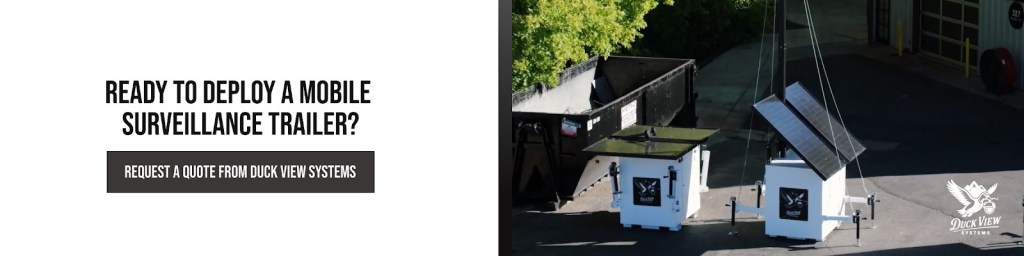
Ready to Deploy a Mobile Surveillance Trailer?
A mobile surveillance trailer provides the kind of proactive, always-on coverage that reactive approaches can never deliver. Construction managers face over $300 million in annual equipment theft losses. Facility managers deal with vandalism, liability exposure, and compliance gaps. Security integrators need reliable hardware that their clients can trust.
Every hour a site operates without proper visibility is an hour of exposure. However, the solution does not require infrastructure projects, utility coordination, or staffing overhead. A mobile surveillance trailer deploys in under an hour and starts working immediately.
The question is not whether your site needs better coverage. It is how quickly you can put it in place.