
Construction firms, retail chains, auto dealerships, and storage yard operators all reach the same question once they confirm a mobile surveillance trailer fits their site: Should you rent or buy a mobile surveillance trailer? The right answer depends on how long you need coverage, how many sites you manage, and how your budget is structured. Duck View Systems manufactures AI-powered, solar-ready units in Kaysville, Utah, and we offer both rental and purchase paths directly, with units that deploy in under an hour and run fully off-grid on solar power and LTE.
Asset protection teams at organizations like Sportsman’s Warehouse have called us a trusted partner with industry-leading AI expertise, and that same support applies whichever path you choose. A short construction phase usually favors renting, while a property you plan to monitor for years usually favors buying. This guide walks through the trade-offs, the breakeven math, and the hidden costs that change the calculation, so you can request the right quote the first time.
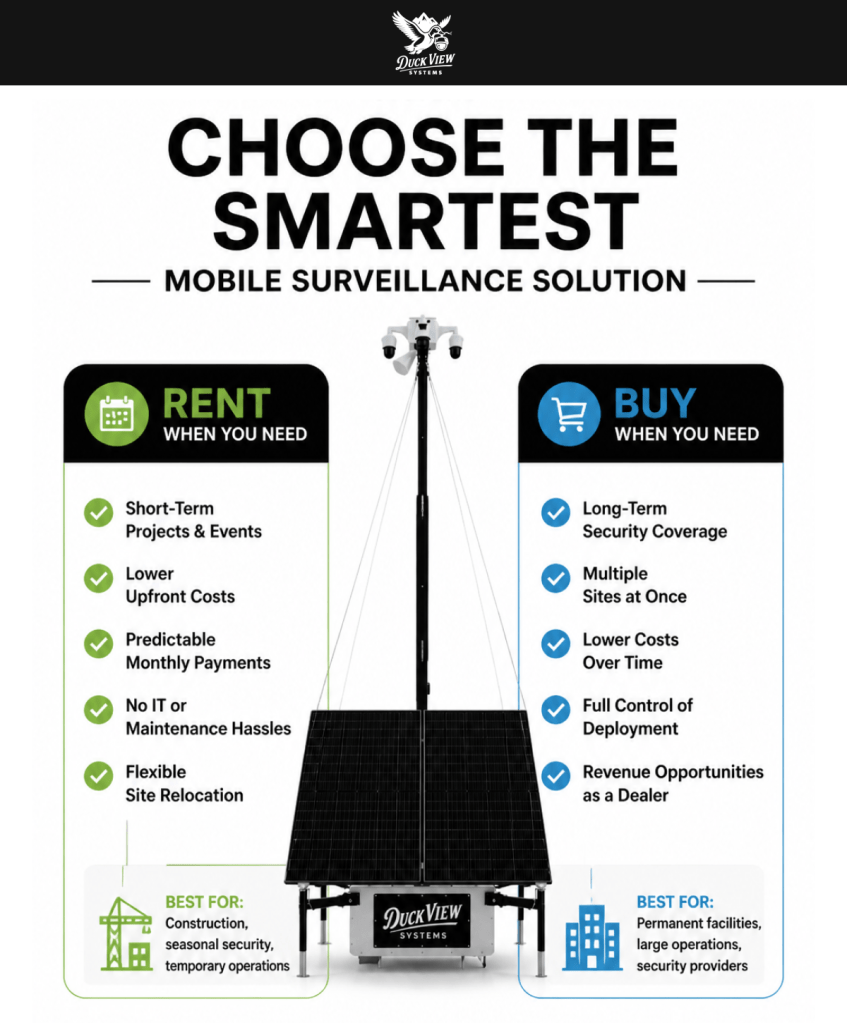
| Quick answer: Renting a mobile surveillance trailer makes sense for short-term or single-site needs, typically under 18 months. Buying makes more sense for longer, multi-site deployments, since rental payments eventually exceed a one-time purchase cost. |
The Core Trade-Off at a Glance
| Renting costs less upfront and stays flexible, while buying costs more upfront but gets cheaper per month the longer you keep the unit. The table below lays out the practical differences across the factors that usually decide the question. |
| Factor | Renting From Duck View Systems | Buying From Duck View Systems |
| Upfront cost | Low; first month’s rent and any setup fee | Higher, full unit cost or financed purchase |
| Recurring monthly cost | $1,400 to $2,300 per unit, billed monthly | None after purchase, aside from optional add-ons |
| Flexibility | High; scale up, scale down, relocate, or cancel | Moderate; the unit is yours, but resale takes time |
| Maintenance | Typically included in the rental | Owner’s responsibility after purchase |
| Ideal project length | Short-term or rolling, generally under 18 months | Long-term or permanent, generally 18+ months |
| Ownership at the end | None; the unit returns to us | Yes, you keep the unit and any resale value |
Most of these factors point in the same direction once you know your project length, which is why that row carries the most weight. A site with an open-ended timeline almost always tilts toward buying once you run the numbers past the breakeven point covered later in this guide, even if the upfront cost feels larger today.
When Renting a Mobile Surveillance Trailer Makes More Sense
| Renting makes more sense when your coverage needs have a clear end date or could change locations on short notice. The monthly rate stays predictable, and you are not stuck owning equipment once the job wraps up. |

Short-Term Projects and Cash-Flow Considerations
A few patterns point toward renting rather than buying:
- Short-term projects under roughly 18 months, such as a single construction phase, a seasonal retail lot, or a temporary storage yard.
- Cash-flow sensitive operations that would rather spread costs across a monthly bill than commit a large sum upfront.
- Teams without internal maintenance or IT resources to manage hardware, since rental plans typically include upkeep and support.
- Sites where coverage needs move from location to location on a rolling basis, since a rented unit can relocate without leaving idle equipment behind.
Renting also keeps your options open. You can add units as a project scales up, or release them the moment the job finishes, instead of carrying equipment you no longer need. Our How Much Does It Cost to Rent a Mobile Surveillance Trailer guide breaks down the full rental pricing tiers, our Solar-Powered Surveillance Trailer page notes that flexible rental agreements are available for periods as short as a few days, and our Jobsite Security Camera Rental page covers the construction-specific case in more detail.
That flexibility is especially valuable when project timelines are uncertain. If a construction schedule is extended, an event runs longer than expected, or security needs change, a rental can generally be extended without requiring a new equipment purchase. Likewise, once the need for surveillance ends, the unit can be returned instead of remaining as an unused asset. For organizations with temporary or changing security requirements, this makes renting a practical option while preserving the flexibility to adjust as circumstances evolve.
For a broader side-by-side case for renting first, see 5 Convincing Reasons to Rent a Mobile Surveillance Trailer.
When Buying or Becoming a Dealer Makes More Sense
| Buying makes more sense when you need the same coverage for years rather than months, or when you want to offer surveillance coverage to your own clients instead of protecting a single site. Once a unit is paid off, the monthly cost drops to near zero outside of optional add-ons and routine upkeep. |
Multi-Site Mobile Surveillance Trailer Deployments
A few patterns point toward buying rather than renting:
- Long-term, recurring security needs at a fixed property, such as a permanent storage yard, a remote facility, or a critical-infrastructure site.
- Multiple simultaneous sites, where owning several units lowers the average monthly cost, the longer you keep them in service.
- Resale and dealer opportunities: if you want to generate revenue by offering surveillance coverage to your own clients rather than protecting a single site, our dealer program lets you buy units at exclusive wholesale pricing and offer them as rentals, leases, or sales, backed by full onboarding, installation training, and ongoing technical support from our team.
- Risk-averse teams that prefer a fixed, depreciating cost over an open-ended rental commitment with no defined end date.
Buying also builds equity. The unit becomes a balance-sheet asset rather than a recurring expense, and you control redeployment timing without coordinating a lease return. If reselling or leasing coverage to your own clients is the goal, our Become Our Dealer program is built specifically for that model, with wholesale pricing and full support from our team.
Should You Rent or Buy? The 18 to 24 Month Breakeven Rule, Explained
| Most rent-versus-buy comparisons reach their breakeven point somewhere between 18 and 24 months of continuous use. Before that point, renting usually costs less in total. After it, ownership usually pulls ahead. |
Calculating Your Own Breakeven Point
The math itself is simple: multiply the monthly rental rate by the number of months you expect to need coverage, then compare that running total against the purchase price plus any add-ons. Most customers pay $1,650 to $2,000 per month, an 18-month rental adds up to roughly $29,700 to $36,000. A 24-month rental adds up to roughly $39,600 to $48,000.
| Coverage Length | Total Rental Cost ($1,650/mo) | Total Rental Cost ($2,000/mo) | Purchase Price (Same Configuration) |
| 18 months | $29,700 | $36,000 | Quote-based |
| 24 months | $39,600 | $48,000 | Quote-based |
| 36 months | $59,400 | $72,000 | Quote-based |
We do not publish a fixed purchase price online, since pricing is quoted per configuration. Drop your own purchase quote into the right-hand column once you have it, and the month at which the rental total in either of the middle columns crosses that number is your breakeven point. Request a quote for both the rental rate and the purchase price on your specific configuration before finalizing the comparison.
Two factors shift the breakeven point earlier or later. Longer contract terms typically lower the monthly rental rate, which pushes the breakeven point further out. Add-ons such as monitoring, Starlink connectivity, or a generator raise the cost on both sides of the comparison equally, so they rarely change which option wins, only by how much.
Factor in resale value, too. A well-maintained unit retains some value at the end of its service life, which improves the economics of buying even further on projects that run past the breakeven point. A rental, by contrast, has no resale component, since the unit returns to us when the contract ends.
Hidden Costs to Factor In
| Add-ons like monitoring, satellite connectivity, and generator backup apply to both renting and buying, and they can shift your total cost more than the base price alone. |

| Add-On | Approximate Cost | Applies To |
| Monitoring services | $400 – $500 per unit per month | Both rental and purchase are optional, not bundled into any lease tier |
| Starlink connectivity | Additional monthly cost; ask for an exact figure with your quote | Both for remote sites with limited LTE coverage |
| Generator backup | Additional monthly cost; ask for an exact figure with your quote | Trailer add-on for low-sunlight or heavily shaded sites |
| Delivery and setup | Varies based on location and lease length | Both |
| Ongoing maintenance after purchase | Request a quote | Purchase only |
Contract length affects both numbers, too. Month-to-month rentals offer maximum flexibility but carry the highest rate within the published range, while six to twelve-month commitments typically unlock a lower monthly rate. If you already know your project will run a year or longer, ask about the longer-term rate before assuming the higher end of the range applies to your quote.
These costs apply whether you rent or buy, but they hit differently. On a rental, they raise the monthly bill. On a purchased unit, they are the only recurring cost left once the unit is paid off, which is why most buyers see their per-month cost drop sharply over time.
The U.S. Small Business Administration notes that leasing may be a better option for short-term equipment needs, while purchasing equipment can provide greater long-term value despite higher upfront costs. That trade-off applies directly to a mobile surveillance trailer decision.
Purchased equipment may also qualify for a Section 179, which allows businesses to deduct all or part of the cost of qualifying equipment in the year it is placed in service, subject to IRS limits and eligibility requirements, according to IRS Publication 946. Eligibility depends on your specific tax situation, so confirm this with a tax professional before factoring it into your decision. This is general information, not tax advice.
Whichever path fits your timeline, the exact monthly rate or purchase price depends on your site’s camera count, AI package, and add-ons. See our Pricing page for the published monthly ranges, then request a quote from our team to get the real numbers for both options before you decide.
Which Industries Lean Toward Renting or Buying?
| Construction crews tend to rent, while retail chains, auto dealerships, and storage operators more often buy. The pattern follows how long each industry typically needs coverage at a given site. |
| Industry | Typical Lean | Why |
| Construction | Rent | Coverage ends when the project phase or job closes out |
| Events and festivals | Rent | Coverage is needed for days, not years |
| Retail | Buy | Parking lots and storefronts need year-round coverage |
| Automotive dealerships | Buy | Inventory lots need continuous, year-round protection |
| Storage yards and fleet parking | Buy | Long-term, fixed-location monitoring with no end date |
| Police and municipal | Either | Depends on whether the deployment is a short-term hot spot or a persistent zone |
Construction, Events, and Other Short-Cycle Deployments
Construction projects have a built-in end date, so the rental model fits naturally. Crews protect material storage and equipment yards for the length of a phase, then release the unit once the job closes out. Event organizers and seasonal retail lots follow the same logic, since coverage is only needed for a defined window. Our Construction Sites page covers jobsite-specific detection, like PPE compliance and progress monitoring, in more depth.
Retail chains, auto dealerships, and storage or fleet operators more often buy, since their coverage needs do not have an end date. A retail parking lot, a dealership inventory yard, or a remote storage facility typically needs the same monitoring for years, which is exactly the scenario where ownership pulls ahead of renting. A multi-location retailer or dealership group also gains from standardizing on owned units across every lot, since the same configuration, training, and support apply everywhere instead of managing several rental contracts on different renewal dates. Our Automotive Dealership Security page covers the detection features most relevant to vehicle lots, and our Off-Grid Surveillance page covers the solar and LTE setup that makes long-term, permanent ownership practical at remote properties without existing power or network infrastructure.
Police departments, municipalities, and event organizers fall somewhere in between, since their deployment length depends entirely on the operation. A short-term crime hot-spot deployment or a multi-day festival favors rental, while a persistent high-crime zone or a year-round municipal monitoring program favors purchase. Our law enforcement mobile surveillance trailer guide breaks down that range of deployment lengths in more detail.
Duck View Systems’ Flexible Options
| We back every rental and purchase with the same hardware, AI software, and support, since we design and manufacture every unit ourselves in Kaysville, Utah. A purchased unit and a rented unit run identical detection capabilities, including loitering, intrusion, fire and smoke, and PPE compliance, on the same dual-SIM LTE connection and solar-plus-battery power system. |
Nate Salazar, Senior Director of Asset Protection at Sportsman’s Warehouse, has described us as a trusted partner whose industry-leading AI expertise has frequently exceeded expectations. That same hardware and support apply whether your unit arrives on a rental contract or as a purchase.
Purchased units also receive the same remote technical support as rentals, including help with redeployment when you move a unit to a new site or project phase. Choosing to buy does not mean losing the support that comes standard with a rental.
Every unit we rent or sell follows the same five-stage process: deliver and deploy, activate smart monitoring, detect and alert, capture and document, then move and adapt as your site changes. The AI software runs through the same cloud platform on both paths, so a purchased unit is not locked to a static feature set the way a one-time camera purchase often is.
Every unit, rented or purchased, includes a 20-foot mast, two 360-degree PTZ cameras with 25x zoom, four camera feeds, an IP bullhorn speaker, and a white-and-blue LED strobe for visible deterrence. Each one deploys in under an hour with no trenching or wiring required. See our How It Works page for the full deployment walkthrough, or our Mobile Surveillance Trailer solutions page and What Is a Mobile Surveillance Trailer? How It Works and Costs for a full breakdown of the hardware and AI platform behind both options.
Ready to talk through your specific site? Talk to our team about a rental or purchase plan built around your timeline, or, if you would rather offer this coverage to your own clients, ask about becoming our dealer at wholesale pricing.
Frequently Asked Questions
Is it cheaper to rent or buy a mobile surveillance trailer?
It depends on how long you need coverage. Renting costs less in total for deployments under roughly 18 months. Buying costs less per month over a longer timeline, since there is no recurring rental fee once the unit is paid off.
How long should I rent before buying makes more sense?
Most comparisons reach a breakeven point between 18 and 24 months of continuous use. Request a quote for both options on your specific configuration to see where that point falls for your site.
Does Duck View Systems sell units directly, or only through dealers?
We sell and rent units directly to site owners. We also operate a separate dealer program for integrators and resellers who manage coverage across multiple client sites at wholesale pricing.
Is monitoring included whether I rent or buy?
No. Self-monitoring through the mobile app is included with both rental and purchase. Live agent monitoring is an optional add-on priced at $400 – $500 per unit, per month, either way.
Does buying a mobile surveillance trailer qualify for a tax deduction?
Purchased equipment may qualify for a Section 179 deduction, which allows a business to deduct the full cost in the year it is placed in service. Confirm eligibility with a tax professional, since this depends on your specific business and tax situation.
So, Should You Rent or Buy a Mobile Surveillance Trailer? Making the Right Call
There is no universal right answer to whether you should rent or buy a mobile surveillance trailer, only the right answer for your specific timeline and budget. A defined project under 18 months almost always favors renting. A property you will monitor for years almost always favors buying. Either way, the unit, the AI detection, and the support behind it are the same.
If you are still unsure, start with the math. Estimate your project length in months, multiply it by the relevant rental rate, and compare that figure to a purchase quote for the same configuration. The lower total cost over your actual timeline is the right call, regardless of which way conventional wisdom points for your industry.
Book a demo with our team to walk through your site’s specific numbers, or request a quote to compare the exact rental and purchase costs for your configuration before you commit.