

A single unlocked gate can turn a construction site into an open invitation. Property managers and general contractors searching for how to prevent trespassing on construction sites and commercial property usually ask the question after an incident, not before one. An empty lot at dusk, stacked materials, and no one watching create the exact conditions that draw in people who have no business being there. Trespassing rarely stays contained to one walked-through fence line. It tends to escalate into theft, vandalism, or worse before anyone notices. We build mobile surveillance trailers that give unattended sites a working set of eyes, and this guide covers the legal basics, the real risks, and the layered prevention stack that keeps people off property they shouldn’t be on.
The most effective way to prevent trespassing is combining physical barriers with active monitoring, not relying on either alone. Fencing and signage establish the legal boundary that turns an intruder into a trespasser in the eyes of the law. Real-time detection, audio warnings, and a fast response close the gap a fence alone cannot close, because a locked gate does not stop someone willing to climb it. Properties that layer perimeter control, lighting, and AI-powered intrusion detection report far fewer repeat incidents than properties relying on a single measure.
A few things shape how we think about trespassing prevention on active and vacant sites:
- Fencing alone deters casual trespassers but does little against anyone willing to climb, cut, or walk around a gap.
- Posted signage is sometimes a legal prerequisite before certain enforcement actions become available, depending on the state.
- Unattended job sites and vacant commercial lots draw trespassers because no one is present to notice or respond.
- AI-powered intrusion zones and tripwire detection flag a boundary crossing the moment it happens, not during the next morning’s walkthrough.
- A documented pattern of repeat incidents strengthens both a law-enforcement report and a formal trespass notice.
What Legally Counts as Trespassing on Private Property
Trespassing means entering or remaining on private property without the owner’s permission, and the specific legal definition varies by state. Most states treat trespassing as unauthorized entry after the owner has communicated, through signage, fencing, or a direct statement, that entry is not allowed. A person who wanders onto an open, unfenced lot may not meet every state’s legal bar for trespassing until they are asked to leave and refuse to go.
Some states distinguish criminal trespass from civil trespass, and penalties range from a low-level infraction to a more serious charge depending on intent and prior warnings.
This is general information, not legal advice, and property owners should confirm the exact trespassing and criminal statutes that apply in their state before taking enforcement action.
Signage as a Legal Prerequisite Before Enforcement
Several states require posted “No Trespassing” signage at regular intervals along a property line before a trespassing charge can hold up in court. That requirement makes signage more than a formality. Pairing visible signage with a continuous fence line gives a property owner a documented, defensible boundary that a court or a responding officer can point to. It also gives an AI system a clear reference point for intrusion zones and directional line-crossing alerts, since detection technology works best when it mirrors a boundary a person could reasonably be expected to recognize as private property.
Why Job Sites and Vacant Properties Are Common Targets
Job sites and vacant commercial properties are common trespassing targets because they sit unattended for long stretches and hold materials worth taking. A construction site in an active phase can sit empty every night, every weekend, and often for weeks between crews or trade sequences. Vacant retail buildings and undeveloped lots see even less regular activity, with no employees, no lighting schedule, and no one to notice a broken lock or a cut fence panel. That combination, valuable materials plus low natural surveillance, makes these properties easier targets than an occupied building with people coming and going all day.
Squatting is a related risk on properties sitting vacant for extended periods, particularly buildings mid-renovation or awaiting a tenant. A trespasser who establishes a presence on a vacant site, even briefly, is far more likely to return, and each return visit raises the odds of damage, fire risk from makeshift heating, or an escalation into theft.
The Risks of Unaddressed Trespassing
Unaddressed trespassing creates liability exposure, not just a coverage gap. A property owner can be held responsible if a trespasser is injured on a hazardous site, especially a construction property with excavation, exposed rebar, or heavy equipment left in place overnight. Employers already carry a general duty under federal workplace safety law to keep a work environment free of recognized hazards, and the Occupational Safety and Health Administration’s General Duty Clause interpretations outline that obligation in detail. While that duty is aimed at employees, courts in many states extend some level of care toward trespassers on properties known to attract them, particularly children.
Beyond the injury risk, trespassing that goes unaddressed tends to escalate. A person who successfully enters a site once is more likely to return, and what starts as loitering or trespassing frequently becomes theft or vandalism once someone learns a property has no active deterrent. Vacant properties carry an added squatting risk, where a trespasser who is not challenged early can establish an ongoing presence that becomes far harder, and far more expensive, to remove later.
7 Ways to Prevent Trespassing on Construction Sites and Commercial Property
Preventing trespassing takes a layered approach, since no single measure stops every type of intruder. The seven tactics below work together, moving from physical deterrence to active detection to documentation, and each one closes a gap the others leave open.
- Fencing and physical perimeter control. A continuous fence line, ideally six feet or taller with minimal gaps, remains the first physical barrier and the boundary that gives signage and trespassing statutes their legal footing.
- Clear “No Trespassing” signage. Post signs at regular intervals and at every entry point, since several states require this step before certain enforcement actions apply.
- Lighting and visibility. Crime Prevention Through Environmental Design principles call for open sightlines and consistent lighting, which removes the cover a trespasser relies on after dark and makes a person on-site visible from the street.
- AI-powered intrusion and tripwire detection for restricted zones, covered in detail below.
- Real-time audio deterrents and live two-way talk-down. A voice-down warning delivered the moment someone crosses a boundary interrupts an intrusion before it becomes an incident, without putting staff in a face-to-face confrontation. Our Virtual Guard solution handles this automatically.
- Mobile surveillance trailers instead of, or alongside, static fencing and a guard-only approach, compared in detail in the next section.
- Documentation and law-enforcement coordination for repeat offenders, covered in detail later in this guide.
AI-Powered Intrusion and Tripwire Detection for Restricted Zones

AI-powered intrusion and tripwire detection give a fence line an active layer instead of a passive one. An intrusion zone is a mapped area, such as a materials laydown yard or an equipment corral, that triggers an alert the instant someone or something crosses into it. Directional line crossing takes that further, distinguishing between someone walking parallel to a fence and someone actually breaching it. Tripwire detection works as a virtual boundary along a perimeter that doesn’t require physical wiring or trenching to install. Together with object intrusion detection, these features shift monitoring from a scheduled walkthrough to a continuous, real-time watch over every restricted zone on a site.
Mobile Surveillance Trailers vs. Fencing and Guards: What Actually Stops Trespassers

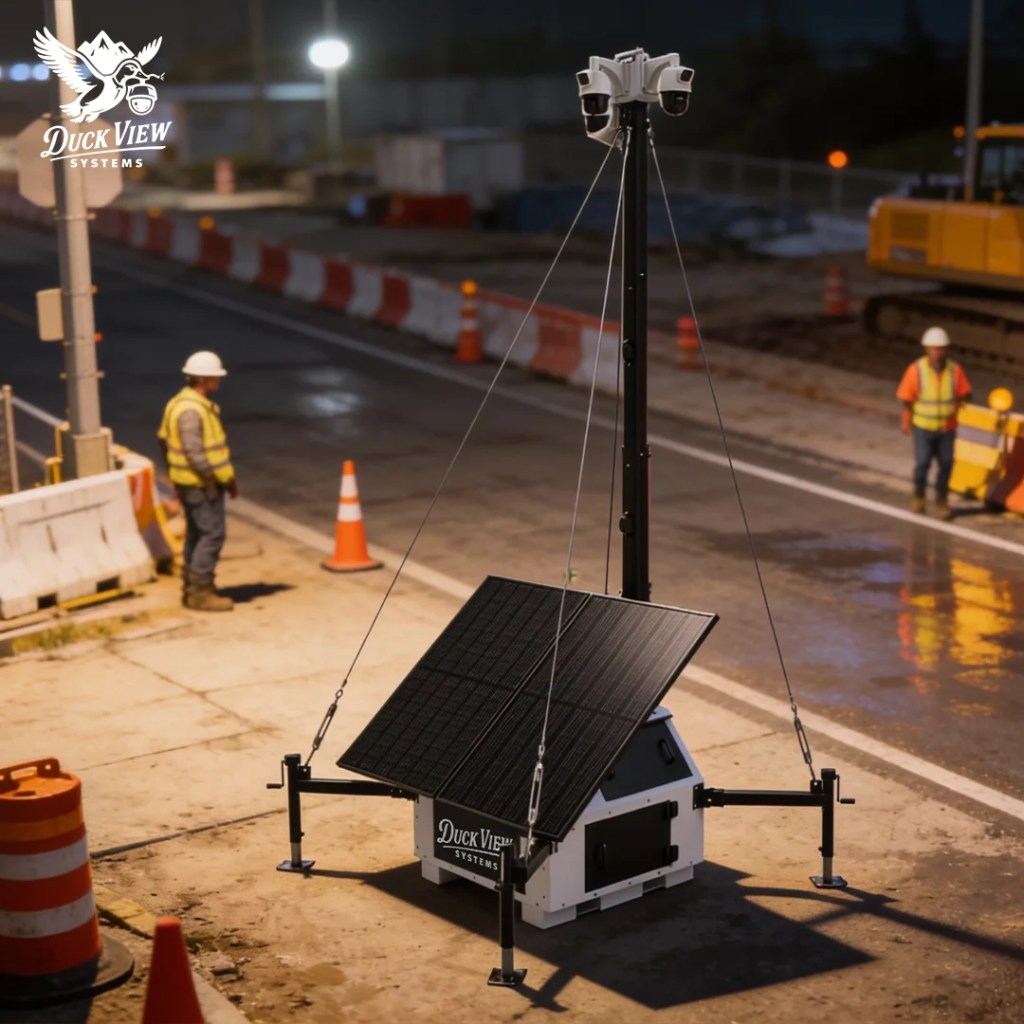
Mobile surveillance trailers stop more trespassing incidents than fencing or guards used alone because they combine a physical deterrent with active, continuous detection. Fencing sets the legal boundary but takes no action once someone breaches it. A guard adds a human presence and judgment, but one person can only watch one section of a site at a time, and guard coverage typically runs on a shift schedule rather than around the clock. A mobile surveillance trailer adds 360-degree PTZ cameras, AI-powered detection, and an audio deterrent that responds to every zone it covers at the same time, without needing a break.
| Approach | Coverage | Response | Best Fit |
| Fencing alone | Physical boundary only | None, passive | Establishing a legal perimeter |
| Guard patrol | One area at a time, shift-based | Manual, delayed between rounds | Sites needing an on-site decision-maker |
| Mobile surveillance trailer | 360-degree, continuous | Real-time AI alert plus audio talk-down | Unattended or after-hours sites |
For sites already working with a security guard service or considering one, our units function as a force multiplier rather than a replacement, extending coverage into hours and corners a single guard can’t watch continuously. Police departments and other law enforcement agencies use mobile surveillance trailers for the same reason, covering high-activity areas without adding headcount.
We publish monthly pricing ranges instead of quoting privately, which most vendors in this category do not do. A mobile surveillance tower typically runs $1,000 to $3,000 per month per unit. Pole-mounted systems, better suited to a semi-permanent, well-lit entrance or parking lot, start at the lower end of that range. Final pricing depends on monitoring, connectivity, backup power, delivery, and lease length, and monitoring is an optional add-on that moves a unit toward the upper end of the range. Our pricing page breaks down what drives the total, and a quote is the only way to get an exact number for a specific site.
| Specification | Verified Value |
| Mast height | 20-foot telescoping mast |
| Camera configuration | 4-camera or 6-camera configurations, 360-degree PTZ, 25x optical zoom |
| Coverage per unit | Typically 2 to 3 acres, depending on layout |
| Deployment time | Under one hour, often operational same day |
| Power | Solar with onboard battery, no trenching or external power required |
How Duck View Systems Detects and Deters Trespassers Automatically
Duck View Systems detects a trespasser the moment they cross a mapped boundary and responds automatically before a person ever has to step in. Our Virtual Guard solution identifies loitering, perimeter breaches, and object intrusion, then reacts with voice-down warnings, strobe lights, or a siren while a live operator reviews the event and can escalate it. Sentry Mode keeps our 360-degree PTZ cameras rotating and scanning unattended areas, feeding a live GPS-based activity map and a real-time alert dashboard stream. AI Patrol runs automated routes across multiple zones on a single site, so a materials yard, an equipment corral, and a gate entrance all get coverage from one unit. Case Reporting turns any incident into a shareable, time-stamped report, backed by an AI Audit Trail with tamper-proof, chain-of-custody metadata, useful for law enforcement or an insurance claim.
We manufacture every unit in Kaysville, Utah, and ship it from our own facility, which is part of why deployment happens in under an hour and often the same day a unit arrives on-site. Nate Salazar, Senior Director of Asset Protection & Safety at Sportsman’s Warehouse, has described Duck View Systems as a trusted partner known for exceptional professionalism, reliability, and industry-leading AI expertise. That kind of feedback reflects what our units do on an active site, not a lab demo.
What to Do If You Catch a Trespasser On-Site
The safest response to catching a trespasser on-site is to avoid direct confrontation and let documentation and audio deterrence do the work. Approaching someone in person puts staff at risk and rarely resolves the situation faster than a recorded, time-stamped alert does. A live two-way talk-down lets an operator address the person directly, identify themselves, and ask them to leave, all without anyone walking up to a stranger on an unlit lot. What happens after that point, including whether and how a property owner can use physical force, depends heavily on state law and local privacy rules, and we’d rather point readers to a licensed attorney than offer a definitive answer here.
Documentation and Law Enforcement Coordination for Repeat Trespassers
Every trespassing incident is worth documenting, even the ones that end without damage or theft. A pattern of repeat incidents, backed by time-stamped video and an audit trail, gives law enforcement something concrete to act on instead of a verbal report. It also supports a formal trespass notice, which several states require before repeat entry can be prosecuted as a more serious offense. The National Insurance Crime Bureau points to consistent documentation and reporting as central to addressing property crime patterns, which is exactly what a chain-of-custody video record provides. Our Natural Language Search feature lets a site manager type a plain description, such as “person near the gate at night,” and pull up the matching event in seconds rather than scrubbing through hours of footage.
Frequently Asked Questions About Trespassing Prevention
Is trespassing a felony?
Trespassing is usually a misdemeanor, but it can become a felony depending on the state, the property type, and whether the person was previously warned or issued a formal notice. Repeat trespassing, trespassing combined with theft or vandalism, or entry onto certain protected properties can all raise the charge. Because these thresholds vary by state, property owners should confirm the exact statute that applies locally.
Can a property owner legally use force against a trespasser?
Most states allow a property owner to use reasonable, non-deadly force to remove a trespasser after asking them to leave, but the specifics vary widely, and deadly force is rarely justified by trespassing alone. This is general information, not legal advice, and anyone facing this situation regularly should talk to a local attorney about what their state permits.
What is an intrusion zone?
An intrusion zone is a mapped area on a property, set up within Duck View Systems’ AI software, that triggers an alert the instant a person or object enters it. It’s commonly drawn around a materials yard, an equipment corral, or a restricted section of a larger site, giving a property owner detection in the specific area that matters most. See our full intrusion zone feature page for the technical details.
How long before someone counts as trespassing versus loitering?
There’s no universal time threshold. Loitering typically describes someone lingering without a clear purpose, while trespassing usually requires unauthorized entry onto a clearly bounded, private property. The two often overlap in practice, since loitering near a fence line is frequently the step right before an actual trespass.
Do I need cameras if I already have a fence?
Yes, because a fence only establishes a boundary; it doesn’t detect or respond when someone crosses it. Cameras and AI-powered intrusion detection add the active layer that catches a breach in real time and gives a property owner a documented record afterward, something a fence alone can never provide on its own.
Does Duck View Systems replace security guards?
No. Duck View Systems is not a security company, and our mobile surveillance trailers work best alongside guard patrols and law enforcement rather than replacing the human judgment a guard brings. Our units extend coverage into the hours and areas a guard can’t watch continuously, functioning as a force multiplier rather than a swap.
Building a Trespassing Prevention Plan That Actually Works
Preventing trespassing on a construction site or commercial property comes down to layering a physical boundary with active, real-time detection, not picking one tactic and hoping it holds. Fencing and signage set the legal line. Lighting removes the cover trespassers rely on. AI-powered intrusion and tripwire detection, paired with audio talk-down, close the gap between a boundary being crossed and someone actually responding to it. We’d be glad to walk through what that layered plan looks like for your construction site or commercial property. Request a quote from us for a free consultation and a custom monitoring plan built around the site you’re trying to protect.