

When comparing a mobile surveillance trailer vs security guards, construction firms, retailers, and auto dealerships paying for round-the-clock protection often ask the same question: Which option provides better security and value? At Duck View Systems, we manufacture solar-powered, AI-equipped surveillance trailers that deploy in under an hour and run off-grid on solar power and LTE, so a site moves from unprotected to monitored the same day. A trailer can replace a guard’s continuous, unblinking presence on most exterior sites, but it cannot replace a guard’s ability to step in physically or use judgment in an unpredictable situation. The right mix depends on the site’s layout, its risk level, and the budget behind it.
Quick Answer: A mobile surveillance trailer can replace a security guard’s continuous monitoring duties on most outdoor sites, since it runs around the clock on solar power and LTE, detects loitering, intrusion, and PPE violations with AI, and triggers audio deterrents instantly. It cannot replace a guard’s ability to physically intervene, so most sites pair one guard with several trailers instead of picking only one option.
The Case for Mobile Surveillance Trailers vs Security Guards
A mobile surveillance trailer beats a single security guard on cost, uptime, and coverage area for most exterior sites. One unit watches a site continuously, with no lunch breaks, shift changes, or call-offs, and a triple360-degree PTZ camera with 25x zoom covers ground that would otherwise take more than one guard walking a foot patrol. The gap becomes clear once monthly costs sit side by side.

Mobile Surveillance Trailer vs Security Guards: The Cost Comparison
We publish our monthly trailer pricing rather than hiding it behind a sales call, and that transparency makes a direct cost comparison possible.
| Factor | Duck View Systems Mobile Trailer | Security Guard |
| Typical monthly cost | $1,400 to $2,300 per unit; most customers pay $1,650 to $2,000 per month | Median guard pay nationally is $38,370 a year, about $18.46 an hour, per the U.S. Bureau of Labor Statistics (May 2024), before agency overhead, supervision, and margin are added |
| Hours of active coverage | 24/7, including overnight and weekends, with battery backup for cloudy stretches | Limited to scheduled hours; round-the-clock coverage requires several guards rotating across shifts |
| Coverage per post | Up to 2 to 3 acres per unit with 360-degree PTZ coverage | Typically one position or a short foot patrol route |
| Detection method | AI flags loitering, intrusion, PPE violations, fire and smoke, and vehicle type and color in real time | Visual scanning and human attention |
| Deterrent response | Audio deterrent through the built-in IP bullhorn, plus an instant alert | Verbal warning or physical presence |
| Consistency | Same detection thresholds at 3 a.m. and 3 p.m., with no fatigue | Attention can decline over a long shift, and the industry sees high turnover |
These guard wage figures reflect base pay only. A contracted guard service typically bills well above that wage once overhead, training, supervision, and profit margin are factored in. Confirm the exact contracted rate in your market before comparing totals line by line.
The gap matters most on sites that need true around-the-clock coverage. A single guard can only watch one position at a time, and stretching that coverage across a full 24-hour day means either paying overtime or splitting the post across several people. Our trailer keeps running through the night on solar and battery power without an extra line item on payroll, which is why the cost difference widens the longer the coverage window runs.
What a Mobile Surveillance Trailer Can Do That a Guard Cannot
A mobile surveillance trailer can watch every angle of a site at once, which one guard physically cannot do. Three 360-degree PTZ cameras per unit, each with 25x optical zoom, cover the full perimeter and the interior of a lot at the same time, while a guard on foot can only watch the direction they happen to be facing. The AI software analyzes every frame from every camera continuously, so it never has to choose which corner of the site to check first.
- Detects loitering, intrusion, PPE violations, fire and smoke, and vehicle type and color, all in real time
- Sends an instant alert and triggers an audio deterrent through the built-in IP bullhorn the moment a threshold is crossed
- Captures high-resolution, time-stamped footage for every event, building an evidence trail a guard’s memory cannot match
- Runs the same detection routine at 3 a.m. as at 3 p.m., with no fatigue, distraction, or shift handoff gap
- Uses Natural Language Search to pull up a clip of “white pickup truck” or “person in vest” in seconds instead of scrubbing hours of footage
AI Detection Coverage Without Fatigue or Blind Spots
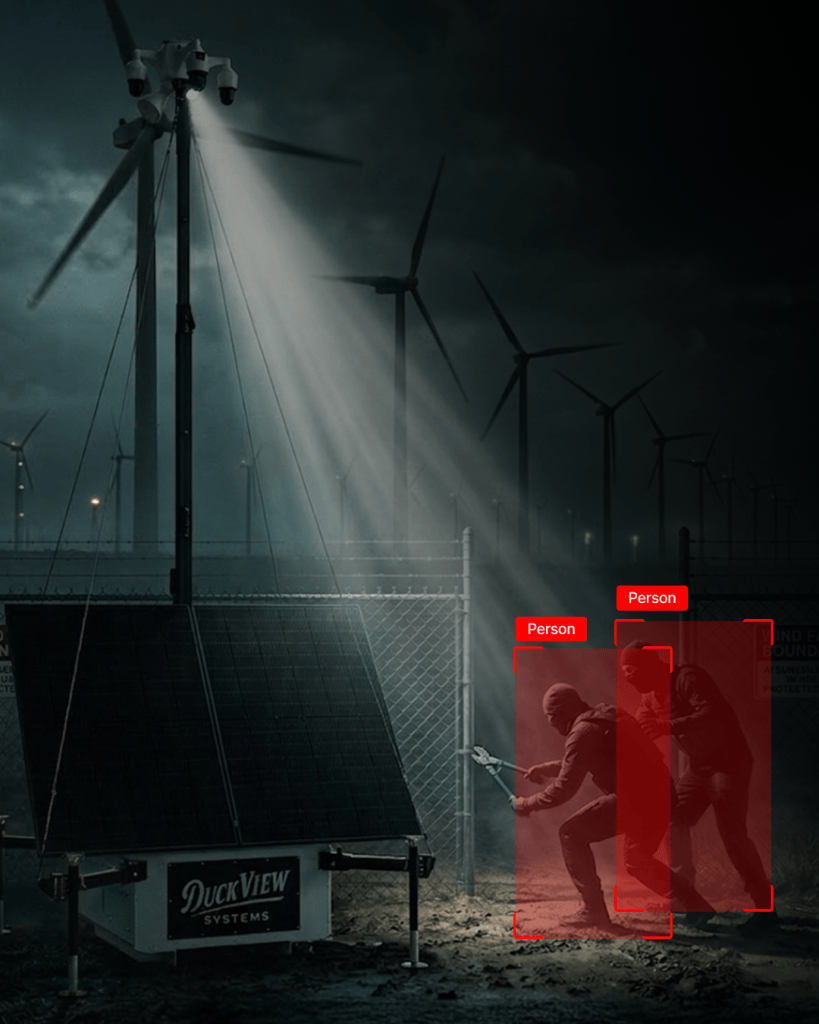
Human attention naturally drifts during a long, quiet shift, and a guard watching one gate cannot also watch the back fence at the same time. The AI Patrol feature spreads that same attention across every zone on the site at once, and it does not get tired, distracted, or pulled away for a break. Sentry Mode reacts to site events as they happen, and Case Reporting turns a flagged incident into a documented report with the relevant footage attached, which gives a site owner something a guard’s verbal account alone does not: a time-stamped, exportable record.
What Security Guards Still Do Better
A security guard still beats a camera system at the tasks that need a human body and human judgment on-site. A trailer can detect an intrusion and trigger a loud warning, but it cannot physically stop someone from climbing a fence or walk a visitor to their car. A guard reads a tense situation and decides, in real time, whether to de-escalate, call the police, or simply stand visibly present, and that judgment call is not something an algorithm makes on its own.
Guards also handle tasks that have nothing to do with detecting threats, like checking ID badges, directing delivery trucks, or letting in a contractor who forgot their access code. On sites that need a person at the front desk or gate around the clock, a guard remains the right tool, and a surveillance trailer becomes the force multiplier that covers everywhere else.
There is also a liability dimension worth factoring in. Some insurance policies and corporate risk requirements call for a documented human response to certain incident types, and a guard’s physical presence can satisfy that requirement in a way a camera alone cannot. Site owners with strict liability, union, or contractual staffing requirements should weigh those obligations before cutting guard hours, even if a trailer would technically cover the detection side of the job.
The Hybrid Model: Guards and Trailers Working Together
The hybrid model pairs a smaller guard team with multiple mobile surveillance trailers, so the site gets full coverage for less than an all-guard staffing plan would cost. Instead of stationing three guards around a large lot, a site owner can post one guard at the access point and let two or more of our trailers cover the rest of the perimeter and the interior. The guard handles ID checks, gate access, and any situation that needs a physical response, while the trailers handle continuous AI detection across zones that a single guard could never watch at once. The Virtual Guard feature increases site awareness between rounds, reacting instantly to flagged activity and giving the on-site guard a heads-up before they would otherwise notice.
One Guard Plus Two Trailers: A Hybrid Staffing Model
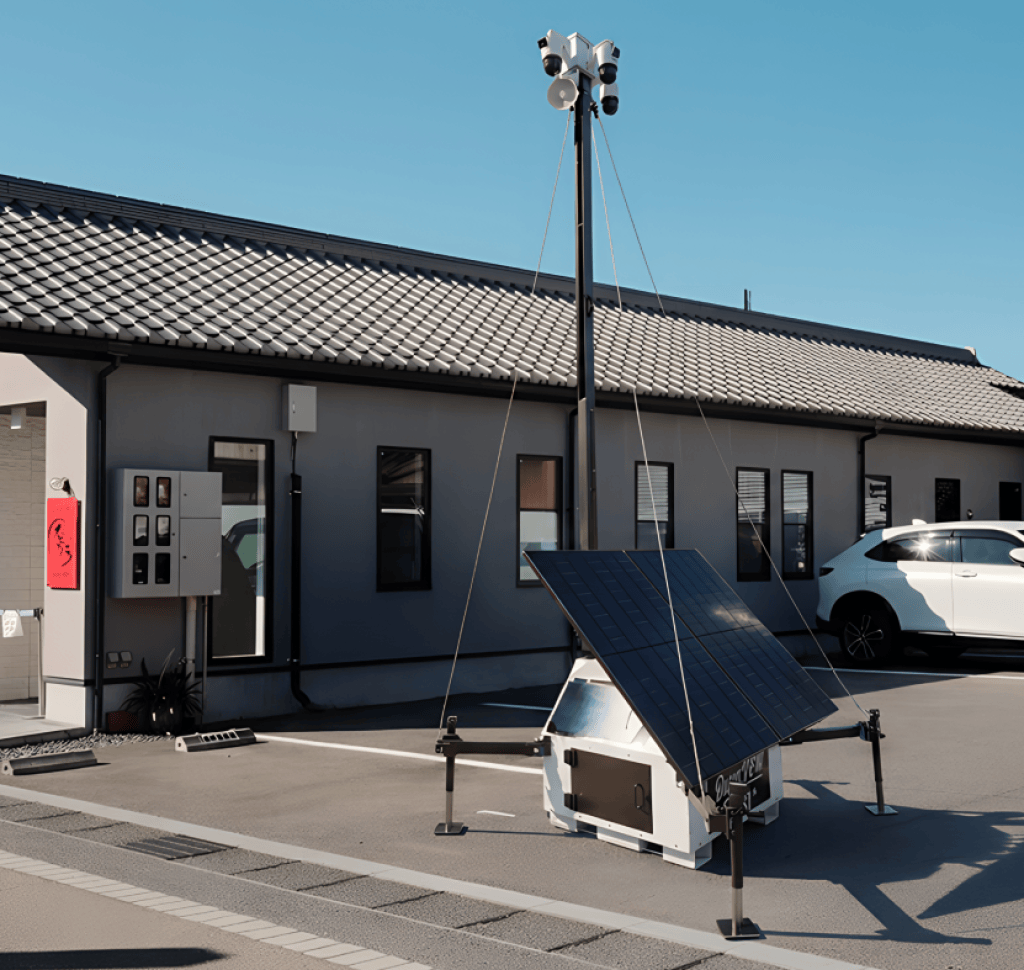
On a multi-acre construction site or auto dealership lot, two trailers can cover roughly 4 to 6 acres of perimeter and yard space between them. At the same time, one guard manages the gate and responds to whatever the trailers flag. That single guard now spends fewer hours on pure patrol time and more time on decision-making and response, which is the part of the job that actually needs a person. Site owners considering this mix should still budget for a monitoring add-on, since live alert escalation is not included in the base trailer price by default.
ROI Calculation Example for a Construction Site
A construction site comparing three guards on round-the-clock rotation to two trailers plus one guard usually sees the trailer-based mix cost less while covering more ground. The estimate below starts from our trailer pricing and the Bureau of Labor Statistics’ median guard wage; actual contracted guard rates vary by region and security firm and should be confirmed locally before finalizing a budget.
| Staffing Model | What It Covers | Estimated Monthly Cost |
| Single guard post, 24/7/365 (about 4.2 full-time guards needed to cover every hour of the year) | One gate or position, watched continuously | Base wages alone run near $13,400 to $13,500 a month, using the BLS May 2024 median guard wage. Contracted billing rates that add agency overhead, supervision, and margin typically run higher. |
| 2 Duck View Systems trailers + 1 guard (guard on gate duty, single daily shift) | AI detection across 4 to 6 acres of perimeter and yard, plus a staffed gate | $2,800 to $4,600 a month for two trailers, plus one guard’s wage for a single shift, plus monitoring add-ons if selected |
| Optional add-ons (either staffing model) | Live monitoring, backup connectivity, and generator backup | Monitoring: $400 to $500 per tower per month. Starlink: about $150 per tower per month. Generator backup: about $400 per tower per month |
These numbers are starting points, not guarantees. A site in a high-cost labor market or one that requires armed, licensed guards will see higher totals on the guard side, while remote delivery and longer lease terms can shift the trailer side up or down. Request a written quote for both options before locking in a budget.
Construction sites carry immense financial exposure if they go unwatched between guard shifts. According to compiled NER and NICB asset safety metrics, heavy equipment theft costs the U.S. construction industry between $300 million and $1 billion a year, with fewer than 25% of stolen machines ever recovered. This vulnerability is heavily exposed by the fact that 70% of all job site thefts occur between Friday evening and Monday morning, when sites are left dark and unattended. Portable equipment like generators and air compressors consistently rank as top-five prime targets for thieves, which is why contractors increasingly budget for continuous automated surveillance loops rather than relying on scheduled human foot patrols alone.
Real-World Results: What Site Owners Report
Site owners who shift part of their guard budget toward mobile surveillance report fewer gaps in coverage and faster incident documentation. Nate Salazar, Senior Director of Asset Protection and Safety at Sportsman’s Warehouse, describes us as a trusted partner with industry-leading AI expertise that has frequently exceeded his team’s expectations. That kind of result lines up with what continuous AI detection is built to do: watch every zone, flag what matters, and hand the security team a documented incident instead of a guard’s recollection from hours earlier.
We also work with security integrators who deploy and support these units for end customers, though this guide focuses on the direct guard-versus-trailer comparison most site owners are weighing for their own property.
Choosing the Right Mix for Your Site Type
The right balance between guards and trailers depends mostly on whether a site needs a person physically present or just a watchful, documented presence.
- Construction sites change layout often and usually sit empty overnight. A trailer alone typically covers off-hours, with a guard added only during high-theft phases like material delivery.
- Retail parking lots and storefronts need a visible deterrent during business hours and an unblinking watch overnight. Many retailers keep loss-prevention staff inside and let a trailer cover the lot; the guide to retail theft prevention covers this in more depth.
- Automotive dealership lots keep inventory outside around the clock with high resale value per vehicle. A trailer with AI vehicle detection, plus an after-hours guard for the busiest lots, covers both the routine watch and peak-risk hours.
- Storage yards and fleet lots are usually unmanned already, so a trailer often replaces the need for a guard altogether rather than supplementing one.
Local crime patterns and insurance requirements should factor into the split as well. A site with a documented history of break-ins may need a faster physical response than a trailer alone provides, even when the AI detection catches the activity the moment it happens. In those cases, the trailer still earns its place by documenting every incident and cutting the number of guard hours needed, even if it does not eliminate the guard post.

Frequently Asked Questions
Can a mobile surveillance trailer fully replace a security guard?
Our trailers replace the continuous-watch part of a guard’s job, including overnight patrol and perimeter monitoring, but they cannot physically intervene. Sites that need someone to check IDs, open gates, or respond to a confrontation in person typically keep at least one guard on staff alongside the trailer.
How much cheaper is a mobile surveillance trailer than a security guard?
A trailer typically runs $1,400 to $2,300 a month, while a single guard post staffed around the clock costs several times that once wages, overhead, and agency margin are included. Exact savings depend on local guard rates and the specific coverage hours needed, which we recommend confirming with a local provider before finalizing a budget.
What is a Virtual Guard, and how is it different from an on-site guard?
Virtual Guard is our AI feature that increases site awareness and reacts instantly to activity flagged by a trailer’s cameras. It is software running on the unit’s hardware, not a remote human watching a live feed, so it differs from both a staffed monitoring center and an on-site guard.
Can AI surveillance replace security personnel for high-risk sites?
High-risk sites that need physical intervention, access control, or de-escalation usually keep a guard on staff and add trailers to extend coverage rather than replacing personnel outright.
Do I still need a guard if I have a Duck View Systems trailer on-site?
Most sites do not need a guard for basic perimeter watch once a trailer is deployed, but sites with a staffed entrance, regular visitor traffic, or a history of confrontational incidents usually keep a guard for the tasks a camera cannot perform.
Can a guard and a mobile surveillance trailer work on the same site?
Yes. The hybrid model pairs one guard with two or more trailers, so the guard handles gate duty and physical response while the trailers cover the rest of the site continuously.
Mobile Surveillance Trailer vs Security Guards: Match the Tool to the Job
Most sites are not a strict either-or choice between guards and surveillance trailers. A mobile surveillance trailer provides continuous AI-powered detection, audio deterrence, and fully documented footage across wide areas that a single guard cannot realistically monitor alone. Meanwhile, security personnel remain essential for gate control, ID verification, and any situation that requires a physical response on the ground.
To see what fits your site best, you can book a demo with us to experience the detection and alerting in action. If you’re already planning deployment, you can also request a quote from us for a tailored configuration and pricing based on your specific security needs.