
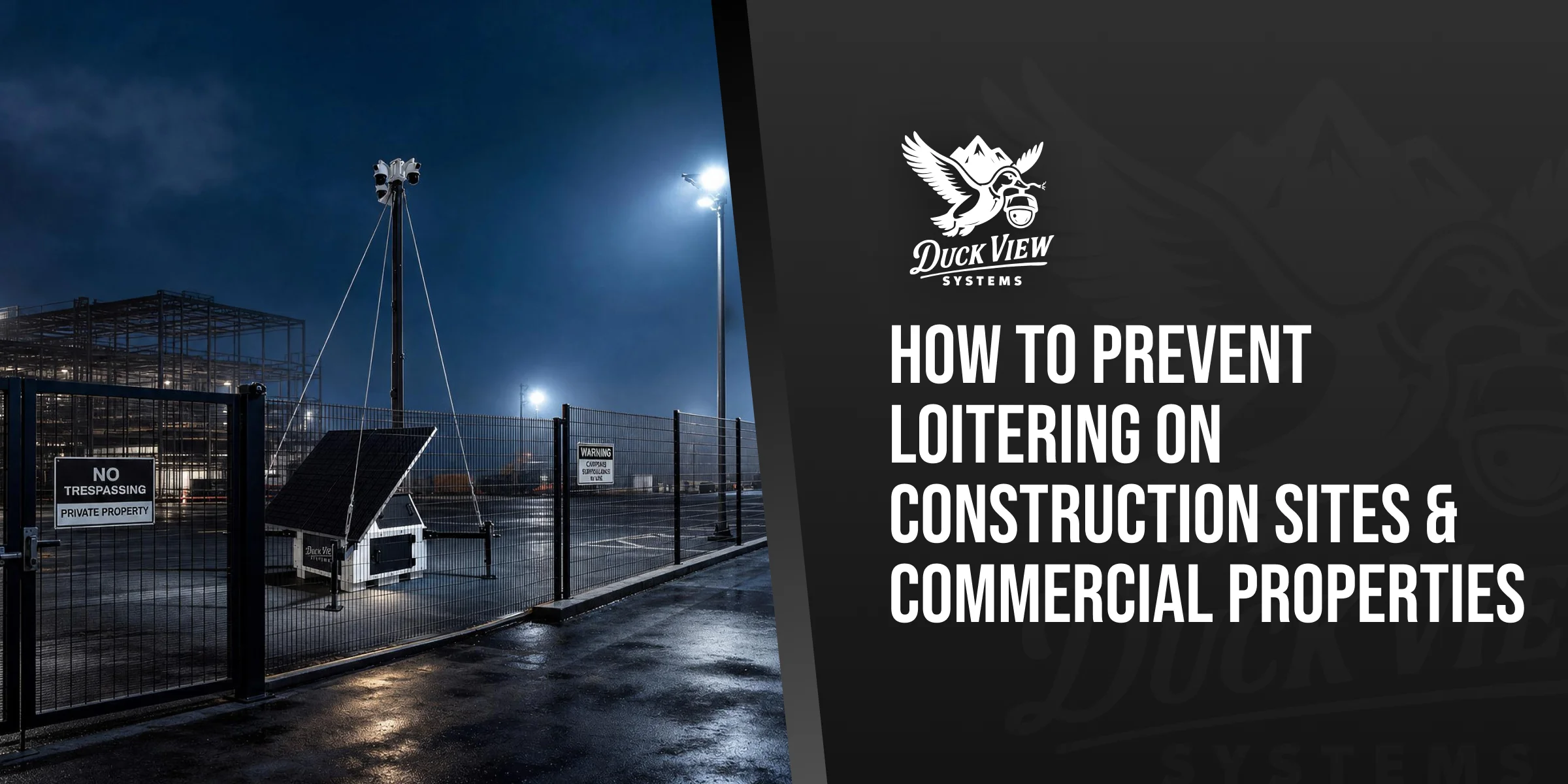
Loitering on a construction site or commercial property rarely stays harmless for long. A person lingering near equipment, a fenced perimeter, or a loading dock after hours is often testing the site before a bigger move. Property managers ask how to prevent loitering because it sits in a gray zone, not quite trespassing and not quite a crime, yet it is a real precursor to bigger incidents. This guide covers what counts as loitering, whether it is illegal, and seven practical ways to stop it before it escalates into theft or vandalism. We build our mobile surveillance trailers around exactly this kind of early warning problem, and this guide draws on what we see in the field every week.
A few things matter most before you build a prevention plan for your site:
- Most loitering incidents cluster in the same blind spots: unlit parking rows, rear entrances, and unfenced storage yards.
- State loitering and trespass laws differ, so document the time, location, and behavior before asking someone to leave.
- Properties with no visible deterrence see repeat visits from the same individuals more often than monitored ones.
- Dwell time, not a single sighting, is what separates loitering from someone tying a shoe or waiting for a ride.
- A layered approach combining lighting, signage, physical barriers, and real-time detection consistently outperforms any single tactic alone.
What Counts as Loitering on a Job Site or Commercial Property
Loitering means staying in a public or private area without a clear purpose, typically well past the point where a reasonable observer would expect someone to move on. On a construction site, that looks like a person standing near stored equipment, walking a fence line after hours, or sitting in a parked vehicle near a gate for an extended period. On a retail or commercial property, it looks like someone stationed near an entrance, a loading dock, or a dark corner of the parking lot with no apparent reason to be there.
Loitering is a behavior pattern, not an appearance. Property managers and courts generally weigh three factors: how long someone stays, whether they have a legitimate purpose, and whether the location is posted or restricted. Dwell time is the clearest signal. A person who pauses for a minute while checking a phone is different from someone who has circled a fenced construction yard three times in twenty minutes.
Loitering by itself is usually not a crime. It becomes trespassing once someone stays after being told to leave, or enters posted or restricted property without permission. We cover that distinction in more depth in our guide on how to prevent trespassing on construction sites.
Why Loitering Is a Warning Sign, Not Just a Nuisance
Loitering is frequently the first visible sign before theft, vandalism, or a break-in attempt, not a separate and lesser issue to shrug off. Someone casing a property for unlocked gates, unattended equipment, or gaps in a fence line will often loiter nearby before acting. Construction sites are a common target because they hold expensive, resellable equipment and often sit unattended overnight or on weekends.
Heavy equipment theft alone costs the construction industry an estimated $400 million a year, according to National Equipment Register estimates cited in industry reporting on jobsite theft prevention technology. That figure does not include tools, materials, or the schedule delays a single theft can cause. Retail properties see a similar pattern in poorly monitored parking areas, where loitering often precedes vehicle break-ins or theft near entrances and loading docks.
Treating loitering as background noise ignores the fact that it is usually observable, avoidable behavior. A person who lingers past a normal dwell-time threshold gives a monitored site time to respond before anything is taken or damaged.
Automotive dealerships face a version of this same pattern along vehicle rows after closing, where someone lingering near inventory is frequently scouting for an easy tamper target rather than shopping. Renewable energy sites see it along perimeter fencing, where remote, unstaffed acreage gives an intruder time to test for gaps before returning with tools. Police and law enforcement partners describe the same behavior at festivals, parades, and other high-activity events where no permanent infrastructure exists to watch a crowd. The setting changes, but the underlying signal- someone staying where they do not belong longer than they should- does not.
Is Loitering Illegal? What Property Owners Should Know
Loitering laws vary significantly by state, and property owners should confirm their local statutes rather than assume a single national rule applies. Many states define criminal loitering narrowly, tied to specific circumstances such as loitering for the purpose of drug activity, rather than banning the general act of standing around.
On private property, the more useful legal tool is usually trespass, not loitering. Most states allow a private property owner or an authorized representative to ask someone without a legitimate purpose to leave, and staying after that request typically converts the situation into trespassing. Posted “No Loitering” or “No Trespassing” signage strengthens that position because it puts visitors on notice before an incident occurs.
This is general information, not legal advice. Loitering and trespass statutes differ by state and sometimes by municipality, so confirm the specific rules that apply to your property with local counsel or law enforcement before drafting a formal policy.
7 Ways to Prevent Loitering

Preventing loitering works best as a layered strategy, not a single fix. The seven tactics below build on each other, starting with passive design choices and ending with active, real-time detection.
| Method | Type | What It Does |
| Environmental design (CPTED) | Passive | Improves lighting and sightlines so there is nowhere to hide |
| Signage | Passive | Puts visitors on legal notice before an incident occurs |
| Physical barriers | Passive | Slows or blocks access to restricted areas |
| Guard patrols | Active, scheduled | Provides a human presence at set intervals |
| AI-powered loitering detection | Active, continuous | Flags dwell time in real time, day and night |
| Audio deterrents | Active, reactive | Issues a live or automated warning once triggered |
| Documentation and trespass notices | Administrative | Builds a record for repeat offenders |
AI-Powered Loitering Detection and Real-Time Dwell-Time Alerts
AI-powered loitering detection uses computer vision to track how long a person or vehicle stays inside a defined zone, then triggers an alert once that dwell time crosses a set threshold. Unlike a guard glancing at a monitor, the system watches every zone continuously and does not lose focus after hour six of a shift. Our Virtual Guard solution pairs this detection with voice-down warnings, lights, or sirens, and a live operator reviews the alert before it escalates. We cover the underlying detection mechanics, including dwell-time thresholds, in our complete guide to AI loitering detection, so we will not repeat that ground here.
Environmental design, often called CPTED, or Crime Prevention Through Environmental Design, removes the hiding spots that make loitering comfortable in the first place. The Department of Justice’s CPTED guidelines outline how lighting, landscaping, and sightlines reduce opportunity crime by making people visible instead of concealed.
Clear No Loitering and No Trespassing signage does more legal work than most owners realize. In many states, posted signage is what allows a property owner to enforce a trespass charge once someone stays after being asked to leave.
Physical barriers, including fencing, gates, and controlled access points, slow down casual loitering and channel legitimate visitors through a single, visible entry point. On active construction sites, temporary fencing around staged equipment removes the easiest excuse for someone to be standing nearby.
Traditional guard patrols provide a visible human presence, but a single guard can only be in one place at a time. Patrol routes on a multi-acre lot or large site leave real gaps between rounds. That coverage limit is where continuous, camera-based detection covers ground a patrol schedule cannot reach.
Audio deterrents, specifically real-time or automated talk-down warnings powered by AI Audio Event Detection, interrupt loitering behavior before it develops further. A voice warning that a location is under monitoring and that activity has been recorded changes the calculation for someone testing a site.
Documentation and formal trespass notices matter most for repeat offenders. A time-stamped record with chain-of-custody metadata gives property owners, and law enforcement when needed, a defensible record of the pattern rather than a single isolated incident.
How Dwell-Time Detection Tells Loitering Apart from Normal Foot Traffic
Dwell-time detection tells loitering apart from normal foot traffic by measuring how long a person or vehicle stays inside a defined zone rather than simply reacting to motion. A shopper walking through a parking row for twenty seconds does not trigger an alert. Someone standing at a fence line, circling back through the same zone, or idling near a restricted area for several minutes does.
This distinction matters because basic motion sensors flag everything: wind moving a branch, a passing car, a delivery driver dropping off a package. Dwell-time logic filters that noise out and reserves alerts for behavior that actually resembles loitering. Our AI Loitering Detection feature applies this logic across every camera feed on a deployed unit, day and night.
What Triggers a Loitering Alert
A few patterns commonly cross the threshold and generate a review:
- A person or vehicle remaining inside a defined zone past a preset dwell-time limit.
- Repeated entry and exit from the same restricted area within a short window.
- A vehicle idling near a gate, dock, or fence line with no apparent purpose.
- Pacing or circling behavior along a perimeter rather than passing through it.
How Duck View Systems Helps Prevent Loitering
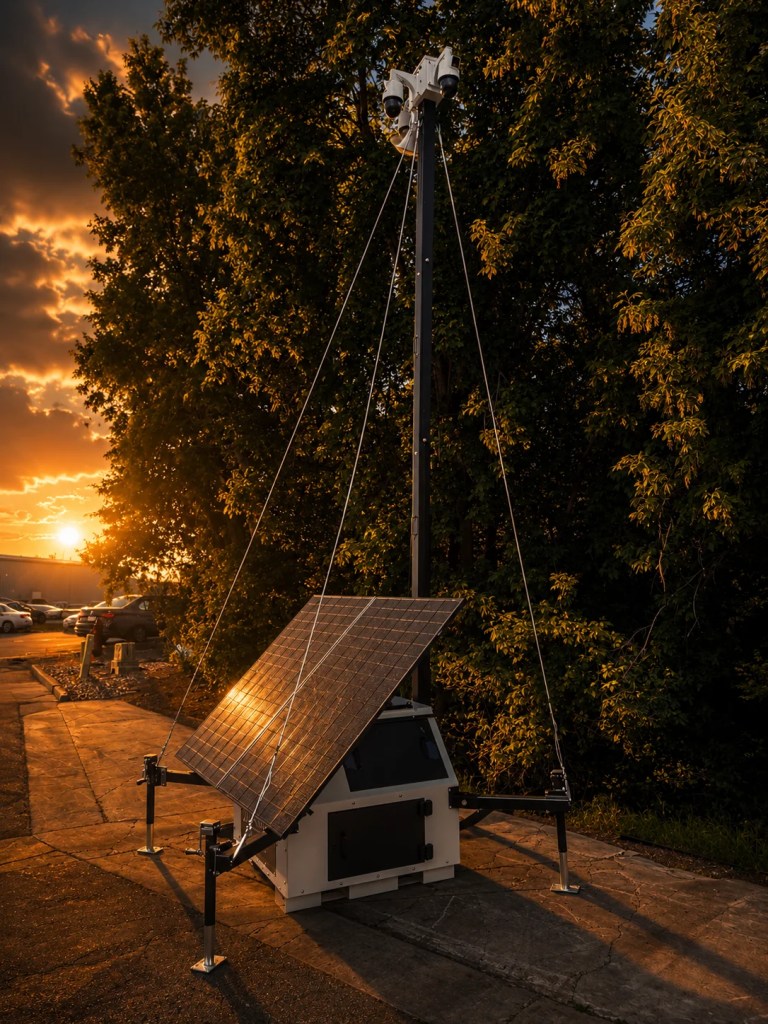
We help prevent loitering by combining continuous AI monitoring with real-time deterrence on a solar-powered, deployable mobile surveillance trailer. Units deploy in under an hour on a 5-foot by 5-foot footprint with a 20-foot telescoping mast, so a site gets coverage the same day a loitering or theft pattern is identified.
| Specification | Verified Detail |
| Base footprint | 5 ft x 5 ft |
| Mast height | 20-foot telescoping mast |
| Camera feeds | Four per unit |
| PTZ cameras | Two 360-degree PTZ cameras, 25x optical zoom |
| Coverage per unit | Typically 2 to 3 acres |
| Deployment time | Under one hour |
| Power | Solar with onboard battery, no trenching or wiring |
| AI Inspector patrol interval | Every five minutes, with daily summary reports |
Sentry Mode, AI Patrol, and Virtual Guard Working Together
Sentry Mode runs autonomous monitoring patterns using the high-resolution PTZ cameras, rotating and zooming to scan the property when it is unattended. AI Patrol adds automated camera routes across multiple zones for broader situational awareness on larger sites. Virtual Guard ties both together with proactive deterrence, issuing voice-down warnings, lights, or sirens when loitering behavior crosses a dwell-time threshold, with a live operator reviewing every alert before escalation.
This is a layer that adds to a site’s existing team, not a replacement for one. Guards and on-site staff still make judgment calls and respond in person. AI monitoring covers the hours and blind spots where a person cannot watch every camera feed at once, and hands off a documented, time-stamped alert when something needs a human decision.
We are American-made, with US manufacturing and support based in Kaysville, Utah. Units are built and shipped from our own facility, and support comes from the people who engineer them, which is part of why lead times run fast. Nate Salazar, Senior Director of Asset Protection and Safety at Sportsman’s Warehouse, has described us as a trusted partner whose AI expertise has become an asset to his organization’s protection strategy. He is the only named customer testimonial we publish, and we do not attribute quotes to anyone else.
We also publish real monthly pricing ranges upfront, typically $1,000 to $3,000 per unit for a mobile surveillance tower per month, because most vendors in this category quote privately and buyers deserve to budget before they call sales. Final pricing depends on monitoring, connectivity, backup power, delivery, and lease length, and monitoring is always an add-on rather than something bundled by default.

Frequently Asked Questions About Loitering Prevention
Is loitering a crime?
Loitering itself is usually not a standalone crime in most states. It typically becomes a legal issue once it turns into trespassing, ties to another offense, or violates a specific local ordinance. Confirm the statute in your state before treating loitering alone as grounds for legal action.
How long before behavior counts as loitering?
There is no single national time limit. Most states leave this to context, and property-level monitoring systems set their own dwell-time thresholds based on the zone being watched. A gate or restricted area typically warrants a shorter threshold than an open parking lot.
Can I legally ask someone to leave private property?
In most states, yes. A property owner or an authorized representative can generally ask a person without a legitimate purpose to leave private property, and staying after that request often supports a trespass charge. Confirm the exact requirements in your state, since some require posted signage first.
What is the difference between loitering and trespassing?
Loitering is remaining in an area without a clear purpose. Trespassing is entering or remaining on property without permission after being told to leave or after crossing posted restrictions. Loitering is frequently the behavior that precedes a trespassing incident, which is why property managers treat it as an early signal rather than a separate, unrelated issue.
Can AI monitoring replace security guards on a site?
No, and we do not position it that way. AI monitoring adds continuous coverage and documentation to a site’s existing team. Guards and staff still make the judgment calls and respond in person; the system’s job is to watch every zone, filter out noise, and flag what actually needs a human decision.
Does loitering detection work at night or in low light?
Yes. Our units include night vision on the PTZ cameras, so dwell-time tracking and loitering alerts continue after dark, when a large share of loitering-to-theft escalation actually happens. A dark, unmonitored lot or yard is exactly the setting loitering thrives in, which is why continuous, around-the-clock coverage matters more than daytime coverage alone.
Preventing Loitering Starts With Visibility on Construction Sites and Commercial Properties
Preventing loitering on a construction site or commercial property comes down to reducing opportunity and increasing visibility, long before someone crosses the line into trespassing or theft. Environmental design, signage, and physical barriers set the foundation, and continuous AI-powered loitering detection covers the hours when no one is watching a monitor. Layer these tactics instead of relying on any single one, and document behavior consistently so a repeat issue does not become a bigger one.
We build mobile surveillance trailers that combine dwell-time detection, live audio deterrence, and daily patrol summaries into a single solar-powered unit deployable in under an hour. If loitering, theft, or unauthorized access is a recurring issue on your property, request a quote from us for a free consultation and a custom monitoring plan built around your site.