Why Construction Site Surveillance Is No Longer Optional
Construction site surveillance is one of the most critical investments a general contractor or project manager can make today. Between rising material costs, tighter project timelines, and increasingly brazen theft, unmonitored jobsites are paying a steep price. The numbers tell the story clearly.
Construction site theft costs the industry $300 million to $1 billion annually in the United States, with most estimates around $400 million in direct financial losses. And here is the part that stings even more: the recovery rate remains dismally low at less than 25% for stolen equipment and materials, meaning most stolen items are never recovered.
This guide covers everything general contractors, project managers, and construction safety managers need to know. You will learn why traditional security methods fall short, how modern AI-powered mobile surveillance changes the game, and how to build a practical protection plan for every phase of a project.
The True Scale of Construction Theft
Before diving into solutions, it helps to understand what your site is actually up against.
An estimated$300 million to $1 billion in losses accumulate each year because of construction site theft. Tools, heavy equipment, and building materials make up more than 60 percent of construction site theft.
The financial damage goes far beyond replacing stolen items. Consider the downstream costs:
- Project delays from waiting on replacement equipment, often costing $10,000 or more per day
- Insurance premiums increase following multiple claims
- Labor downtime when crews arrive to find missing tools or materials
- Morale damage that affects worker productivity and retention
- Legal liability when unauthorized people get hurt on an unsecured site
Theft adds an estimated 1–5% to overall project costs, impacting budgets, timelines, and insurance premiums. On a $5 million build, that means up to $250,000 in avoidable losses.
The most frequently stolen items include power tools (41%), hand tools (23%), small equipment (15%), and materials such as copper wiring, lumber, and HVAC components. Copper theft alone is a significant driver. $1 billion worth of copper is stolen from construction sites annually.
Furthermore, theft does not happen only at night. Weekend mornings and holiday periods are peak windows for jobsite crime, when sites are empty and response times are slow.

Utah Construction Sites Face Unique Pressures
For contractors operating in Utah, the local context adds another layer of urgency. Utahns reported a staggering $32 million in construction-related losses over the last three years, according to the Utah Commerce Department. Utah’s rapid population growth and booming housing market have made active construction zones increasingly attractive targets.
The good news is that proactive monitoring tools are now accessible to contractors of every size. Duck View Systems, based in Kaysville, Utah, has helped integrator partners deploy smarter surveillance across active builds throughout the state.
Why Traditional Security Methods Fail on Jobsites
Many contractors still rely on one of two approaches: security guards or basic fixed cameras. Both have serious limitations.
The Problem With Security Guards
Guards are expensive, require scheduling coordination, and can only be in one place at a time. On a sprawling multi-acre site, a single guard leaves wide blind spots. Additionally, guards cannot automatically document PPE violations, track material volumes, or produce incident logs for insurance purposes. Their presence can also deter theft only while they are physically visible.
The Problem With Basic Fixed Cameras
Traditional fixed cameras require trenching, electrical infrastructure, and permanent mounting. Deploying them on a jobsite means waiting for contractors to run cable, install power, and configure network connections. By the time the system is operational, the highest-risk early phases of a project have already passed.
Moreover, basic cameras are reactive. They record what happened. They do not alert you in real time, identify PPE violations, detect loitering behavior, or trigger audio deterrents. When theft occurs, you have footage. However, with a less-than-25% equipment recovery rate, footage alone rarely gets your tools back.
Pro Tip: The most dangerous period on any construction site is the first two to four weeks. Equipment has arrived, footings are poured, and the site is active, but permanent infrastructure for fixed cameras is not yet in place. This is exactly when you need a rapid-deploy surveillance solution that is operational from day one.
Mobile Surveillance Trailers for Jobsites: How Modern Units Deploy

The evolution in construction site monitoring comes from self-contained, AI-powered mobile surveillance trailers. These units flip the traditional model entirely.
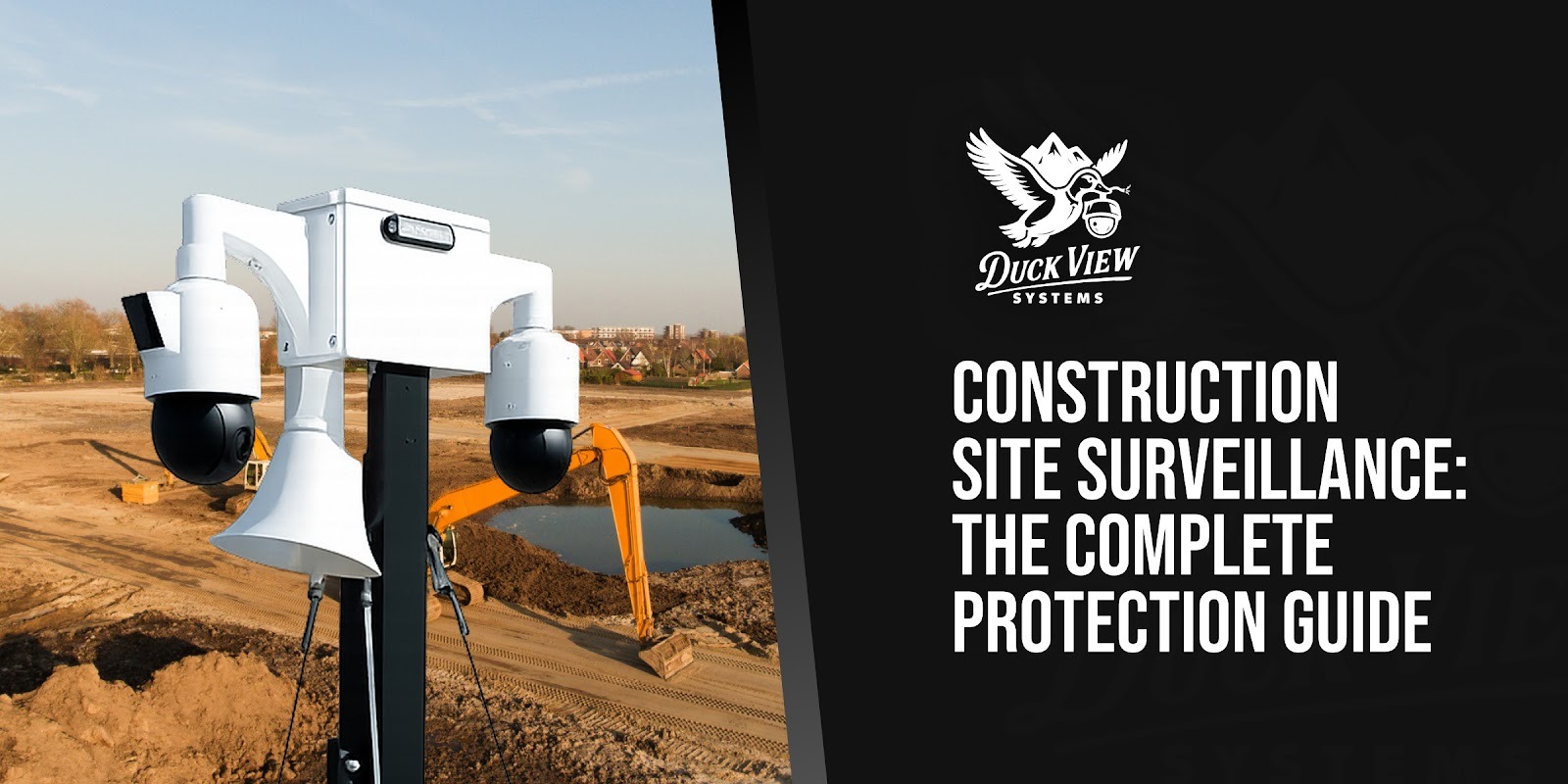
Instead of waiting weeks for infrastructure, a mobile surveillance trailer arrives on a flatbed, gets positioned strategically, and goes live in under an hour. No trenching. No electrical contractors. No Wi-Fi required.
Duck View Systems’ units are solar-powered and connect via LTE, which means they function just as effectively on a remote rural site as they do in an urban core. The 20-foot mast provides elevated, wide-angle coverage that a ground-mounted camera simply cannot replicate.
Key Deployment Advantages
| Feature | Traditional Fixed Camera | Duck View Mobile Unit |
|---|---|---|
| Setup time | Days to weeks | Under 1 hour |
| Infrastructure needed | Trenching + wiring | None |
| Power source | Hardwired electrical | Solar-powered |
| Connectivity | Fixed network | LTE cellular |
| Relocatable | No | Yes |
| AI detection | Limited | Full suite |
This flexibility is critical because construction sites are not static. As work progresses, your highest-risk zones shift. Equipment storage, material staging areas, and perimeter access points all change over the life of a project. A mobile unit moves with those changes.
AI Detection: What Smart Surveillance Actually Sees

This is where modern construction site monitoring separates itself from legacy camera systems. AI-powered detection does not just record video. It analyzes every frame and triggers alerts based on specific behaviors and conditions.
Duck View’s AI-powered units are capable of detecting:
- Intrusion into restricted zones or site perimeters
- Loitering when individuals linger beyond a set time threshold
- PPE violations, including missing hard hats and high-visibility vests
- Vehicle type and color for tracking authorized versus unauthorized vehicles
- Graffiti and vandalism through behavior pattern recognition
- Fire and smoke both indoors and outdoors
PPE Compliance: Safety and Documentation in One Step
One of the most valuable applications for safety managers is automated PPE compliance tracking. Hard hat and safety vest detection means you get notified the moment a worker steps on site without proper equipment. Every entry is logged automatically, which creates an audit trail that is invaluable during OSHA inspections.
This removes the burden from site supervisors who currently rely on manual walkthroughs and morning safety checks. Instead, the system flags violations as they happen, so corrective action occurs in real time.
Pro Tip: Documenting PPE compliance proactively can significantly reduce your exposure in OSHA recordkeeping audits. When every entry is timestamped and logged automatically, you have evidence of a safety-conscious operation that goes far beyond self-reported logs.
AI Patrol and Virtual Guard Features
Two of Duck View’s most powerful features for continuous coverage are AI Patrol and Virtual Guard.
AI Patrol brings consistent, automated coverage to every zone across the site. Rather than relying on a static camera angle, the system actively sweeps designated areas on a schedule, ensuring no corner of the site goes unwatched.
Virtual Guard elevates the response capability. When a threat is detected, built-in speakers can trigger automated audio warnings or allow a live operator to communicate directly through the unit. This turns a passive camera into an active deterrent.
The combination of these two features effectively replicates what a professional security guard does, but across every corner of your site simultaneously, around the clock.
Rapid Deployment: From Delivery to Live Coverage in Under One Hour
Here is what the deployment timeline actually looks like with a Duck View unit:
- Deliver and position the unit with a standard vehicle. No heavy equipment needed.
- Extend the 20-foot mast to achieve elevated, wide-angle site coverage.
- Activate LTE connectivity for instant remote access. No Wi-Fi required.
- AI detection begins immediately, covering PPE, intrusion zones, and site activity.
- Access live feeds from your phone, tablet, or control center.
The entire footprint is just 5 feet by 5 feet, meaning the unit fits almost anywhere on an active site without blocking workflow. Furthermore, when the project phase changes or the site closes out, the unit moves to your next project with equal simplicity.
This stands in contrast to the weeks-long process of trenching conduit, running electrical, and configuring a fixed network that traditional camera installations require.
Remote Construction Site Monitoring: Managing Multiple Sites From Your Phone
For general contractors running multiple projects simultaneously, centralized remote visibility is a game-changer. Duck View’s mobile monitoring capability lets you access live feeds, review playback, and receive real-time alerts directly from your mobile device.
Consequently, a project manager overseeing three active builds in different parts of Utah can check on all of them from a single interface without leaving the office. Alerts come through immediately when a threshold is triggered, whether that is an intrusion after hours, a PPE violation during the workday, or a material volume change overnight.
Natural Language Search: Find Footage Instantly
One of the most practical features for day-to-day use is Natural Language Search. Instead of scrubbing through hours of footage, you simply type a search query like “white pickup truck near gate” or “person without a hard hat,” and the system locates matching events instantly across your entire camera network.
This dramatically reduces the time spent reviewing footage after an incident, and makes it far easier to compile documentation for insurance claims or OSHA logs.
Compliance and Documentation: OSHA, Insurance, and Incident Reporting
Construction site surveillance is not just about preventing theft. It is equally valuable for documentation, compliance, and legal protection.
OSHA Recordkeeping
Automated PPE compliance logs create a timestamped record of every safety event on site. When an OSHA inspector arrives, you can demonstrate a documented pattern of safety enforcement rather than relying on handwritten logs.
Incident Reports and Insurance Proof
Duck View’s Case Reporting feature turns surveillance events into actionable, shareable reports instantly. When an incident occurs, you have dated footage, an AI-generated event summary, and a complete chain of custody for the documentation. This is exactly what insurance adjusters and legal teams need when processing claims.
The difference between having clear, timestamped footage and a completed case report versus a vague verbal account can mean the difference between a successful insurance claim and a denied one.
Sentry Mode and Focus Mode for High-Value Zones
Sentry Mode provides perimeter-level protection that reacts instantly when a boundary is crossed. For high-value equipment storage areas, this means immediate alerts the moment someone enters a restricted zone after hours.
Focus Mode allows the system to lock onto a specific target and track its movement across the site. If an unauthorized vehicle enters the premises, Focus Mode maintains visual contact and logs the sequence of events automatically.
Construction Theft Prevention Checklist
Use this checklist to evaluate your current jobsite security posture:
Perimeter and Access
- Clearly defined site perimeter with controlled entry points
- Signage indicating active surveillance on premises
- Lighting at all access points and high-value storage areas
Equipment and Materials
- High-value tools and equipment are secured in locked storage after hours
- Material deliveries documented with timestamps
- Serial numbers and asset identifiers are recorded for all major equipment
Monitoring and Detection
- Mobile surveillance unit covering primary site zones
- Real-time alerts configured for after-hours intrusion
- AI-powered loitering detection is active at the perimeter
Compliance and Documentation
- Automated PPE compliance logging active
- Incident reporting workflow established
- Insurance documentation updated with surveillance system information
- Remote access configured for project managers
Response Protocol
- Audio deterrent system configured and tested
- Emergency contact protocol established for after-hours alerts
- Footage review process defined for incident investigation

Frequently Asked Questions About Construction Site Surveillance
What is the most effective form of construction site surveillance?
AI-powered mobile surveillance trailers are currently the most effective solution. They deploy in under an hour, require no permanent infrastructure, use LTE connectivity, and include real-time AI detection for intrusion, PPE violations, loitering, and material tracking. Unlike fixed cameras, they can be repositioned as project phases change.
How does AI detection reduce false alarms on a busy jobsite?
Modern AI systems are trained to distinguish between normal site activity and actual threats. Duck View’s units use behavior recognition to identify anomalies such as loitering beyond a time threshold, unauthorized zone entry, or after-hours movement, rather than triggering on every instance of motion. Consequently, alerts are meaningful and actionable rather than constant.
Can construction site monitoring help with OSHA compliance?
Yes. Automated PPE detection logs every instance of a worker entering without a hard hat or safety vest, creating a timestamped audit trail. This documentation supports OSHA recordkeeping and demonstrates a proactive safety enforcement program during inspections.
How much does it cost to lose equipment without surveillance?
The average loss per theft incident is approximately $6,000 to $30,000 depending on equipment type. Beyond the replacement cost, project delays from missing equipment can cost $10,000 or more per day. Insurance premiums also rise after repeated claims. Proactive surveillance is a fraction of those costs.
Does a mobile surveillance trailer work in areas without Wi-Fi?
Yes. Duck View units connect via LTE cellular networks, which means they function in remote rural sites, areas with no existing network infrastructure, and locations where Wi-Fi is unavailable. This makes them suitable for all phases of construction, including early site prep.
What happens when a threat is detected after hours?
Duck View’s system triggers real-time alerts to designated contacts via mobile. Additionally, Virtual Guard allows for live audio intervention through built-in speakers, deterring trespassers before theft or vandalism occurs. The event is automatically logged with footage for documentation.
How do I monitor multiple construction sites at once?
Duck View’s remote monitoring platform allows project managers to access live feeds, review playback, and receive alerts from multiple units simultaneously through a single mobile interface. This means one person can maintain awareness across several active projects without traveling between sites.
Construction Site Surveillance That Works When You Cannot Be There
Construction site surveillance is not a luxury. It is the operational infrastructure that protects your investment from the first delivery through the final inspection. With billions of dollars in annual losses hitting the industry, and recovery rates under 25%, passive security measures no longer meet the standard.
Duck View Systems gives contractors a practical, proven path to full-site protection. Solar-powered units deploy in under an hour, AI detection runs 24 hours a day, and remote monitoring keeps you connected from anywhere. Whether you are managing a single site in Salt Lake City or overseeing a portfolio of builds across Utah, Duck View’s mobile surveillance platform scales to meet you where you are.
Ready to protect your jobsite? Contact Duck View Systems today for a free consultation and custom quote. Your next project deserves smarter surveillance from day one.