
Construction site surveillance cameras can quickly become an expensive mistake without a clear checklist, leading to blind spots, wasted budget, and systems that fail the moment power or Wi-Fi disappears. General contractors and project owners need equipment built for outdoor job sites, not repurposed home security gear. This guide walks through the features, power options, and AI capabilities that separate a system that stops theft from one that only records it. We manufacture AI-powered mobile surveillance trailers built for exactly this problem, and this guide shows you how to evaluate any system against that standard.
Quick Answer: The right construction site surveillance cameras combine 360-degree PTZ coverage with night vision, solar power with battery backup, LTE connectivity, and AI detection for intrusion, loitering, and PPE violations. Look for real-time audio deterrents and time-stamped reporting, not just recording.
Why Generic Cameras Fail on Construction Sites
Generic cameras fail on construction sites because they depend on infrastructure that job sites do not yet have. A standard home or retail camera assumes stable Wi-Fi, a nearby outlet, and a fixed, permanent location. Construction sites offer none of these in the early phases. The ground is often bare dirt with no trenched power and no router. Weather ranges from summer heat to winter freeze, and dust, vibration from heavy equipment, and theft targeting the camera itself are constant risks. A jobsite camera has to survive conditions a consumer device was never designed for.
Site layouts also change fast. Equipment moves, material laydown areas shift, and the highest-risk zone in week one is rarely the highest-risk zone in week twelve. A camera bolted to a single fixed point cannot follow that risk. This is the core reason purpose-built construction site surveillance cameras outperform repurposed consumer hardware on active jobsites.
Fixed vs. Mobile vs. Trailer Cameras for Jobsite Coverage
Fixed cameras suit permanent structures with existing power, while mobile trailer units suit active, changing, or off-grid construction sites. Each option trades off differently on cost, setup time, and flexibility. The table below compares the three most common approaches contractors evaluate.
| Factor | Fixed Wired Cameras | Plug-In Wireless Cameras | Mobile Surveillance Trailer |
| Power source | Requires trenched 110V | Requires a nearby outlet | Solar with battery backup |
| Setup time | Days to weeks | Hours, if power exists | Under an hour |
| Coverage per unit | Single fixed angle | Single fixed angle | Up to 2-3 acres, 360-degree |
| Relocatable as site changes | No | Limited | Yes, towable |
| Works with no Wi-Fi | No | No | Yes, LTE connected |
Fixed cameras remain the right call for a permanent site office or gate that will not move for years. Wireless plug-in cameras work where outlets exist, but flexibility matters more than raw coverage. For active job sites without permanent power, a mobile surveillance trailer vs. fixed cameras comparison consistently favors the trailer on speed, coverage, and total cost once trenching and cabling are factored in.
Must-Have Camera Features for Construction Site Surveillance
The must-have features for construction site surveillance cameras are high-resolution zoom, reliable night vision, and full 360-degree coverage from a single elevated position. Anything less leaves gaps a thief or trespasser can exploit. These three specs determine whether footage is actually usable when an incident happens.
PTZ Zoom, Night Vision, and 360-Degree Coverage
Pan-tilt-zoom, or PTZ, cameras let a single unit cover a wide radius instead of one static angle. Duck View Systems units include three 360-degree PTZ cameras with 25x optical zoom per trailer, mounted on a 20-foot mast for elevated sightlines over stacked materials and parked equipment. Night vision matters just as much as daytime resolution, since most jobsite theft happens after hours or on weekends when the site sits empty. A camera that produces clear color video in daylight but a grainy, unusable frame at 2 a.m. has not actually solved the coverage problem.
Mast height also affects real-world coverage more than most buyers expect. A camera mounted at eye level gets blocked by stacked lumber, parked trucks, and site trailers within the first few weeks of a project. Elevating the camera above those obstructions on a 20-foot mast keeps sightlines open across the full site, even as material stacks grow taller during active phases of the build. When comparing systems, ask how many camera feeds a single unit provides and whether the zoom is optical or digital. Digital zoom simply crops and enlarges pixels, producing a blurry result at a distance. Optical zoom uses the physical lens to magnify the image, which is why 25x optical zoom can pick out a face or a license plate from across a multi-acre lot without losing detail.
Power and Connectivity Options That Keep Cameras Running
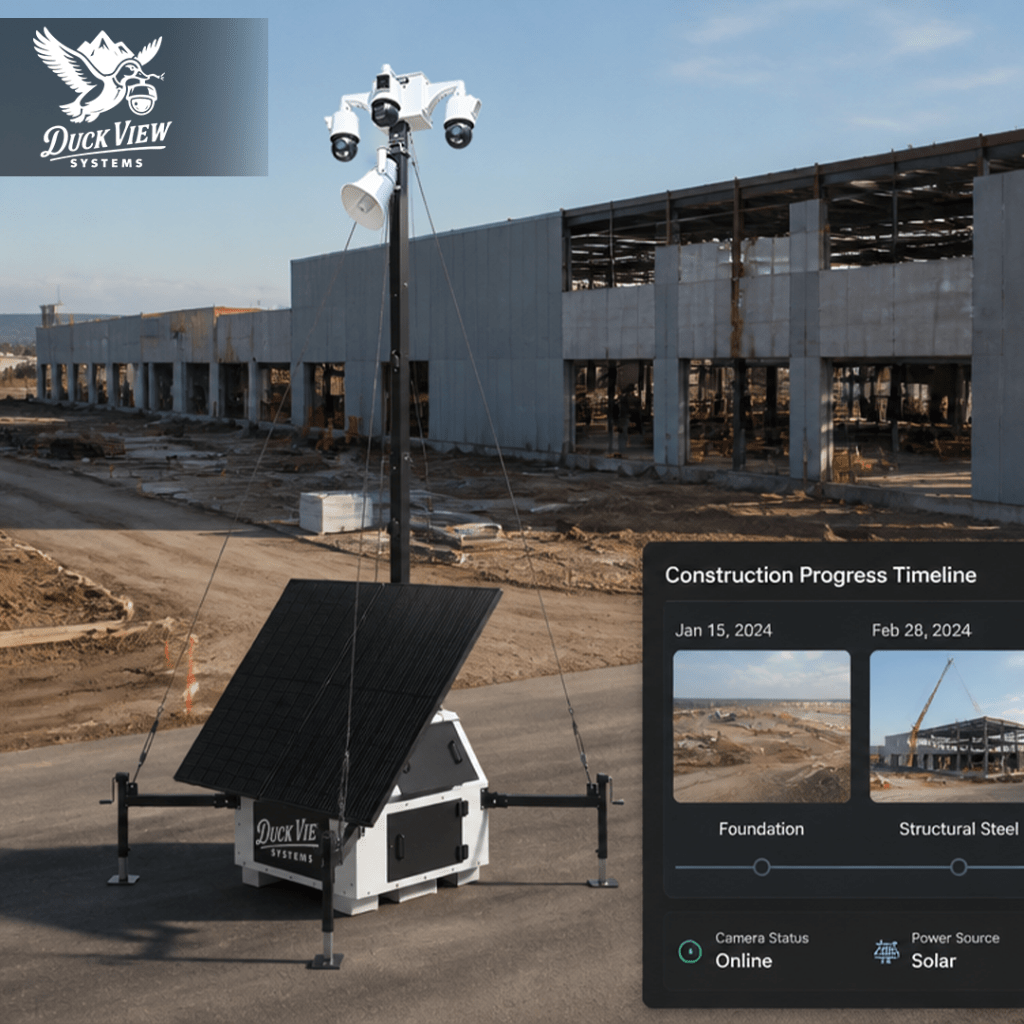
Power and connectivity determine whether a camera system works on day one of a project or has to wait for utilities to catch up. Solar power paired with LTE removes both dependencies at once, which is why it has become the standard for active construction sites.
Solar Arrays, Battery Banks, and LTE
A solar array captures energy during daylight hours and feeds a battery bank that keeps cameras and AI processing running overnight and through cloudy stretches. According to the U.S. Department of Energy, solar cells convert sunlight into electrical charges that flow through the panel and into onboard storage, which is the same basic mechanism that keeps a mobile surveillance trailer online without a wired connection. Duck View Systems trailers run fully off-grid on solar with battery backup and connect via LTE, so a unit can go live on a bare dirt lot before any utilities exist on site. Connectivity should never depend on site Wi-Fi. LTE means the camera platform stays online even in rural or remote areas where cellular is the only signal available.
AI Capabilities That Actually Stop Theft and Violations
AI capabilities stop theft and violations by interpreting behavior in real time instead of simply recording it. A passive camera only produces evidence after a loss has already happened. An AI-driven system flags the problem while it is still preventable.
Loitering, Intrusion, and PPE Detection in Practice
Duck View Systems’ AI Patrol feature automates scheduled scans across every zone of a site using the camera’s PTZ capabilities, so no single blind angle goes unwatched between checks. The AI also detects loitering when someone lingers past a set time threshold, flags intrusion into restricted zones or perimeters, and identifies missing hard hats or safety vests for automated PPE compliance logging. License plate recognition adds another layer, logging vehicle activity so unauthorized trucks or trailers entering the yard get flagged automatically. Learn more about how License Plate Recognition works alongside the other detection features on our unit.
Real-Time Alerts and Deterrents Beat After-the-Fact Footage
Real-time alerts and deterrents stop an incident from becoming a loss, while after-the-fact footage only documents what already happened. This is the single biggest functional gap between a basic camera and a full surveillance platform.
Audio Deterrents and Two-Way Talk-Down
When Duck View Systems’ AI detects a threat, the unit triggers a loudspeaker audio warning through an integrated IP bullhorn, along with a white and blue LED strobe for visible deterrence. Sentry Mode runs continuous autonomous PTZ scanning so the system is actively watching every zone rather than waiting for a trigger event, and alerts are routed to designated contacts in real time so someone can respond before the situation escalates. According to CISA, video surveillance is one layer in a broader physical security strategy that should combine deterrence, detection, and access control rather than relying on any single measure alone. Camera footage becomes part of that layered approach, not a replacement for it.
Audio deterrents also raise a practical question worth addressing before deployment: recording and two-way audio are subject to state, not just federal, law, and requirements for consent and posted notice vary by state. This is general information, not legal advice, and site owners should confirm local recording and signage requirements with legal counsel before activating audio features on a new site.
What a Security Guard Still Does Better
A security guard still does one thing no camera system can: physically intervene. Our AI Patrol and Sentry Mode features detect, alert, and deter through audio warnings and strobes, but they cannot stop a person, check identification, or escort someone off a site. For sites that need a physical presence at an access point, such as verifying delivery drivers or managing subcontractor check-in, a guard or gate attendant remains the right tool for that specific job.
Many contractors combine both. A guard handles access control at the gate during work hours, while a Duck View Systems trailer with Virtual Guard and AI Patrol covers the rest of the site around the clock, including nights and weekends when guard costs are highest and incidents are most common. Neither approach replaces the other; they solve different parts of the same problem.
Footage, Storage, and Reporting for Compliance and Claims
Footage, storage, and reporting matter most after an incident, when a contractor needs to produce clear evidence for insurance, law enforcement, or an OSHA compliance review. A system that only stores raw video without organization adds hours of manual work at the worst possible time.
Case Reporting turns logged events into shareable, time-stamped incident reports automatically, compiling the relevant clips, snapshots, and metadata into one file. Storage should be high-resolution and secure, with tamper detection that flags any attempt to disable or move the unit. For safety managers, automated PPE logs create an audit-ready record that goes beyond a handwritten daily checklist.
Ongoing Maintenance and Support
A solar surveillance trailer requires relatively little maintenance, but it is not completely maintenance-free. The primary routine task is keeping the solar panels clean by periodically removing dust, pollen, and other debris that can reduce charging efficiency, particularly on active job sites. We also include remote health monitoring capabilities that allow operators to monitor system performance proactively, while the onboard LTE modem automatically connects to the strongest available cellular network.
Although the batteries are designed to support operation through overnight periods and extended cloudy weather, maintenance schedules, service intervals, and support plans should be confirmed with us when requesting a quote.
What Do Duck View Systems Cameras Cost
We publish monthly rental ranges rather than a single fixed price because the right configuration depends on site size, monitoring needs, and connectivity. Below are the ranges, with add-ons that can affect the final monthly figure.
| System or Add-On | Typical Monthly Cost | Notes |
| Mobile surveillance trailer/tower | $1,400 – $2,300 / month | Most customers pay $1,650 – $2,000 / month |
| Pole-mounted camera system | Starting at $825 / month | Requires existing 110V power |
| Monitoring services | $400 – $500 /tower/month | Largest add-on, not included by default |
| Starlink connectivity | ~$150 /tower/month | Backup for LTE in weak-signal areas |
| Generator backup | ~$400 / tower/month | Or built into the Canvas Back Tower model |
Final pricing depends on the length of the lease, delivery distance, and whether monitoring or generator backup is added. Longer lease terms typically lower the effective monthly rate. Review the full pricing breakdown, then request a quote for an exact number based on your site.
Choosing the Right System for Your Site

Choosing the right system for your site comes down to matching camera features to your actual risk level, not buying the most expensive option available. A small, short-duration project with a single access point may only need one unit with basic AI detection. A large multi-acre site with valuable equipment and multiple entry points needs full 360-degree PTZ coverage, AI Patrol, and audio deterrents working together.
Start by mapping the site’s actual risk points before comparing hardware specs. Identify where equipment and materials are staged overnight, where the perimeter is easiest to breach, and which entry points see the most vehicle and foot traffic. A single trailer positioned to cover a material laydown yard does more for loss prevention than several fixed cameras spread thin across low-risk areas. Project duration matters too. A short-term deployment favors a rental model with fast setup and teardown, while a multi-year build may justify a longer lease term with a lower effective monthly rate. Whatever the timeline, the goal is the same: continuous, unblinking coverage of the areas where a loss would actually hurt the project budget.
Coverage math is simple once you know the number. A single Duck View Systems unit covers up to 2 to 3 acres depending on layout, so a compact half-acre lot with one gate needs only one trailer, while a sprawling multi-phase site may need two or three positioned to cover separate laydown yards. Site owners should walk the perimeter and count actual entry points rather than relying on total acreage alone, since a site with several access roads needs more coverage per acre than one with a single controlled gate.
For a deeper walkthrough of how the full platform fits together, see our complete construction site surveillance guide or read how a mobile surveillance trailer deploys from delivery to full operation.
Why Teams Choose Duck View Systems
We build every unit as a US-based manufacturer with support centers in Kaysville, Utah, and we back that with verified specs rather than marketing claims. Every trailer includes four camera feeds, three 360-degree PTZ cameras with 25x zoom, a dual-SIM cellular modem with automatic carrier switching, an IP bullhorn speaker, and an LED strobe, all mounted on a 20-foot mast and powered by solar with battery backup.
Nate Salazar, Senior Director of Asset Protection and Safety at Sportsman’s Warehouse, has called Duck View Systems a trusted partner with industry-leading AI expertise that has frequently exceeded expectations. We also work with integrator partners nationwide, though the site owner evaluating a jobsite deployment remains the primary focus of this guide.

Frequently Asked Questions
What cameras are best for construction sites?
The best cameras for construction sites are 360-degree PTZ units with night vision, solar power, and LTE connectivity, since jobsites rarely have permanent power or Wi-Fi in the early phases of a project.
Do I need solar-powered cameras for a construction site?
Solar power is the most practical option for active construction sites because it removes the need for trenching or a nearby outlet, letting cameras go live the same day a site opens.
What resolution do I need for jobsite surveillance cameras?
High-resolution, zoom-capable footage is important for identifying faces, vehicles, and license plates at a distance, which is why 25x optical zoom on a PTZ camera outperforms a fixed low-zoom lens.
Can AI cameras detect PPE violations automatically?
Yes. AI-powered systems can detect missing hard hats and safety vests in real time and log each event automatically, creating an audit trail for safety compliance without manual checks.
How many surveillance cameras do I need for a construction site?
Most single-gate sites under a few acres need only one mobile surveillance trailer, since one unit covers up to 2 to 3 acres. Larger or multi-phase sites with several access points typically need more than one unit positioned around the highest-risk zones.
How much do construction site surveillance cameras cost per month?
Duck View Systems mobile surveillance trailers typically run $1,400 to $2,300 per month, with most customers paying $1,650 to $2,000. Pole-mounted systems start at $825 per month where 110V power already exists.
Do surveillance cameras actually deter construction site theft?
Cameras paired with active deterrents such as audio warnings and strobe lights are more effective than passive recording alone, since they intervene during the incident rather than only documenting it afterward. Deterrence claims should be understood as risk reduction, not a guarantee.
Get Construction Site Surveillance Cameras Built for Your Project
Choosing the right construction site surveillance cameras means matching PTZ coverage, solar and LTE power, and AI detection to the realities of your site instead of settling for consumer-grade hardware.
Request a quote from us to get a configuration built for your project, or book a demo to see the AI detection and deterrent features in action before you commit.