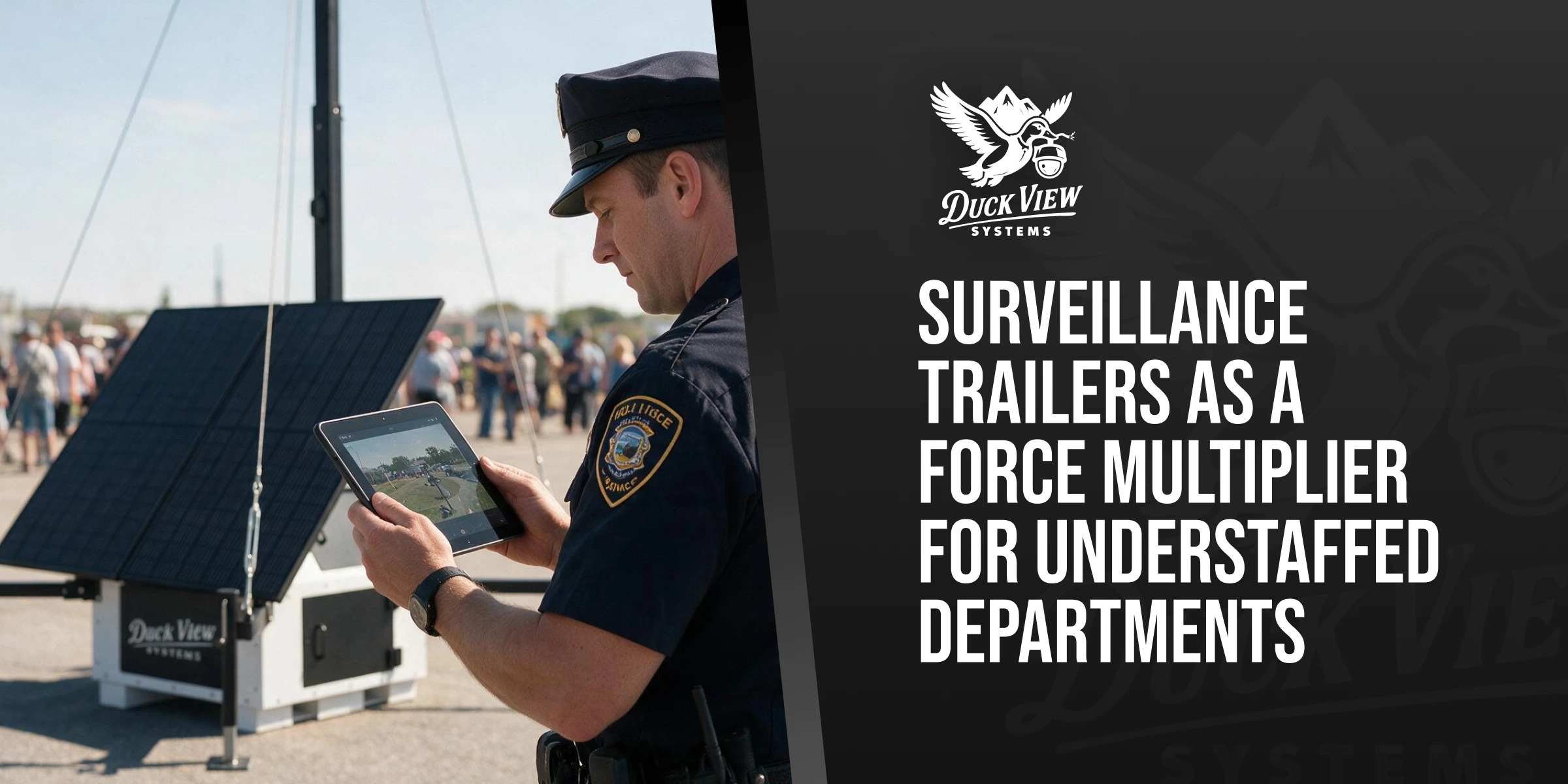
A police force multiplier surveillance trailer gives a department more eyes on more ground without adding a single position to the payroll. Departments across the country are running fewer sworn officers than they are budgeted for, and the gap between authorized and actual strength keeps widening in small and mid-size agencies alike. When a department cannot hire its way out of a coverage gap, the question shifts from who can we hire to what can extend the officers we already have. Mobile, AI-powered surveillance units from Duck View Systems, a US manufacturer based in Kaysville, Utah, are built to answer exactly that question, and our police and law enforcement units deploy in under an hour on solar power and LTE, with no trenching or grid connection required.
A surveillance trailer acts as a police force multiplier by watching a fixed area continuously, flagging loitering, intrusion, and crowd activity in real time, and sending an alert the moment something needs attention, so one trailer effectively extends the reach of the officers already on shift instead of asking them to be in two places at once.
Key Takeaways
- Local police departments reported roughly 39,500 unfilled sworn positions nationwide in the most recent BJS staffing survey, with tens of thousands more open across sheriffs’ offices and state agencies.
- A single trailer covers a fixed zone around the clock without a shift change, a meal break, or an overtime line item.
- Automated detection and alerts mean officers respond to flagged activity instead of watching a static feed or walking a perimeter on a schedule.
- Deployment takes under an hour, so a department can stand up coverage at a new hot spot or event the same day the need appears.
How a Surveillance Trailer Acts as a Police Force Multiplier

A mobile surveillance trailer acts as a police force multiplier by taking over the tasks that consume officer hours without needing a badge to perform them: continuous watch, automated detection, and documentation. A trailer does not replace an officer’s judgment or authority, but it removes the burden of simply being present and watching, which is where most patrol hours disappear on a quiet shift.
Think about how a typical patrol shift actually spends its hours. A large share of that time goes toward driving a route, checking a lot that has been quiet for weeks, or sitting on a location just in case something happens. None of that requires a sworn officer’s specific authority, and all of it is exactly the kind of continuous, repetitive watch that a stationary AI system performs better than a human ever could, since the system does not lose focus, take a break, or miss a shift change. Redirecting that watch-and-wait time to a trailer is what frees an officer to spend a shift on calls, investigations, and community contact instead.
Every Duck View Systems unit combines a 20-foot mast with 360-degree PTZ cameras, solar power with battery backup, and an onboard multi-SIM cellular modem, so it can go live on a bare lot or an undeveloped hot spot the same day a commander requests coverage. Once deployed, the AI on board recognizes loitering, perimeter breaches, vehicle type and color, and suspicious pacing automatically, then triggers an audio deterrent and pushes a real-time alert. The department decides how alerts route, whether to a dispatch center, a patrol unit, or a command post, so the trailer extends visibility without changing who makes the call on the ground.
Agencies already use trailers this way for a wide range of missions, from hot-spot deterrence to event coverage to search support. Our overview of how law enforcement agencies use mobile surveillance trailers walks through those deployment patterns in more detail, but the throughline across every use case is the same: a trailer holds a position and keeps watching so an officer does not have to.
The Officer Shortage Problem

The officer shortage is not a perception problem. It shows up directly in national staffing data and in the day-to-day math of covering a patrol area with fewer bodies than the budget calls for. The Bureau of Justice Statistics reported roughly 64,200 full-time sworn vacancies across state and local law enforcement agencies nationwide, with about 39,500 of those openings in local police departments alone.
The trend behind that number is still moving in the wrong direction for many agencies. According to the Police Executive Research Forum’s Responding to the Staffing Crisis report, 65 percent of surveyed agencies saw retirements increase, and 66 percent saw resignations increase over a recent two-year span, while 69 percent of agencies reported a drop in applications for open officer positions over the same period. Fewer applicants and more departures leave commanders stretching the same headcount across a growing list of hot spots, events, and routine patrol duties.
Small and Rural Departments Feel the Gap First
The shortage lands hardest on smaller agencies. Nearly half of local police departments nationwide employ fewer than 10 full-time-equivalent sworn officers, according to the same BJS data, which means losing even one or two positions to retirement or resignation can force a department to cut back on proactive patrol entirely and shift into a purely reactive, call-response posture. A department that size rarely has the option of pulling an officer from one beat to cover another without leaving a gap somewhere. A trailer gives a small department a way to maintain visibility in a known problem area without pulling a single officer off the road.
Where Trailers Replace or Extend Officer Presence

Trailers extend officer presence most effectively in situations where continuous watch matters more than the ability to physically intervene. That distinction determines where a trailer is the right tool and where an officer still needs to be present.
- Overnight and off-hours watch on lots, yards, and facilities where a patrol car would otherwise swing by only once or twice a shift.
- Known hot spots that need sustained visibility for weeks at a time without tying up a patrol unit every night.
- Temporary events, from parades to public gatherings, where coverage is needed for a defined window and then the unit relocates.
- Chokepoints and entry or exit routes where continuous vehicle and pedestrian visibility supports an investigation or a BOLO.
- Remote or undeveloped areas without grid power or Wi-Fi, where a fixed camera installation is not practical or affordable.
None of this replaces the officer who needs to make an arrest, interview a witness, or physically respond to a call in progress. A trailer cannot open a locked gate, calm an agitated person, or use force when a situation calls for it. The realistic goal is to let a trailer absorb the watch-and-document workload so the officers on duty spend their time on the calls that actually need a sworn presence, rather than treating the trailer as a stand-in for the officer entirely.
Police Force Multiplier Coverage for Overnight and Weekend Gaps
Overnight and weekend shifts are usually where staffing gaps hurt the most, since fewer officers are on duty exactly when property crime and disorder tend to rise. A trailer keeps running on solar and battery power straight through the night without a shift change, so a location that used to get one drive-by an hour now has continuous coverage. When the AI flags activity at 3 a.m., the alert reaches whoever is on duty immediately, instead of waiting for the next scheduled patrol pass.
Reclaiming Patrol Hours: The Efficiency Math
Reclaiming patrol hours starts with identifying which tasks eat officer time without requiring an officer’s judgment, then handing those tasks to a system that runs continuously. The table below breaks down four common tasks and how the math changes once a trailer is in place.
| Task | With Officers Only | With Trailer Support |
| Overnight perimeter watch | 1 officer, 8-10 hr shift, one vantage point | Trailer runs unattended all night on solar and battery, watching every zone in range |
| Documenting an incident | Officer writes report from memory and any available footage | Time-stamped, high-resolution footage and an automated case report are ready on request |
| Reviewing hours of footage for a lead | An investigator scrubs raw video manually | Natural Language Search returns matching clips from a plain-text description in seconds |
| Covering a second flagged location | Requires pulling a unit from patrol or calling in overtime | A second trailer deploys in under an hour without touching the patrol schedule |
The budget side of the math matters too. An unarmed guard on 24/7 rotation typically runs $16,500 to $20,400 per month before overtime and administrative overhead, while a monitored Duck View Systems trailer typically runs $1,500 to $3,000 per month. Full details are on our cost to rent a mobile surveillance trailer page. That gap does not mean a department should cut every guard post, but it does mean a single hot spot or event that would otherwise need a dedicated overtime detail can often be covered by a trailer for a fraction of the cost, freeing the overtime budget for calls that genuinely need an officer on foot.
Automated coverage like this pairs directly with AI Patrol, which runs a trailer’s PTZ cameras through scheduled or adaptive routes across a site so no single zone depends on an officer remembering to check it. Instead of one patrol car covering a route once an hour, the trailer sweeps its assigned zones continuously and only pulls a human’s attention when something is actually flagged.
Automated Monitoring and Alerts
Automated monitoring shifts the department’s role from watching a screen to responding to a verified alert. When the system detects loitering, an intrusion, or a flagged vehicle, it can trigger an on-device audio warning immediately while routing a real-time notification to whoever the department designates, whether that’s a dispatcher, a patrol supervisor, or an on-call unit. Our Virtual Guard capability adds a layer of live verification on top of the automated detection, so alerts arriving at dispatch have already been checked, which cuts down on officers being sent to investigate activity that turns out to be nothing.
A department running several trailers across different neighborhoods or event sites can view all of them from a single cloud interface rather than assigning a separate monitor to each unit. That matters for staffing math specifically: one analyst or dispatcher can maintain situational awareness across multiple deployed units at once, instead of the department needing to dedicate a person to each individual camera feed.
Deploying a Force-Multiplier Unit When Staffing Is Already Stretched
Deploying a force-multiplier unit does not require pulling officers off patrol to manage the rollout. Duck View Systems units arrive field-ready, so a department can go from request to live coverage in a single work shift.
- A department identifies the hot spot, event, or coverage gap and requests a quote or a site assessment.
- The unit ships or is delivered to the location, already integrated with its solar array, mast, cameras, and connectivity hardware.
- Technicians position the trailer, raise the 20-foot mast, and calibrate the cameras and alert thresholds to the site, a process that fits inside an hour.
The unit goes live on solar power and dual-SIM LTE, streaming to the department’s designated contacts and indexing footage through Natural Language Search so investigators can pull a clip by typing a plain description instead of scrubbing hours of video.
Because setup is measured in minutes and hours rather than weeks, a department can respond to a sudden spike in one neighborhood or a short-notice event without waiting on a capital project or a construction timeline.
Redeploying Across Multiple Hot Spots
A trailer is not committed to one address for the life of the unit. Because it runs on its own solar power and LTE connection rather than a fixed utility hookup, a department can pull a unit after a hot spot cools down and reposition it at the next priority location the same week. Smaller agencies without the budget for permanent camera infrastructure at every problem location can rotate a small number of trailers across a rolling list of priorities instead, getting continuous coverage everywhere it is needed over the course of a year without buying and installing fixed cameras at every site.

Frequently Asked Questions About Force-Multiplier Surveillance Technology
Can a surveillance trailer replace an officer?
No. A trailer extends an officer’s visibility and documents activity continuously, but it cannot make an arrest, de-escalate a confrontation, or physically intervene. Departments get the most value by using a trailer to cover routine watch duties so officers are freed up for the calls that need a sworn presence.
How many patrol hours can a trailer save?
The exact number depends on the site and how it was patrolled before, but a trailer covering an overnight or off-hours shift that previously needed a periodic drive-by can eliminate that patrol task entirely, since the unit provides continuous, unattended coverage of the zone instead of a once-an-hour pass. Departments that redirect those reclaimed hours toward calls that need a sworn officer typically see the biggest operational benefit, rather than simply reducing headcount. Request a site-specific assessment for a concrete estimate based on your current patrol pattern.
Does the system need someone monitoring it 24/7?
No constant human monitoring is required for the AI detection to function. The system analyzes footage continuously and only pushes an alert when it flags loitering, an intrusion, or another configured behavior, so staff time is spent responding to verified events instead of watching a live feed.
How quickly can understaffed departments deploy a unit?
Duck View Systems units are field-ready and typically go live in under an hour once on site, since they run on solar power and LTE with no trenching, wiring, or Wi-Fi setup required. Departments can request a quote and move from decision to live coverage the same day for most locations.
Extend Your Department’s Reach with a Police Force Multiplier Surveillance Trailer
A police force multiplier surveillance trailer gives an understaffed department continuous, documented coverage of the areas that matter most, without adding a single line item to the payroll. Duck View Systems builds and supports every unit in Kaysville, Utah, and Nate Salazar, Senior Director of Asset Protection and Safety at Sportsman’s Warehouse, has called us a trusted partner with industry-leading AI expertise that has exceeded expectations.
If a specific hot spot or event needs coverage fast, our team can walk through configuration options on a call; book a demo through our contact page to see the detection and alerting in action. When a department is ready to move, the fastest next step is to request a quote from us and get a same-day deployment plan built around the specific coverage gap.
Staffing shortages are not going away on their own, but a police force multiplier surveillance trailer gives a department a practical way to extend its reach today, using the officers it already has, deployed on the calls that actually need them.