
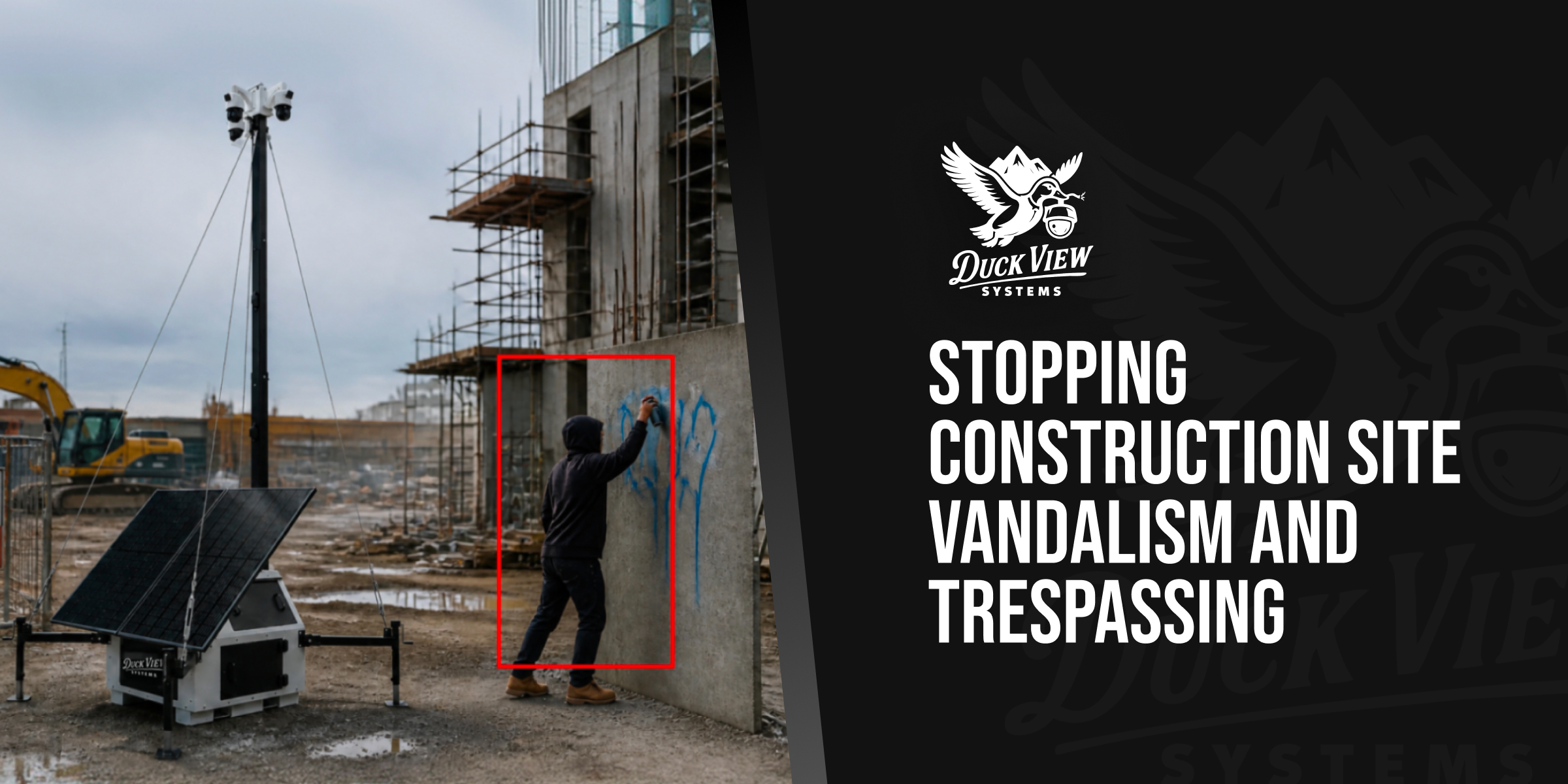
Construction site vandalism and trespassing can lead to costly delays, property damage, insurance claims, and safety risks long after workers leave for the day. Graffiti, broken windows, damaged fencing, and unauthorized entry are most common during nights and weekends when a jobsite appears unattended. Physical barriers alone are rarely enough to stop determined intruders. This guide explains why construction sites attract vandals and trespassers, the security measures that reduce incidents, and how AI-powered monitoring helps detect, deter, and document activity before damage escalates. For a broader look at jobsite protection, see our complete construction site surveillance guide, which covers theft prevention, safety compliance, and remote monitoring.
Quick Answer: Stopping construction site vandalism and trespassing requires a layered security strategy that combines durable fencing, proper lighting, controlled site access, clear warning signs, and real-time AI surveillance. AI-powered mobile surveillance trailers detect unauthorized activity, issue live audio warnings, and record time-stamped evidence to help prevent damage and support police or insurance investigations. Duck View Systems trailers deploy in under an hour, operate on solar power with LTE connectivity, and provide around-the-clock monitoring for remote or temporary jobsites.
The Scope of Construction Site Vandalism
Construction site vandalism covers a wide range of damage, from spray-painted walls to smashed equipment glass and torn perimeter fencing, and the FBI’s National Incident-Based Reporting System (NIBRS) classifies Destruction/Damage/Vandalism of Property as its own offense category. Open lots, unfinished structures, and stacked materials give vandals plenty of surfaces to target and few witnesses to worry about. Unlike theft, vandalism does not always have a clear financial motive. Some of it is opportunistic property damage, and some of it is trespassing that escalates once someone realizes no one is watching.
| Vandalism Type | Typical Target on a Jobsite | Why It Compounds |
| Graffiti | Exterior walls, fencing, equipment | Repeated tagging returns fast once a site is marked as unwatched |
| Structural damage | Windows, drywall, fixtures, siding | Repairs delay inspections and push back trade schedules |
| Equipment sabotage | Machinery, hoses, wiring, fuel lines | Downtime while parts are sourced and repaired |
| Fence and barrier damage | Perimeter fencing, gates, barricades | Creates an open access point for further theft or trespassing |
Because vandalism and trespassing often happen together, a site with one unresolved incident tends to see a second one soon after. Left unaddressed, a damaged fence line or an unremoved tag signals that the property has no active oversight.
Multi-phase projects face a wider window of exposure than a single-building build. Foundations, framing, and finish work each leave different assets exposed at different times, which means the risk profile of a jobsite shifts every few weeks. A perimeter that was secure during excavation may have new gaps once framing crews open access points for material delivery. Reviewing the site’s vulnerable areas at each phase transition, rather than only at project kickoff, keeps physical deterrents and monitoring coverage aligned with what is actually on site.
Why Vandals Target Jobsites
Vandals target jobsites because construction properties combine open access, low visibility, and long stretches of downtime with no one present. A site that sits idle every night and all weekend gives an intruder hours to act without interruption.
Why Construction Site Vandalism Often Goes Unreported
Construction site vandalism often goes unreported because crews may not notice minor damage until it affects a task, and a supervisor without timestamped footage has little to report beyond a general description. Without a documented pattern, repeat incidents at the same site rarely get connected to each other, which makes the property look like an ongoing soft target rather than a site under active management.
Perceived risk plays a large role in the decision to trespass. A site with no visible cameras, no lighting, and no signage reads as unmonitored, even when a contractor genuinely intends to check on it. Visible deterrents change that calculation before anyone sets foot on the property.
Timing follows a predictable pattern. Weekend evenings and holiday closures see the longest unattended stretches, and vandals who scout a site during the day often return once they know the crew has left for good. Sites near foot traffic, transit stops, or vacant adjacent lots see more casual trespassing, while more isolated jobsites tend to attract fewer incidents but face slower response times when something does happen, since neighbors are less likely to notice or report activity.
Physical Deterrents That Reduce Vandalism
Physical deterrents reduce construction site vandalism by making unauthorized access slower, more visible, and less appealing before anyone reaches the interior of the site. Fencing, barriers, and lighting form the first layer of any jobsite protection plan, and they work best when paired with active monitoring rather than standing alone.
Fencing, Barriers, and Lighting That Deter Vandals
The Security Industry Association’s guidance on perimeter security barriers notes that fence height, construction, material, and anti-climb features all influence how effectively a barrier delays and discourages unauthorized entry. A taller, more robust fence generally requires more time and effort to breach than a basic chain-link fence, increasing the level of physical protection around a construction site. Lighting complements physical barriers by improving visibility around the perimeter, but it should be used alongside fencing rather than as a replacement for it.
Barriers around high-value equipment and material staging areas add a second layer inside the outer fence line, which matters because a determined trespasser who clears the perimeter should still face resistance before reaching the equipment yard.
An effective perimeter also depends on maintaining the integrity of the barrier over time. Regular inspections help identify damaged fencing, weakened gates, or other vulnerabilities that could reduce the effectiveness of the site’s physical security and should be addressed before they can be exploited.

Access Control and Signage
Access control and signage reduce vandalism by defining exactly who is allowed on site and making that boundary unmistakable to anyone passing by. A locked gate with a sign-in log tells legitimate visitors and subcontractors where to go, while posted monitoring notices tell everyone else the property is actively watched.
Clear boundaries matter as much as the fence itself. Marked entry points, restricted zones around equipment, and posted hours of operation give crews and inspectors an obvious path while making any deviation from that path immediately noticeable on camera. Posted monitoring notices, stating that the site uses active AI surveillance and audio deterrents, add a psychological layer on top of the physical one. According to the Cybersecurity and Infrastructure Security Agency’s physical security guidance, visibility and clearly defined boundaries support both crime prevention and faster response when an incident does occur, which is exactly the combination a construction site needs during unattended hours.
A sign-in log at the main gate, even a simple clipboard or digital check-in, creates a basic record of who was on site and when. That record becomes useful the moment an incident is discovered, since it narrows down whether the damage happened during business hours or after the last authorized person left. Subcontractor crews who understand the access rules also become an informal layer of oversight, since unfamiliar vehicles or people near restricted zones tend to stand out to workers who are used to seeing the same faces every day.
Active Deterrence With Audio Warnings
Active deterrence with audio warnings stops a vandalism attempt in progress instead of only recording it for later review. Passive cameras document damage after the fact, but an audio deterrent engages the moment AI detects a person in a restricted zone, which interrupts the act before it happens.
Real-Time Audio Deterrents and Voice-Downs
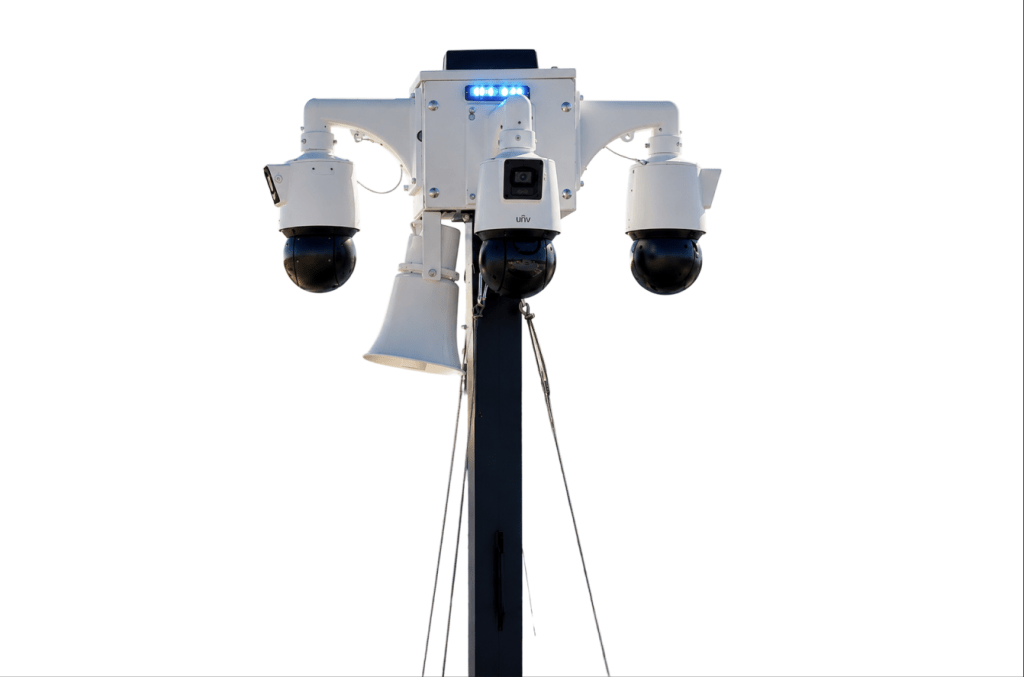
Our mobile surveillance trailers include an IP bullhorn speaker built into the unit, which delivers live or automated voice-down warnings the moment the AI flags an intrusion or loitering event. Most people who are testing whether a site is watched leave immediately once a loudspeaker addresses them directly. Paired with a white and blue LED strobe light, the combination of sound and visible light creates an unmistakable signal that the area is under active monitoring, not just recorded.
This kind of real-time response is a core part of our construction site surveillance cameras, which combine detection, deterrence, and documentation in a single self-contained unit.
Audio deterrents work because they remove the anonymity a trespasser is counting on. A dark, quiet site suggests no one is aware of an intrusion, but a voice warning through a loudspeaker makes it clear the site is actively watched and responding in real time. Many people leave the moment they hear a warning, well before any further escalation is needed, which is why the audio layer often prevents an incident from progressing to actual property damage.
Catching Vandals With Real-Time Alerts
Catching vandals with real-time alerts depends on AI that can tell the difference between routine site activity and an actual threat, then notify the right people the moment it happens. A generic motion sensor triggers on wind, wildlife, or passing traffic, which trains crews to ignore alerts entirely.
Motion Detection and Mobile Alerts

Our AI analyzes behavior, not just movement, and flags loitering, perimeter breaches, and unauthorized entry into restricted zones. When the system detects an event, it sends a real-time alert to your phone or dashboard, so a supervisor or monitoring contact knows about a trespasser within seconds instead of discovering the damage the next morning.
Sentry Mode adds continuous autonomous PTZ scanning across the site, so the camera is actively sweeping for unusual activity rather than waiting in a fixed position. Combined with the 20-foot mast and 360-degree coverage, this closes the blind spots that a single static camera would miss.
Mobile alerts matter most in the minutes right after an intrusion is detected, since that window determines whether a supervisor can respond, call local authorities, or simply confirm the audio deterrent handled the situation. A dashboard notification with a timestamped clip lets a site manager verify what happened from a phone without driving to the property at 2 a.m. for what turns out to be a false alarm.
Using Footage With Law Enforcement
Using footage with law enforcement and insurance turns a vandalism incident from a frustrating loss into a documented case with a real chance of resolution. Clear, time-stamped, high-resolution footage gives officers something specific to act on instead of a vague description after the fact.
Our units record in high resolution with secure, time-stamped storage, and the
Case Reporting feature compiles that footage, along with notes and event logs, into a shareable report for police, insurance adjusters, or internal stakeholders. A complete case report, rather than a phone video or a secondhand account, gives an insurance claim the documentation it needs and gives law enforcement a stronger basis to pursue a lead.
This is general information, not legal advice. Recording and audio-deterrent use on private property is generally permitted, but consent and notice requirements vary by state, so confirm local regulations before finalizing your monitoring and signage plan.
A documented case report also helps beyond the immediate incident. Contractors managing several active sites can review recurring patterns across properties, such as a vandalism spree that moves from one nearby jobsite to another, and share that pattern with local police or neighboring site managers. That kind of shared visibility is difficult to build from memory alone, but straightforward once every incident is logged with a timestamp and a clip.
Building a Layered Anti-Vandalism Strategy
Building a layered anti-vandalism strategy means combining physical barriers, access control, and active AI monitoring so that no single failure point leaves the site exposed. Each layer covers a gap the others cannot close on their own.
A security guard can physically confront a trespasser and make real-time judgment calls, which is a genuine advantage AI monitoring does not replicate. A guard’s coverage is limited to one location at a time, however, and fatigue and blind spots are real factors during overnight shifts. Passive fixed cameras record continuously but take no action and require someone to review footage after the fact, often after the damage is already done. A mobile AI surveillance unit closes that gap by watching the entire perimeter at once, triggering an audio warning immediately, and generating a documented report automatically, without needing wiring or a fixed installation.
| Factor | Security Guard | Passive Fixed Camera | Duck View AI Surveillance |
| Response speed | Immediate, but only where present | None, records only | Automated audio warning in real time |
| Coverage | One position at a time | Fixed field of view | 360-degree PTZ, up to 2 to 3 acres per unit |
| Physical intervention | Yes | No | No, deters rather than intervenes |
| Documentation | Manual notes or verbal report | Raw footage only | Time-stamped footage plus automated Case Reporting |
| Setup time | Immediate, ongoing staffing cost | Days to weeks for wiring | Under an hour, solar and LTE, no trenching |
Nate Salazar, Senior Director of Asset Protection & Safety at Sportsman’s Warehouse, has described Duck View Systems as a trusted partner with industry-leading AI expertise that has consistently exceeded expectations, a theme reflected across the retail and construction sites where our units are deployed.
We manufacture every unit in Kaysville, Utah, and design them to go live the same day a site opens, closing the early-project window when fencing and formal security have not yet caught up with an active jobsite.
Frequently Asked Questions
How do you stop vandalism on a construction site?
Duck View Systems recommends layering durable fencing and lighting, clear signage and access control, and active AI monitoring with real-time audio deterrents. No single layer stops every incident, but together they remove the low-risk conditions vandals look for.
Do cameras deter vandals?
Visible cameras alone provide some deterrence, but active systems that trigger real-time audio warnings and strobe lights are significantly more effective than passive recording, because they interrupt an incident in progress instead of only capturing it afterward.
What is the most common type of vandalism on a construction site?
Graffiti and general property damage, such as broken windows, torn fencing, and damaged equipment, are among the most frequently reported forms of construction site vandalism, alongside trespassing that sometimes escalates into theft.
Is construction site vandalism covered by insurance?
Coverage depends on the policy, the property’s location, and the carrier. Site owners should confirm vandalism coverage with their insurance provider directly. Documented, time-stamped footage generally strengthens a claim regardless of the policy terms.
Should I report vandalism to police even if nothing was stolen?
Yes. A police report creates an official record, which matters for insurance claims and for establishing a pattern if the same site experiences repeat incidents. Time-stamped footage and a compiled case report make that process faster for both the officer and the site owner.
Protect Your Project from Construction Site Vandalism and Trespassing
Vandalism and trespassing rarely happen once. A site that shows no active monitoring tends to see repeat incidents until something changes the calculation for whoever is testing the property. Layered fencing, lighting, access control, and active AI surveillance work together to make that calculation obvious from the outside.
Request a quote today to see how a mobile surveillance trailer can start protecting your site the same day it arrives, or book a demo to walk through your site’s specific risk factors with our team.