
A multi-day festival, a downtown marathon route, or a county fair has no fixed cameras, no wired power, and only a few weeks of lead time, which leaves a gap that hired guards alone cannot close. That is the gap that event organizers, festival producers, and venue operators across the country are filling with mobile surveillance trailers. At Duck View Systems, we manufacture American-made mobile surveillance trailers for events and festivals that deploy in under an hour on solar power and LTE, giving event sites AI detection, audio deterrents, and time-stamped footage without trenching a single cable.
Quick Answer: Yes. Each mobile surveillance trailer for events and festivals covers up to 2 to 3 acres of grounds, parking, or perimeter and detects loitering, intrusion, and crowd activity in real time, triggering audio deterrents the moment a threat is confirmed. Because the units run on solar power and LTE, they deploy in under an hour at any event or festival site, with no wired power or Wi-Fi required.
Why Event and Festival Organizers Are Turning to Mobile Surveillance Trailers
Event and festival organizers are increasingly turning to mobile surveillance trailers because temporary sites cannot wait weeks for wired camera installations and cannot rely on security personnel alone to cover large, open areas.
Most festivals, marathons, and fairgrounds operate for only a short period, yet they span wide spaces that often lack existing power or network infrastructure needed for fixed security systems. Installing traditional cameras in these environments is usually impractical within the event timeline.
While security guards remain essential, their coverage is inherently limited. A guard stationed at a main entrance cannot simultaneously monitor distant parking areas, perimeter fencing, vendor zones, or unattended equipment storage points. Large public events naturally carry elevated security risks due to high crowd density and open access points, which is why agencies like CISA emphasize the importance of comprehensive physical security planning for public gatherings.
Mobile surveillance trailers help bridge the gap between on-the-ground security personnel and permanent camera systems that are not feasible for temporary deployments. These units can be rapidly deployed, raise a mast with elevated cameras, and begin monitoring key areas, often including AI-based detection, on the same day. This allows organizers to extend coverage across areas that would otherwise require multiple additional guards working around the clock. For a closer look at how this compares in real-world use cases, see the breakdown of mobile surveillance trailers vs. fixed security cameras.
How a Mobile Surveillance Trailer Covers an Event or Festival Site
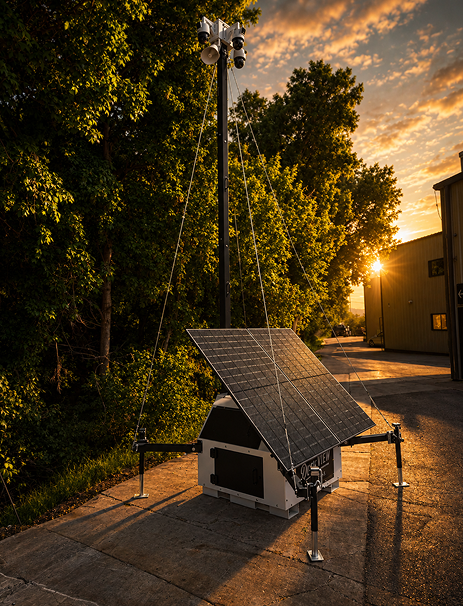
A mobile surveillance trailer covers an event site by running its own power, its own connectivity, and its own AI analytics from the moment it is parked, so coverage does not depend on the venue having existing infrastructure. Every mobile surveillance trailer arrives fully integrated. A single person tows it into position, levels it on four outriggers, raises the 20-foot mast, and the unit is live on solar power and dual-SIM LTE within the hour. There is no trenching for the vendor row, no waiting on the venue’s electrician, and no dependence on site Wi-Fi that festival grounds rarely have anyway.
Once it is up, the AI platform analyzes the live feed continuously, watching for loitering near a closed gate, an intrusion across a fenced perimeter, a fire or smoke event near a cooking vendor, or a vehicle approaching a restricted access lane. The full how it works walkthrough covers the five-stage lifecycle, from delivery and deployment through detection, documentation, and redeployment to the next event.
Solar and Battery Power for Multi-Day Events
Solar and battery power keep a unit running through a multi-day festival without anyone needing to swap a generator tank or run an extension cord across a public walkway. The trailer’s solar array recharges an onboard battery bank during daylight hours, and the battery carries the AI processor, the PTZ cameras, and the LTE modem overnight, when most festival incidents involving unattended equipment or perimeter breaches tend to happen.
A festival site with no nearby generator pad or a multi-day camping event with limited daylight hours can also add a generator backup add-on, which keeps the unit fully powered through extended overcast stretches or unusually heavy AI and deterrent activity. Sites without reliable cell coverage in the area can add Starlink connectivity instead of relying on the dual-SIM LTE modem alone. For more on running a unit through low-light conditions, see The no-WiFi security camera guide to off-grid deployment.
Specs and Deployment Timeline for Event Security
Each of our mobile surveillance units has a 5-by-5-foot base and a 20-foot mast, deploys in under an hour, and runs fully off-grid on solar power with LTE, covering up to 2 to 3 acres per unit with a 360-degree PTZ camera. The table below summarizes the specs that matter most when planning event coverage.
| Spec | Detail |
| Footprint | 5 ft x 5 ft base |
| Mast height | 20 feet, telescoping with outriggers for stability |
| Camera | Two 360-degree PTZ cameras, 25x optical zoom, four total camera feeds |
| Coverage per unit | Up to 2 to 3 acres, layout dependent |
| Power | Solar array with onboard battery bank; optional generator add-on |
| Connectivity | Dual-SIM LTE modem with automatic carrier switching; optional Starlink |
| Deploy time | Under one hour; same-day operational |
| Deterrents | IP bullhorn speaker; white and blue LED strobe light |
That same-day deployment matters most during load-in, when a festival site is still a construction zone of staging, fencing, and vendor setup. A unit placed during load-in is already collecting baseline footage and running detection before gates open to the public, rather than arriving the morning of the event with no time to configure detection zones.
Key Event and Festival Use Cases for Mobile Surveillance Trailers
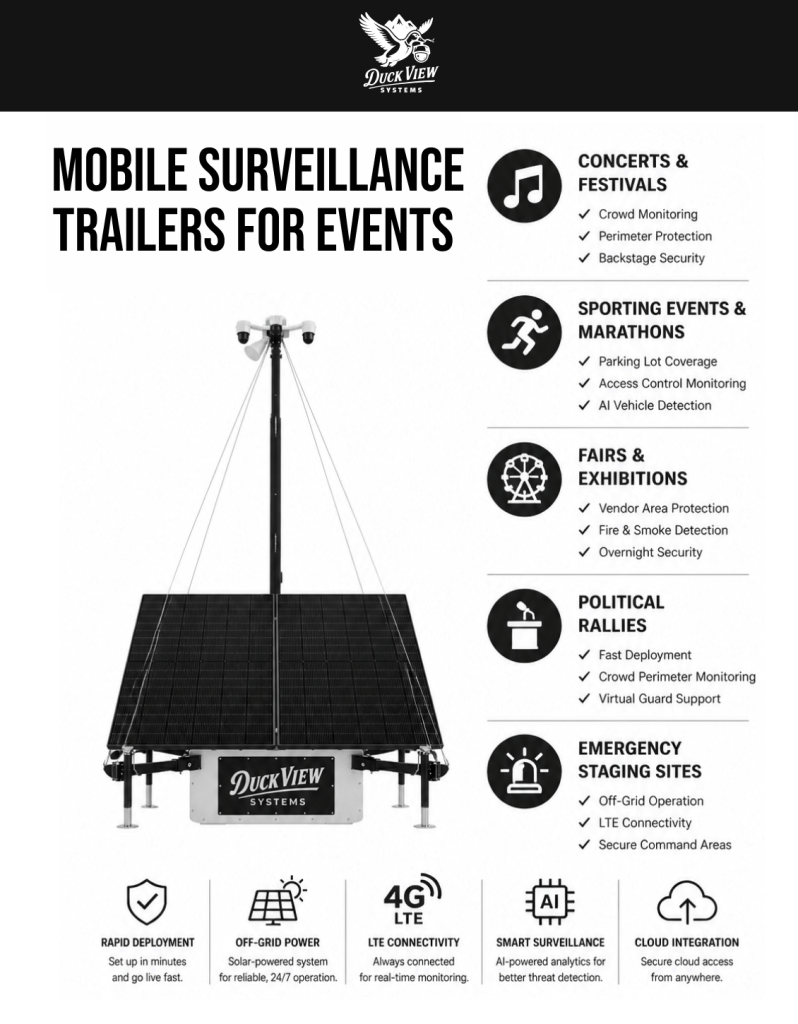
Mobile surveillance trailers cover a wide range of event types because the same off-grid, solar-and-LTE platform adapts to any temporary site, from a single-stage concert to a multi-day fairground.
Concerts, Festivals, and Sporting Events
Concerts, festivals, and sporting events typically need coverage for parking, perimeter fencing, and overflow areas that sit outside the main venue’s existing camera system. A music festival spread across open fields, a marathon route that crosses dozens of city blocks, or a tailgate lot outside a stadium all share the same problem: the official venue security ends at the gate, and everything beyond it is unmonitored unless an organizer brings in additional coverage. A trailer placed at the edge of a parking field or along a perimeter fence line extends that coverage without needing a permit to run cable across public right-of-way.
- Multi-day music festivals, where a unit can stay in place for the full run of the event and reposition as stages or vendor rows shift between days.
- Fairs and county exhibitions, where livestock areas, midway sections, and overflow parking each need separate coverage.
- Marathons and road races, where a trailer can cover a staging area, a finish line, or a stretch of route with limited existing infrastructure.
- Political rallies and public demonstrations, where perimeter awareness and crowd-area visibility support the public safety teams already on site.
- Emergency management and disaster-response staging areas, where a unit can monitor a supply depot or a temporary shelter site that has no permanent security infrastructure.
Some of these use cases overlap directly with public safety. Police departments already use the same trailer platform for crowd events, and the law enforcement mobile surveillance trailer guide and Police & Law Enforcement page cover how municipal teams deploy units for event and crowd monitoring specifically.
Features That Matter Most for Event and Festival Security
The features that matter most for event security are the ones built for crowds and vehicles moving through a temporary site: real-time crowd-area monitoring, automated patrol across multiple zones, and vehicle and license plate visibility in parking areas.
The Virtual Guard feature watches for loitering near closed gates, intrusion across a fenced perimeter, and unauthorized zone entry, then responds instantly with an audio warning or alert escalation rather than waiting for someone to review footage after the fact. AI Patrol moves the PTZ camera through preset zones automatically, which matters at an event site with multiple areas, such as a main stage, a vendor row, and a parking field, that a single fixed camera could never cover at once. Sentry Mode adds autonomous scanning on top of that, logging every patrol pass and detection on a live activity feed so an event’s security lead can see what the unit has covered without watching a static monitor all day.
Parking Areas and Vehicle Monitoring with License Plate Recognition
Parking areas and vehicle monitoring benefit from license plate recognition because event parking fields rarely have gated access control, which makes vehicle identification the main way to track who entered and when. The Focus Mode feature locks onto a detected vehicle or person automatically, captures plate and vehicle details at a distance, and logs the event with a timestamp, which is useful for an overflow lot, a VIP parking area, or a vendor loading zone where unauthorized vehicles are a recurring problem at multi-day events.
Audio Deterrents and Real-Time Alert Escalation
Audio deterrents and real-time alert escalation give an event security team a way to intervene the moment the AI confirms a threat, instead of only documenting it after the fact. Every unit’s onboard IP bullhorn speaker can issue a recorded or live audio warning when AI Tripwire Detection or a defined intrusion zone is crossed, while the white and blue LED strobe adds a visible signal that the area is monitored. That combination matters at night, when a festival’s perimeter fence and overflow lots see the most unauthorized activity but the fewest staff on patrol.
Mobile Surveillance Trailers vs. Additional Security Guards for an Event

A mobile surveillance trailer covers wide-area ground with continuous AI detection, while a security guard provides physical presence and can intervene directly, which means the two are usually complementary rather than a strict either-or decision for most event budgets.
| Factor | Mobile Surveillance Trailer | Additional Security Guard |
| Coverage area | Up to 2 to 3 acres per unit, continuous | One position or patrol route at a time |
| Operating hours | 24/7, including overnight load-in and load-out | Limited to scheduled shifts |
| Physical intervention | No; relies on audio deterrent and alert escalation | Yes, can physically intervene or de-escalate |
| Setup time | Under one hour, no infrastructure required | Immediate, but limited to one location |
| Typical monthly cost | $1,400 to $2,300 per unit (most pay $1,650 to $2,000) | Varies by staffing agency and shift length; |
| Best fit | Perimeter, parking, and overnight coverage | Gate checks, crowd interaction, credential checks |
Most event security plans use both. A trailer covers the overnight perimeter and the overflow parking field, where staffing a guard around the clock is impractical, while guards stay at gates and stages where credential checks and crowd interaction require a person. The pricing page lists the full published monthly ranges for both the trailer and our pole-mounted system, along with add-ons like monitoring, Starlink, and generator backup. Short-term, single-weekend event rentals may carry a delivery or setup charge on top of the monthly range, depending on location and lease length.
Planning Your Event Surveillance Setup: A Timeline
Planning an event surveillance setup starts well before load-in, since site assessment, unit placement, and detection-zone configuration all take time to get right. The timeline below reflects how most organizers work with us ahead of a multi-day event.
- 6 to 8 weeks out: Confirm event footprint, identify perimeter lines, parking fields, and any restricted zones, and request a quote for the number of units the site needs.
- 3 to 4 weeks out: Finalize unit placement based on the site map, including power and connectivity considerations for remote sections of the grounds.
- 1 to 2 days before load-in: Units arrive and deploy, with masts raised and AI detection zones configured to match fencing, gates, and vendor layout.
- During the event: Units run continuously, with AI Patrol and Sentry Mode covering assigned zones and Virtual Guard responding to detected events in real time.
- Load-out: Units redeploy the same day the event closes, since the trailer’s mobility means there is no fixed installation to remove.
Crowd management at a live event is its own planning discipline, distinct from reacting to a problem once it starts, according to the Event Safety Alliance, whose ANSI ES1.9 standard separates proactive crowd management from after-the-fact crowd control. A mobile surveillance trailer supports the management side of that distinction by giving organizers continuous visibility into a site before a small issue, like a fence breach or an unattended vehicle, becomes a larger one.
Why Event Organizers Choose Duck View Systems
Event organizers choose us because every unit is manufactured in Kaysville, Utah, and ships with the same verified hardware and AI platform regardless of whether it is covering a construction site, a retail lot, or a festival grounds. Nate Salazar, Senior Director of Asset Protection and Safety at Sportsman’s Warehouse, has described our company as a trusted partner whose AI expertise has consistently exceeded expectations, the same platform and support that event organizers get when they request a unit for a weekend festival or a multi-week fair.
We are a manufacturer first, and we sell through a network of integrator partners rather than competing with the security firms and staffing agencies that event organizers already work with. If your event security plan already includes guards, a trailer adds the overnight and perimeter coverage that staffing alone cannot reach cost-effectively, without replacing the people who handle gate checks and crowd interaction.
Every unit runs the same five-stage process regardless of site type: deliver and deploy, activate smart monitoring, detect and alert, capture and document, then move and adapt as the event’s footprint changes from one day to the next.
Frequently Asked Questions
Can mobile surveillance trailers be used for events and festivals?
Yes. our mobile surveillance trailers deploy in under an hour on solar power and LTE, which makes them well-suited to temporary event and festival sites that have no existing wired power or network infrastructure.
How many mobile surveillance trailers does a festival need?
The number of units depends on the size of the grounds and how many separate zones, such as parking fields, perimeter fence lines, and vendor areas, need independent coverage. Since each unit covers up to 2 to 3 acres, a multi-day festival spread across a large footprint typically needs several units placed around the perimeter and parking areas rather than a single unit at the main gate.
Do mobile surveillance trailers need a generator at an outdoor event?
Not by default. Each unit runs on its own solar array and onboard battery bank, so a generator is not required for standard operation. A generator backup add-on is available for multi-day events with limited daylight hours or unusually heavy AI and deterrent activity.
Can a mobile surveillance trailer monitor a parking lot at a concert or fair?
Yes. The Focus Mode feature tracks vehicles and captures plate and vehicle detail in parking areas, which is useful for overflow lots, VIP parking, and vendor loading zones that typically have no gated access control at a temporary event site.
How much does it cost to add a mobile surveillance trailer to an event?
Our monthly rental range is $1,400 to $2,300 per unit, with most customers paying $1,650 to $2,000 per month, plus optional add-ons such as monitoring, Starlink connectivity, or generator backup. Short-term or single-weekend event rentals may carry an additional delivery or setup charge depending on location and lease length, so the exact cost for a specific event is best confirmed through a quote.
Is a mobile surveillance trailer legal to use at a public event?
Surveillance laws vary by state and by the specifics of where cameras and audio deterrents are pointed, so event organizers should confirm local regulations with their own legal counsel before deployment. This is general information, not legal advice.
Protect Your Next Gathering With a Mobile Surveillance Trailer for Events
A mobile surveillance trailer gives event and festival organizers the continuous, off-grid coverage that temporary sites cannot get from wired cameras and cannot afford through additional security guards alone. From single-day concerts to multi-week fairs, the same solar-powered, LTE-connected platform deploys in under an hour, monitors crowds, parking areas, and perimeters in real time, and captures time-stamped evidence when incidents occur.
If you’re planning an upcoming event and want to strengthen security without the delays or infrastructure costs of permanent camera systems, we can help you design the right surveillance solution for your site. Book a demo with us to see how our mobile surveillance trailers can support your event security strategy.