

Hot spot policing surveillance trailers give law enforcement agencies a mobile way to add visible, AI-monitored coverage to the small number of blocks, lots, and corridors that generate a disproportionate share of calls for service. For departments using place-based policing strategies, the challenge is maintaining a visible presence in those locations without pulling patrol officers away from the rest of the beat. Duck View Systems trailers provide solar-powered, LTE-connected coverage that can be deployed quickly, allowing agencies to shift surveillance as crime patterns change.
Hot spot policing surveillance trailers work by positioning a mobile, AI-equipped unit directly in a high-crime location to provide visible deterrence, real-time detection, and automated alerts without requiring an officer to remain on the block around the clock. Because the trailer can be relocated as crime patterns shift, agencies can align coverage with current data rather than committing resources to a permanent post.
Key Takeaways
- Hot spot policing is rated Effective for reducing overall crime by the National Institute of Justice’s CrimeSolutions clearinghouse, based on a meta-analysis of controlled studies.
- A single trailer provides elevated PTZ camera coverage across a targeted hot spot, extending continuous visibility beyond what periodic patrol passes can provide.
- Units run on solar and battery power with dual-SIM LTE, so a trailer can go live on a vacant lot, alley, or unlit corner before any utility work is done.
- Automated Case Reporting logs every deterrence event and alert with a timestamp, giving analysts a before/after record without pulling raw footage by hand.
- Redeployment takes hours, not weeks, so a unit can move to the next hot spot as soon as crime data shows the current location has stabilized.
What Is Hot Spot Policing with Surveillance Trailers?
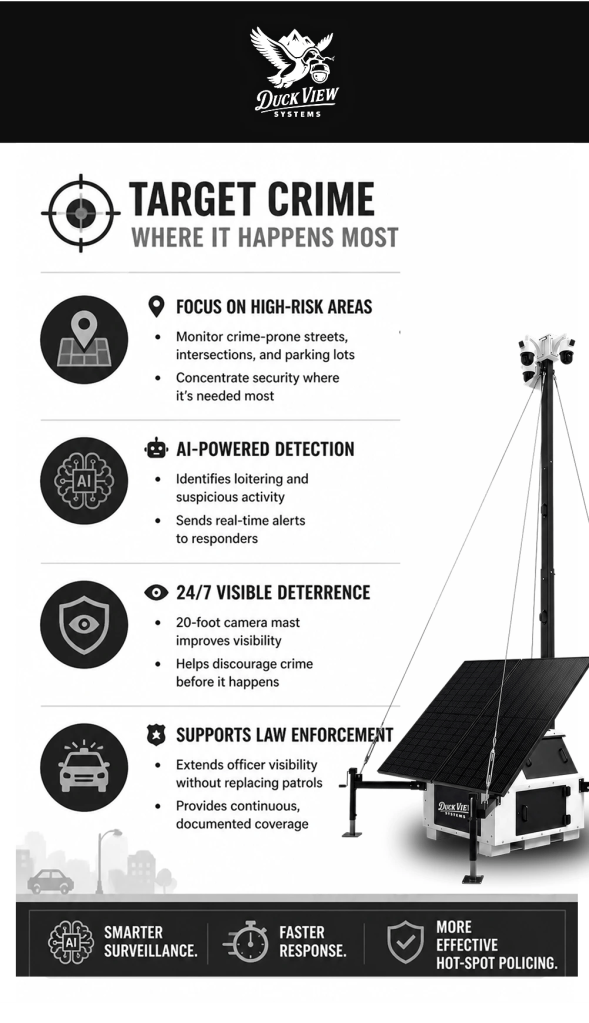
Hot spot policing with surveillance trailers means concentrating a mobile, AI-equipped unit at a small, data-defined location, usually a street segment, intersection, or parking lot, where crime is disproportionately concentrated. The strategy itself is decades old: agencies have long known that a small share of addresses and blocks generate a large share of calls for service, and that focusing patrol resources there produces measurably better results than spreading the same resources evenly across a district.
What changes with a mobile surveillance trailer is how that concentrated presence gets delivered. Instead of assigning an officer to sit on a corner for a shift, or running extra patrol loops through the same three blocks, a department places a unit that watches continuously, flags loitering and perimeter activity with AI detection, and pushes a real-time alert the moment something crosses a defined threshold. The trailer does not replace an officer’s judgment or authority to intervene; it extends visibility and deterrence to a location that would otherwise only get periodic drive-bys.
A hot spot in this context is not necessarily a whole neighborhood. Hot spots can be defined at a much smaller geographic scale, including individual addresses, buildings, block faces, street segments, intersections, or clusters of nearby locations where crime is concentrated. That small footprint is well suited to a mobile surveillance trailer that can provide targeted coverage and move when the data identifies a different priority location.
A typical example looks like this: a department notices a cluster of overnight vehicle break-ins concentrated on one parking structure and the block around it. Rather than assigning a patrol unit to sit there for weeks, the department places a trailer at the location. The unit watches continuously; the strobe and camera mast are visible from every approach, and any confirmed loitering or perimeter activity after hours triggers an audio warning and an alert to dispatch. The officer’s discretion and authority to respond don’t change; what changes is that the block now has round-the-clock, documented coverage instead of coverage that depends on how often a patrol car happens to drive past.
We manufacture these units and sell through a network of integrators and security dealers who handle installation and support in most markets, so a department’s day-to-day point of contact is usually local even though the hardware and AI platform come from us.
Why Visible Deterrence Reduces Crime in Hot Spots
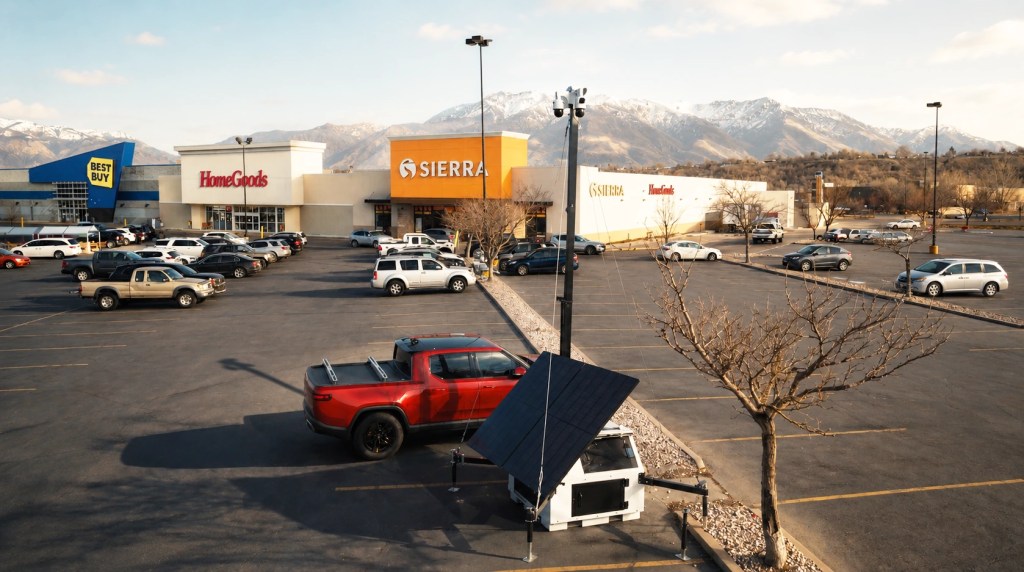
Visible deterrence reduces crime in hot spots because most opportunistic offenders weigh the odds of getting caught before they act, and a marked, obviously monitored presence raises that perceived risk. The National Institute of Justice’s CrimeSolutions clearinghouse rates hot spot policing as Effective for reducing overall crime, with a 2019 update to the underlying meta-analysis rating four additional outcomes, violent, property, public order, and drug and alcohol offenses, as Promising.
The same pattern holds for camera-based deterrence specifically. Urban Institute research on public surveillance camera systems in Baltimore and Chicago found that cameras were linked to reduced crime, with the effect extending beyond the immediate area of camera coverage. Chicago’s system returned more than four dollars in averted-crime cost savings for every dollar spent, and Baltimore returned fifty cents on the dollar. The researchers noted that the most effective systems shared three traits: they were monitored by trained staff, had enough camera density to catch activity as it happened, and were integrated into routine police work rather than left as a passive archive.
A mobile surveillance trailer is built around that same combination. Sentry Mode keeps the PTZ camera actively sweeping the hot spot instead of watching one fixed angle, and Virtual Guard turns a detected threat into an immediate audio warning rather than a note for tomorrow’s report. The strobe light and loudspeaker are the visible half of the deterrent; the alert that reaches dispatch in seconds is the operational half.
How to Identify and Prioritize Crime Hot Spots
Identifying and prioritizing crime hot spots starts with the department’s own calls-for-service and incident data, not with a general sense of which neighborhoods feel risky. The steps below reflect how most agencies build a defensible, data-driven deployment list.
- Pull calls-for-service and reported-incident data for a rolling 90- to 180-day window, mapped to specific addresses or block segments rather than beats or districts.
- Rank locations by frequency and severity, weighting violent and firearm-related incidents more heavily than lower-level disorder calls.
- Cross-reference the ranked list against community complaints, business-owner reports, and any recent spikes flagged by patrol supervisors.
- Confirm each candidate location can physically host a trailer, checking for a stable, level surface, sightlines, and safe access for setup and removal.
- Set a review interval, typically 30 to 90 days, to re-rank hot spots using updated data rather than leaving a unit in place indefinitely.
Departments that already run mobile units for other purposes can fold this into an existing workflow; our guide on how law enforcement agencies use mobile surveillance trailers covers deployment patterns beyond hot spot work, including events, checkpoints, and search operations.
Between formal review cycles, AI Patrol keeps a deployed trailer sweeping preset zones within the hot spot automatically, rather than holding on a single fixed view. That matters for analysts building the prioritization list, since a unit already on scene at a lower-tier hot spot can still surface useful activity data on the rest of the block while the department decides where to deploy next.
Deploying Trailers for Maximum Deterrent Effect
Deploying a trailer for maximum deterrent effect comes down to placement, visibility, and how tightly the unit is tied into an agency’s response protocol. The checklist below covers the factors that separate a hot spot deployment that actually changes behavior from one that just sits there.
- parate a hot spot deployment that actually changes behavior from one that just sits there.
- Position the mast and PTZ camera so the trailer has unobstructed sightlines across the full hot spot, not just the nearest entrance or corner.
- Keep the strobe light and signage visible from the main approach; deterrence depends on people noticing the unit before they act, not after.
- Configure detection thresholds for the specific behavior driving the hot spot designation- loitering, vehicle break-ins, open-air drug activity- rather than leaving generic defaults in place.
- Set escalation rules so a confirmed alert reaches dispatch or a designated officer directly, instead of waiting for someone to check a dashboard.
- Log every deterrence event automatically so the deployment builds a data trail from day one, not just from when someone remembers to note it.
Departments running several hot spots at once should also plan the rotation order before the first trailer goes out. Redeployment between locations takes a fraction of the time a fixed-camera install would, since there’s no trenching, conduit, or permanent power hookup involved, which means the schedule can follow whichever block the data flags next rather than being locked in by installation cost.
Setting Dwell Time and Placement by Crime Type
Dwell time should match the crime pattern driving the deployment. A location generating late-night vehicle burglaries needs a unit in place through the overnight hours for at least several consecutive weeks, since the goal is to disrupt an established pattern rather than catch one incident. A location tied to a short-term spike, a string of daytime thefts around a specific business, can often see results faster and be reassigned sooner. Focus Mode lets an operator zoom in and hold on a specific zone within the hot spot, which is useful when the problem behavior is concentrated at one entrance or doorway rather than spread across the whole block.
Handling Crime Displacement
Crime displacement, the concern that deterring activity at one hot spot simply pushes it a block or two away, is a fair question for any command staff evaluating this strategy. The evidence on hot spot policing generally does not show the offsetting displacement that critics often assume; some studies even find a modest diffusion of benefits into surrounding blocks. That said, departments should still track calls for service in the immediately adjacent area during a deployment, both to confirm the pattern is holding locally and to catch any early sign of displacement before deciding whether to relocate or add a second unit.
Measuring Results in High-Crime Zones
Measuring results in a high-crime zone means comparing the same metrics before and after deployment, using a consistent method so the comparison holds up when a chief or city council asks for evidence. The table below outlines the categories most departments track.
Consistency matters more than any single number. Pulling the before-count and after-count from the same data source, over the same length of window, and against the same block boundary is what makes a comparison defensible instead of anecdotal. A department that mixes a 90-day baseline with a 30-day post-deployment window, or widens the boundary after the fact, will end up with results that don’t hold up to scrutiny even if the underlying deterrence effect is real.
| Metric | Before deployment | After deployment | How it’s measured |
| Calls for service | Baseline count, 90-day window | Post-deployment count, same window length | Pulled from CAD/RMS by address or block segment |
| Reported incidents | Baseline count by category | Post-deployment count by category | Incident reports filtered to the hot spot boundary |
| Deterrence events | Not applicable | Total AI-triggered alerts and audio warnings | Automated Case Reporting log, timestamped |
| Adjacent-block activity | Baseline count | Post-deployment count | CAD/RMS data for surrounding blocks, checked for displacement |
Every alert and deterrence event the trailer generates is captured automatically through Case Reporting, which time-stamps each event and compiles it into a shareable log. That gives an analyst a running record of activity at the hot spot without pulling raw footage every time someone asks what the unit flagged and when, and it gives command staff a documented basis for deciding whether to extend, move, or close out a deployment.
For departments running this alongside broader deployments, Natural Language Search lets an analyst search stored footage across every active hot spot by typing a plain description, such as a vehicle color or clothing detail, instead of scrubbing hours of video from each location by hand when a pattern needs a closer look.
Frequently Asked Questions About Hot Spot Policing Technology
Can one trailer be redeployed between multiple hot spots?
Yes. Because the unit runs on solar power and LTE with no wired infrastructure, a trailer can be relocated to a new hot spot in the time it takes to tow it and reposition the mast, generally under an hour once on site. Departments managing a rotating list of priority locations often move a single trailer through several hot spots over a review cycle rather than buying separate hardware for each one.
Does hot spot policing actually reduce crime?
Yes, according to the evidence base reviewed by the National Institute of Justice’s CrimeSolutions clearinghouse, which rates hot spot policing as Effective for reducing overall crime. Results vary by location and how consistently the strategy is applied, which is why departments should track their own before-and-after data alongside the general research.
How long should a trailer stay in one hot spot?
Most deployments run somewhere between 30 and 90 days before a review, though a location tied to a persistent pattern, like recurring overnight break-ins, may warrant a longer placement. The right interval depends on how quickly calls for service and reported incidents drop and hold at the location, which is why a scheduled data review matters more than a fixed calendar date.
Does surveillance just displace crime elsewhere?
The research on hot spot policing generally does not show significant offsetting displacement to nearby blocks, and some studies find a modest diffusion of benefits into the surrounding area instead. Departments should still monitor calls for service on adjacent blocks during a deployment to confirm the pattern holds locally and to catch any early signs of displacement.
How do I prove a trailer reduced crime in an area?
Compare calls-for-service and reported-incident counts for the hot spot in a fixed window before and after deployment, using the same data source and boundary both times. Pairing that with the deployment’s automated Case Reporting log gives a timestamped record of every alert and deterrence event alongside the crime-data comparison, which is the kind of documentation a chief or city council typically wants to see before approving continued or expanded use.
Strengthen Hot Spot Policing with Duck View Surveillance Trailers
Hot spot policing surveillance trailers give law enforcement agencies a flexible way to extend visible, data-driven coverage to locations where crime is concentrated. Instead of committing officers to a fixed post, a mobile unit can provide continuous monitoring, automated alerts, and documented activity while allowing patrol resources to remain available for calls elsewhere. When crime patterns change, the trailer can move with the data.
The strongest deployments combine targeted placement with measurable evaluation. By comparing calls for service, reported incidents, adjacent-block activity, and documented deterrence events before and after deployment, command staff can build a clearer picture of whether a hot spot is stabilizing and where coverage should go next. Duck View Systems’ mobile surveillance trailers are designed to support this type of flexible, technology-assisted deployment.
Request a quote to discuss a hot spot deployment plan for your department, or contact our team to see how mobile surveillance can support your existing patrol strategy.