

Automating PPE compliance monitoring on construction sites helps address one of the biggest challenges in jobsite safety: identifying missing protective equipment the moment it happens instead of discovering it during an inspection or after an incident. A missed hard hat or an unclipped harness can go unnoticed for hours because supervisors cannot watch every worker, every zone, and every shift at once. Traditional PPE compliance depends on periodic walkthroughs and manual observations, leaving gaps between inspections where violations can occur. AI-powered mobile surveillance changes this by continuously monitoring active work areas and supporting real-time safety oversight. These are the same construction site surveillance cameras many contractors already rely on for theft prevention and after-hours coverage.
Quick Answer: AI construction site surveillance automates PPE compliance monitoring by continuously analyzing live video for missing hard hats and safety vests, recording each detection with a timestamp, and notifying supervisors in real time. Duck View Systems’ solar-powered, LTE-connected mobile surveillance units provide continuous monitoring without relying on permanent infrastructure, helping construction teams create an audit-ready record of PPE compliance while reducing the need for manual safety inspections.
Why PPE Compliance Is Hard to Enforce Manually
Manual PPE enforcement fails because one supervisor cannot watch every worker on a site at once. A typical jobsite spreads dozens of workers across multiple zones, trades, and shift changes, and a walkthrough only captures a single moment in time. The gap between checks is exactly when violations happen and go unrecorded.
Manual Walkthroughs Miss Violations Between Checks
A safety manager who inspects a site twice a day sees two snapshots out of an eight-hour shift. A worker who removes a hard hat in the heat, skips a vest during a quick material move, or wanders into an active zone without gear is invisible to a checklist unless someone happens to be looking at that exact moment. Large crews and rotating subcontractors make this worse. New faces show up daily, safety orientation varies by trade, and no single person tracks who was briefed on which zone. The result is a compliance record built on sampling, not continuous observation, which weakens it the moment an incident or inspection puts it under scrutiny.
Shift changes create another blind window. A morning crew that clears a walkthrough clean says nothing about the afternoon crew, the night cleanup shift, or a delivery driver who steps out of a truck without a vest for two minutes. Weather adds pressure, too. Workers shed hard hats in extreme heat or swap a vest for a jacket in cold rain, and both choices happen fastest when nobody appears to be watching. None of this reflects bad intent. It reflects the simple math of one supervisor against dozens of workers spread across acres of active site.
OSHA Requirements and the Real Cost of PPE Violations
OSHA requires personal protective equipment whenever engineering and administrative controls cannot fully remove a hazard, and failing to enforce it carries direct financial exposure. The Occupational Safety and Health Administration sets the maximum penalty for a serious or other-than-serious violation at $16,550 per violation, and willful or repeated violations can reach $165,514 per violation. PPE for eye and face protection alone accounted for 1,665 citations nationally in fiscal year 2025, according to OSHA’s top 10 most frequently cited standards list, showing that PPE gaps remain a routine, not rare, finding during inspections.
Penalties are only part of the cost. A citation becomes part of a contractor’s public safety record, which insurance underwriters and prequalification platforms review when setting premiums and bid eligibility. A pattern of PPE violations can affect an Experience Modification Rate for years after the citation is resolved, well beyond the fine itself.
Citations are also cumulative in a way many site owners underestimate. Each worker found without required gear during a single inspection can generate a separate violation, so a walkthrough that catches five workers without hard hats does not produce one fine; it can produce five. Repeat findings within a five-year window escalate to the willful or repeated penalty tier, which is nearly ten times the base amount. This is the core financial argument for continuous monitoring: the cost of missing a violation compounds fast, while the cost of catching it in the moment does not.
| Violation Type | Maximum Penalty (2026) | Note |
| Serious / Other-Than-Serious | $16,550 per violation | Applies per violation, per worker cited |
| Failure to Abate | $16,550 per day beyond deadline | Accrues daily until corrected |
| Willful or Repeated | $165,514 per violation | Can compound quickly across a crew |
The Business Case for Automated PPE Compliance
Automated PPE compliance pays for itself by closing the gap between citations, insurance costs, and preventable injuries. A continuous detection record demonstrates a documented pattern of enforcement, which is exactly what OSHA and underwriters want to see instead of a handwritten daily log. Injury costs compound quickly once a worker is hurt: medical claims, lost productivity, potential OSHA referral, and reputational damage with clients who require clean safety records to bid. A system that catches a missing hard hat before an incident, rather than documenting one after, shifts the entire cost curve in the contractor’s favor.
There is also a bidding angle that safety managers increasingly run into. General contractors and developers now screen subcontractors against prequalification scores that weigh citation history and injury rates directly. A subcontractor that can show a documented, automated PPE program has a straightforward answer when a client asks how compliance gets enforced day to day, instead of pointing to a clipboard that only reflects two visits a day.
How AI Detects PPE Violations in Real Time
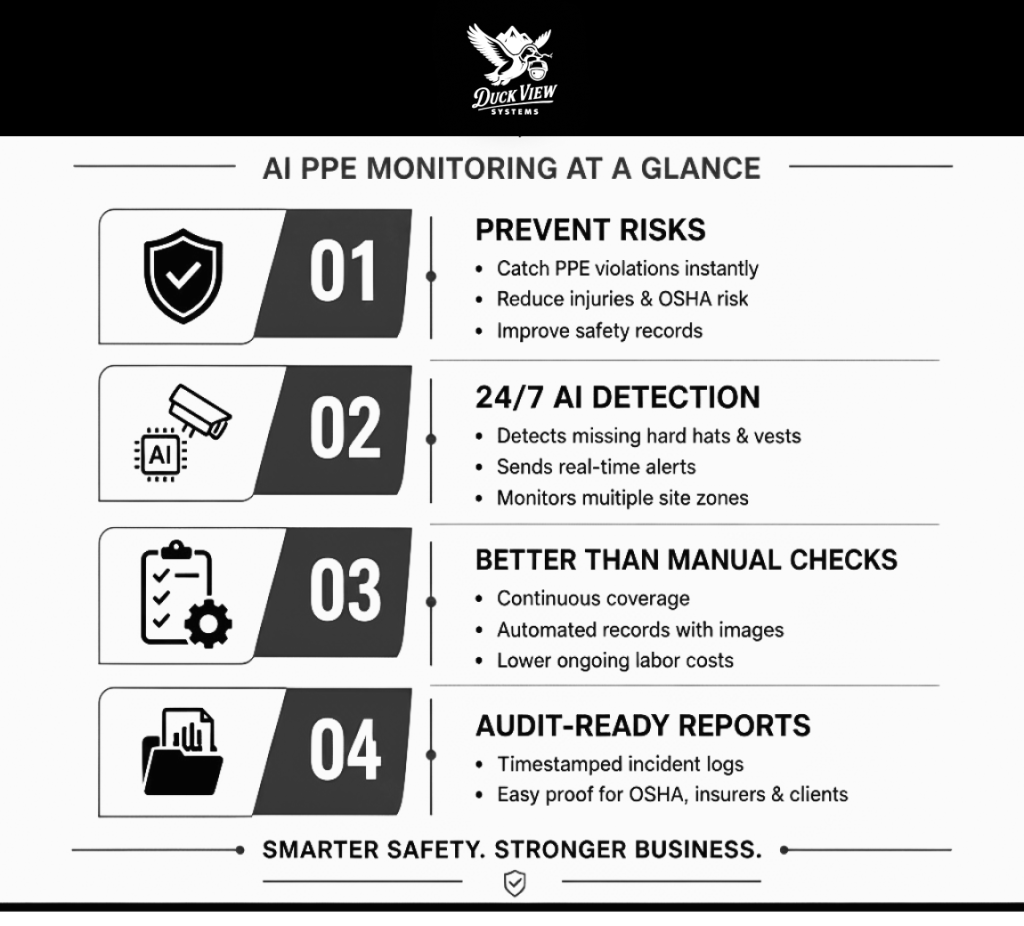
AI-based PPE detection works by continuously analyzing live video for the presence or absence of required gear on every person in frame. Our units run this analysis directly on live camera feeds, so a missing hard hat or vest generates an alert within seconds rather than waiting for a human reviewer.
Hard Hat and Vest Detection in Practice
The system identifies each person entering a monitored zone and checks for hard hats and high-visibility vests against the configured requirement for that area. When someone is missing required gear, the unit logs the event with a timestamp and still image, then routes an alert to the contacts you designate. This runs continuously across every zone the unit covers, not just the areas a supervisor happens to be walking past.
Detection accuracy depends on camera placement, lighting, and configuration, and we recommend confirming exact detection rates for your specific site layout with our team rather than assuming a blanket percentage. What we can state is the mechanism: continuous visual analysis replacing point-in-time human checks.
Detection runs on live footage from three 360-degree PTZ cameras with 25x optical zoom, giving the system a wide field of view along with the ability to zoom in on a specific worker or gate when an event needs a closer look. Because the analysis happens continuously rather than on a fixed schedule, the system catches a violation whether it occurs at 7 a.m. during setup or 4 p.m. during a shift change, without needing anyone to schedule an extra walkthrough for those windows.
Behavior Recognition Beyond PPE
PPE detection is one layer of a broader behavior recognition system that also watches for unsafe activity and unauthorized zone entry. AI Patrol runs automated coverage across every zone on a schedule, so a single unit maintains consistent visibility across a spread-out site instead of relying on one fixed camera angle. Restricted zones, active excavation areas, and crane swing radii can each carry their own detection thresholds, flagging entry the moment it happens rather than after a near miss gets reported verbally. The same platform also recognizes broader hazard indicators such as open doors, smoke, and unusual pacing near equipment, so PPE detection sits alongside a wider safety picture rather than functioning as an isolated tool.
AI Monitoring vs. Manual Walkthroughs vs. a Dedicated Safety Guard
AI PPE monitoring provides continuous, zone-wide coverage at a fraction of the cost of a dedicated safety presence, while a manual walkthrough only samples the site and a guard can only watch one area at a time.
| Factor | AI Surveillance Unit | Manual Walkthrough | Dedicated Safety Guard |
| Coverage window | Continuous, 24/7 | Point-in-time, a few checks per shift | One location at a time |
| Zones monitored per unit | Multiple, via automated patrol | Wherever the inspector currently is | Wherever the guard currently is |
| Record created | Timestamped log with image | Handwritten or verbal note | Verbal or written report |
| Works off-grid | Yes, solar and LTE | N/A | N/A |
| Ongoing labor cost | Fixed monthly rate | Part of existing staff time | Hourly or contracted rate |
None of this makes a safety guard or a supervisor’s walkthrough obsolete. A person can physically stop a worker, correct behavior on the spot, and make judgment calls a camera cannot. The strongest programs pair continuous AI detection to catch what happens between checks with a supervisor or guard who handles the in-person coaching and enforcement once an issue is flagged.
Turning Detections Into Audit-Ready Records
Every PPE detection becomes a timestamped, structured record instead of a note in someone’s notebook. Case Reporting compiles logged events, including PPE violations, into shareable reports with the supporting footage attached, ready to hand to an OSHA inspector, a client’s safety auditor, or your own internal review. This matters most during an inspection, when a contractor with a documented, automated enforcement pattern is in a materially different position than one with an inconsistent paper checklist. Keep in mind that automated PPE monitoring supports OSHA readiness and documentation; it does not itself guarantee compliance with every applicable standard, and site-specific requirements should still be reviewed with your safety officer.
These records also help outside of a regulatory context. When an insurance adjuster questions a claim, or a client asks for proof that a subcontractor enforces safety consistently, a folder of timestamped detection logs answers the question in minutes instead of requiring someone to reconstruct events from memory.
Specs, Deployment, and Cost for PPE Monitoring Units
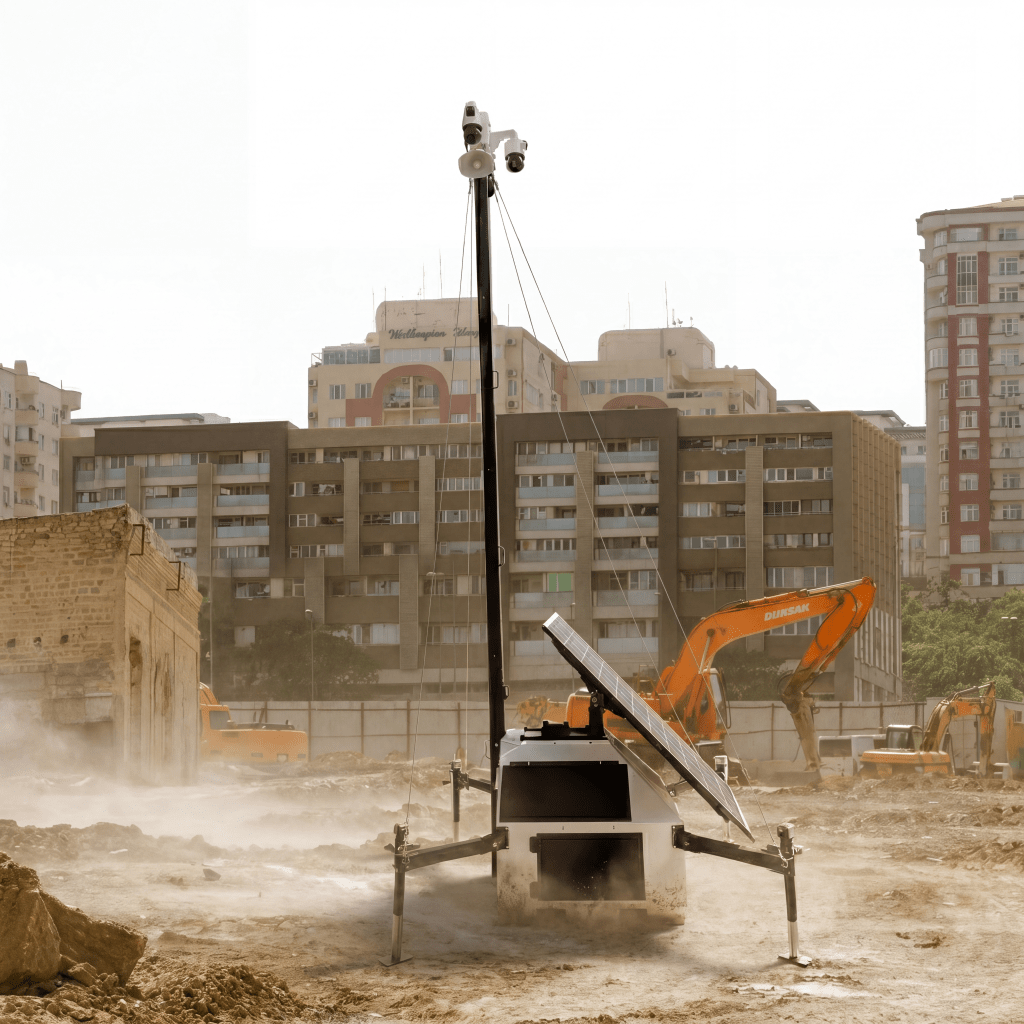
Our mobile surveillance unit deploys with a 5-by-5-foot footprint and a 20-foot mast, running fully off-grid on solar power with battery backup and LTE connectivity, and is typically operational in under an hour with no trenching or wiring.

Deploying a PPE Monitoring Unit in Under an Hour
Setup does not require existing power or Wi-Fi. The unit arrives field-ready, the mast raises to full height, and the solar array and LTE modem bring the system online the same day it lands on site. This matters for construction specifically, since PPE enforcement often needs to start on day one, before permanent utilities exist and before a site office is even set up.
Each unit also carries a dual-SIM cellular modem that switches automatically between two major carriers, an IP bullhorn for audio alerts, and tamper detection that flags any attempt to move or disable the equipment. None of this requires an electrician, a permit for wiring, or a scheduled utility hookup, which is exactly why teams use these units to start PPE enforcement before the rest of the site’s infrastructure is even in place.
| Spec | Verified Value |
| Footprint | 5 ft x 5 ft base |
| Mast height | 20 feet |
| Cameras | Three 360-degree PTZ, 25x optical zoom |
| Power | Solar with battery backup |
| Connectivity | LTE |
| Deploy time | Under an hour; same-day |
| Monthly pricing | $1,400 to $2,300 (most pay $1,650 to $2,000) |
Monitoring services, Starlink connectivity, and generator backup are available as add-ons that raise the monthly cost beyond the base range, and final pricing always depends on lease length, delivery distance, and site-specific factors. We publish these ranges rather than a single fixed price for exactly that reason, and route the exact figure to a quote based on your site.
Building an Automated Safety Program on Your Site
Rolling out automated PPE monitoring starts with mapping which zones require which gear, since a warehouse laydown area and an active excavation site may carry different requirements. From there, detection thresholds get configured per zone, alert routing gets assigned to the right safety contacts, and the unit begins logging from day one of deployment. Most contractors pair this with their existing safety program rather than replacing it. This aligns with the NIOSH Hierarchy of Controls, which recommends using multiple layers of hazard control, including administrative controls and personal protective equipment, rather than relying on a single safety measure. The system becomes the continuous layer that catches what a periodic walkthrough cannot, while your safety manager still owns training, orientation, and enforcement decisions.
A practical rollout typically covers three steps. First, walk the site with the deployment team to identify which zones need PPE detection and which need broader intrusion or behavior detection. Second, set alert routing so the right person, whether that is a site superintendent, a safety manager, or a monitoring center, gets notified the moment a detection fires. Third, review the first two weeks of detection logs together to confirm thresholds are tuned to your site’s actual conditions rather than a generic default.
For a broader look at how mobile surveillance protects a job site beyond PPE, including theft and after-hours monitoring, see our complete construction site surveillance guide.
What Teams Choose Duck View Systems For
Nate Salazar, Senior Director of Asset Protection & Safety at Sportsman’s Warehouse, has described Duck View Systems as a trusted partner with industry-leading AI expertise that has consistently exceeded expectations. Organizations also choose us for our rapid deployment, AI-powered real-time monitoring, and infrastructure-free installation, allowing teams to secure jobsites in under an hour without trenching or Wi-Fi. We manufacture our units in Kaysville, Utah, and build every unit around the same verified hardware: three 360-degree PTZ cameras with 25x zoom, solar power with battery backup, and LTE connectivity, deployable in under an hour with no trenching or Wi-Fi required.

Frequently Asked Questions
Can surveillance cameras detect missing PPE?
Yes. AI-powered cameras can identify whether a worker is wearing a required hard hat or safety vest and log the detection in real time, without a person reviewing footage manually.
Does AI PPE monitoring help with OSHA compliance?
It supports OSHA readiness by creating a timestamped, continuous record of PPE enforcement. It does not itself guarantee compliance with every applicable OSHA standard, so site-specific requirements should still be reviewed with your safety officer.
Does automated PPE monitoring replace a safety manager?
No. It gives a safety manager continuous visibility across every zone instead of point-in-time walkthroughs, but training, orientation, and enforcement decisions remain the safety manager’s responsibility.
What happens when the system detects a missing hard hat or vest?
The unit logs the event with a timestamp and image, then sends an alert to the contacts you designate so the situation can be corrected on site.
Do I need Wi-Fi or existing power to run PPE monitoring on a jobsite?
No. Duck View Systems units run fully off-grid on solar power with battery backup and LTE connectivity, so monitoring can start the same day the unit arrives, even on a site without utilities.
Can one unit monitor PPE across multiple zones on a large site?
Yes. AI Patrol runs automated coverage across multiple defined zones on a schedule, so a single unit maintains consistent visibility rather than watching only one fixed area.
Get PPE Compliance Monitoring for Your Site
Automated PPE monitoring transforms periodic safety walkthroughs into a continuous, documented record of compliance, helping your team identify and address violations that traditional checklists can miss without adding extra headcount. Ready to strengthen jobsite safety? Request a quote from us to find the right solution for your site, or book a demo to see AI-powered PPE detection in action before you commit.