

AI weapon and violence detection in surveillance uses computer vision to identify visual and behavioral indicators that may signal a developing threat, giving police departments and public safety agencies an earlier opportunity to assess what is happening. For agencies exploring mobile surveillance for events, perimeters, and high-crime areas, the goal is not simply to record an incident but to surface relevant activity while it is still unfolding. Duck View Systems describes these capabilities as part of its broader police and law enforcement surveillance solutions, where AI detection, real-time deterrence, and human verification work together to support faster situational awareness.
An AI threat detection surveillance trailer uses computer vision to flag behavioral indicators, such as loitering, perimeter breaches, and suspicious pacing, as they happen, then triggers an audio deterrent and sends a real-time alert so an officer can assess the scene immediately, instead of reviewing footage after an incident has already occurred.
Key Takeaways
- Detects behavioral and visual indicators: the system can flag defined behaviors and conditions, including loitering, intrusion, perimeter breaches, fighting behavior, and weapon visibility where configured for the deployment.
- Built and supported in the U.S.: Duck View Systems trailers are manufactured and supported out of Kaysville, Utah.
- Alerts happen in seconds: a flagged event can trigger the unit’s audio deterrent and push a real-time alert to the assigned officer or dispatcher.
- Works day or night, on or off grid: solar-plus-battery power and dual-SIM LTE keep detection running at events, hot spots, and remote posts without wired power.
- Every detection is documented: flagged events are logged with time-stamped footage for later review or case reporting.
How AI Weapon Detection in Surveillance Works
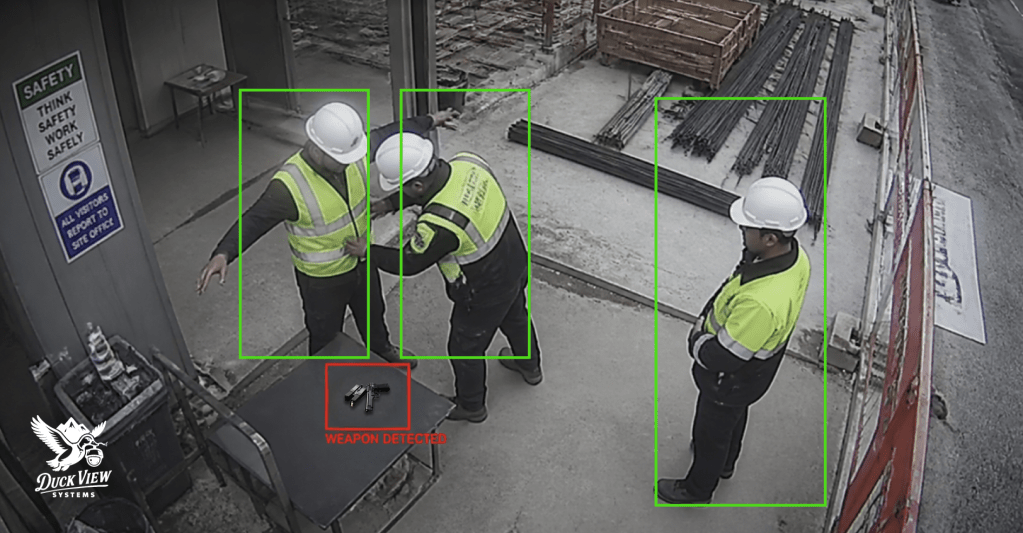
AI threat detection on a mobile surveillance trailer runs computer vision models against a live camera feed, comparing what the cameras see against learned behavior patterns instead of waiting for someone to review recorded video later. Each Duck View Systems unit carries three 360-degree PTZ cameras with 25x optical zoom mounted on a 20-foot mast, giving the AI a wide, elevated field of view across roughly 2 to 3 acres per trailer. The system processes that feed continuously, watching for the same categories of behavior an experienced officer would notice on a walk-through: someone lingering near a fence line, a person cutting across a restricted perimeter, or a vehicle circling a lot longer than a normal visit.
When the AI matches activity to one of those learned patterns, it does not just log the event. It can trigger the unit’s IP bullhorn speaker and LED strobe as an immediate on-site deterrent, and it pushes an alert to whoever is monitoring the feed, whether that is an agency dispatcher, an integrator’s monitoring center, or an officer’s phone. This is the core difference between a trailer built for real-time threat detection and a standard security camera: the unit interprets behavior as it happens rather than only capturing it.
| Spec | Verified detail |
| Footprint / mast | 5 ft x 5 ft base; 20-foot mast; deployable outriggers |
| Cameras | Four camera feeds; three 360-degree PTZ cameras, 25x zoom, night vision |
| Coverage per unit | Up to 2 to 3 acres, layout dependent |
| Power / connectivity | Solar with battery backup; dual-SIM LTE modem with auto-switch |
| Deploy time | Under one hour; same-day |
| Deterrents | IP bullhorn speaker; white/blue LED strobe |
Detection does not rely on a single fixed angle. Sentry Mode drives the PTZ cameras through autonomous scanning across multiple zones on the same trailer, so a single unit can watch an entrance, a fence line, and a parking area without an operator manually steering the camera. That matters for departments covering a large event footprint or a multi-block hot spot with a limited number of units. Instead of choosing one view to monitor, the trailer rotates through its assigned zones, applies the same behavioral models to each one, and still reacts within seconds when it flags loitering, an intrusion, or another learned pattern.
What the AI Detects
The AI on a Duck View Systems surveillance trailer detects a defined set of verified behaviors and conditions, not an open-ended list of anything a camera might see. Detections currently confirmed for law enforcement and public safety deployments include:
- Loitering, when a person or group lingers in one area beyond a set time threshold, useful for flagging a lingering presence near a checkpoint or entrance before it becomes a bigger problem
- Intrusion and perimeter breaches, when someone crosses into a restricted or fenced zone, such as a search perimeter or a secured event boundary
- Suspicious pacing, when movement patterns repeat in a way that differs from normal foot traffic, such as someone circling the same block or entrance repeatedly
- Vehicle type and color, useful for tracking vehicles of interest at a hot spot or event perimeter without requiring a plate read
- Open doors on unattended structures, equipment, or storage, flagged so a department knows a site was accessed while units were away
- Smoking in restricted or high-risk areas, including near fuel storage or posted no-smoking zones at an event
- Graffiti and vandalism, flagged through behavior pattern recognition at the moment it occurs rather than discovered on the next patrol
Continuous coverage of that detection list runs through AI Patrol, which cycles the trailer’s cameras through a scheduled or adaptive route across preset zones. Rather than relying on one static view, AI Patrol keeps every zone on rotation, applying the same detection logic to each stop and logging metadata on what it observed, so a department gets consistent coverage across an entire site or event footprint instead of a single camera angle. Operators can adjust the route points, dwell time, and zoom level at any point, so the patrol pattern can be reset between a hot-spot assignment and an event without redeploying hardware.
Recognizing Fighting Behavior
AI violence detection analyzes movement patterns associated with physical altercations, including aggressive motion, rapid body movements, and interactions between people. Research published in Scientific Reports in 2025 demonstrates how real-time fistfight detection can combine RGB video with human body-pose data to analyze spatial and temporal movement patterns associated with violent behavior. These research findings support the broader use of computer vision for violence detection, while real-world deployments still require appropriate configuration and human verification.
Detecting Stabbings and Sharp-Object Threats
AI surveillance systems can analyze motion patterns associated with weapon-related incidents, including rapid arm movements, posture changes, and close-contact aggressive behavior. Duck View Systems describes stabbing detection and sharp-object threat detection as public-safety capabilities that can help flag rapid arm motions and posture shifts associated with potential edged-weapon incidents. These alerts provide additional situational awareness, but human verification remains essential before officers determine the appropriate response.
Recognizing Loitering and Suspicious Pacing
Loitering and suspicious pacing detection work by tracking how long a person stays in a zone and whether their movement repeats in an irregular pattern, such as circling a building entrance or crossing the same fence line multiple times. Agencies commonly use this at event perimeters and hot-spot locations where a lingering presence, rather than a single visible object, is the first sign something is worth an officer’s attention.
Flagging Intrusion and Perimeter Breaches
Intrusion and perimeter breach detection draws a virtual boundary around a restricted zone and flags the moment someone crosses it, whether that boundary is a fence line, a building perimeter, or a designated no-go area at an event. Because the boundary is software-defined through Focus Mode, it can be adjusted between deployments without moving hardware, which matters for temporary posts like a search perimeter or an event footprint that changes from one weekend to the next.
From Detection to Response in Seconds

From detection to response, the trailer moves through four steps automatically, with an officer or dispatcher making the final call on escalation.
- Detect. The AI flags a behavior match, such as an intrusion or extended loitering, against the live camera feed.
- Verify. The system captures time-stamped footage of the event so a dispatcher or officer can confirm what triggered the alert before responding.
- Alert and deter. The unit can trigger its loudspeaker audio deterrent and LED strobe on-site, while pushing a real-time notification to the monitoring team.
- Escalate. Departments route alerts through Virtual Guard, their own dispatch, or directly to a patrol officer’s phone, so the trailer never makes an enforcement decision on its own.
This hand-off between video analytics and human responders is an important part of public-safety deployment. NIST research on public-safety video analytics notes that detecting an abnormal situation is only part of the challenge. The resulting information also needs to reach the right people at the right time and work within the complex video, information-management, and communications systems used by public safety agencies. That reinforces why an AI alert should support an established response workflow rather than operate as a standalone enforcement decision.
Reducing False Alarms with Context Analysis
Reducing false alarms starts with context, since a system that treats every moving object as a threat quickly gets ignored by the people it is supposed to alert. Configurable thresholds are what keep detection useful instead of noisy. A department can set how long someone must linger before loitering triggers an alert, or draw adjustable detection boundaries with custom priority zones around only the areas that matter, such as an event entrance or a fenced equipment yard, so normal pedestrian and vehicle traffic outside those zones does not generate alerts.
Research from the National Institute of Justice on implementing video analytics in a public surveillance network highlights the importance of strategic camera placement, active monitoring, system integration, and agency-specific implementation. These considerations support a workflow in which automated alerts help direct attention to relevant activity while personnel remain responsible for reviewing and responding to events.
Tuning looks different depending on the deployment. A hot-spot unit watching a corridor overnight might use a short loitering threshold, since almost no one has a reason to stand still there after hours. The same unit covering a festival entrance during the day needs a longer threshold and a tighter perimeter boundary, since crowds naturally slow down and cluster near gates. Setting those thresholds is a configuration step worked out with the department, not a fixed setting built into the hardware, which is why the same trailer can move from a hot spot to an event without any hardware change.
Deploying AI Threat Detection for Events, Hot Spots, and Remote Areas
Deploying AI threat detection away from a fixed camera network usually comes down to power and connectivity, and a solar-powered trailer solves both. A unit can go live at a festival perimeter, a hot-spot corridor, or a rural search area the same day it arrives, without waiting on a wiring crew or a network build-out. For an event commander or a hot-spot policing team, that means the same behavioral detection running at headquarters can follow the operation to wherever it is needed next.
Supporting Hot Spots and Event Perimeters
Hot-spot policing and event coverage both call for the same thing from a mobile unit: consistent detection over an area larger than one officer can watch, without a permanent install. At a designated hot spot, a trailer can hold position for days or weeks, flagging loitering and suspicious pacing along a corridor a department is actively working to deter. At a parade, festival, or planned demonstration, the same detection logic runs across an event perimeter, and the trailer can be relocated between posts as the footprint changes from setup to teardown. In both cases, the unit adds continuous automated coverage alongside the officers already assigned, rather than asking a department to choose between staffing a post and watching it.
Covering Off-Grid and Temporary Deployments
Off-grid and temporary deployments work because each unit runs on solar with battery backup and a dual-SIM LTE modem, so it can go live on a bare lot, a rural hot spot, or an event site before permanent power or network infrastructure exists. Deployment takes under an hour, and the trailer can be relocated for the next event, patrol area, or search perimeter without treating each location as a permanent camera install. After an event or operation, flagged clips and general footage are both searchable through Natural Language Search, so a detective or analyst reviewing a case can pull a description like “person near the north gate at 9 PM” instead of scrubbing hours of recorded video. That real-time-not-rewind approach, combined with automated Case Reporting, gives a department both the immediate alert and the documentation trail an incident review needs later.
Frequently Asked Questions About AI Threat Detection
Can AI actually detect a weapon before it’s used?
AI weapon detection can identify certain visual or behavioral indicators associated with potential weapon-related incidents, but it should not be treated as a guarantee that every weapon will be recognized before it is used. Duck View Systems describes weapon visibility, fighting behavior, and stabbing detection as public-safety detection capabilities, while human personnel remain responsible for verifying alerts and determining the appropriate response.
How does the system avoid false alarms?
Detection thresholds are configurable per zone, so a department can set how long a person must linger or which areas trigger an alert at all. Every flagged event is captured with time-stamped footage so a dispatcher or officer can confirm what happened before responding, rather than acting on the alert alone.
How fast does an alert reach officers?
Alerts push to the monitoring team in real time as soon as the AI flags a behavior match, and the unit can trigger its audio deterrent and LED strobe on-site at the same moment. How quickly an officer physically responds still depends on the department’s own escalation path and staffing, since the trailer notifies people rather than dispatching units itself.
Does AI threat detection work at night?
Yes. Each PTZ camera includes night vision, so behavior detection continues after dark without relying on ambient lighting. Departments planning extended night operations or needing dedicated thermal coverage should discuss camera configuration with a Duck View Systems representative to match the deployment to their specific post.
See AI Weapon Detection Surveillance in Action with Duck View
AI weapon detection surveillance can give public safety teams earlier awareness of fighting behavior, suspicious activity, perimeter breaches, weapon visibility, and other potential threats. Its value depends on appropriate configuration, reliable alerts, and human verification, allowing AI to support situational awareness without replacing officer judgment.
If your department is evaluating AI weapon and violence detection for an event perimeter, hot-spot corridor, or other temporary deployment, talk with Duck View about the detection capabilities and configuration that fit your environment. Request a demo to see how the system can support real-time threat awareness and help your team respond with better information.