
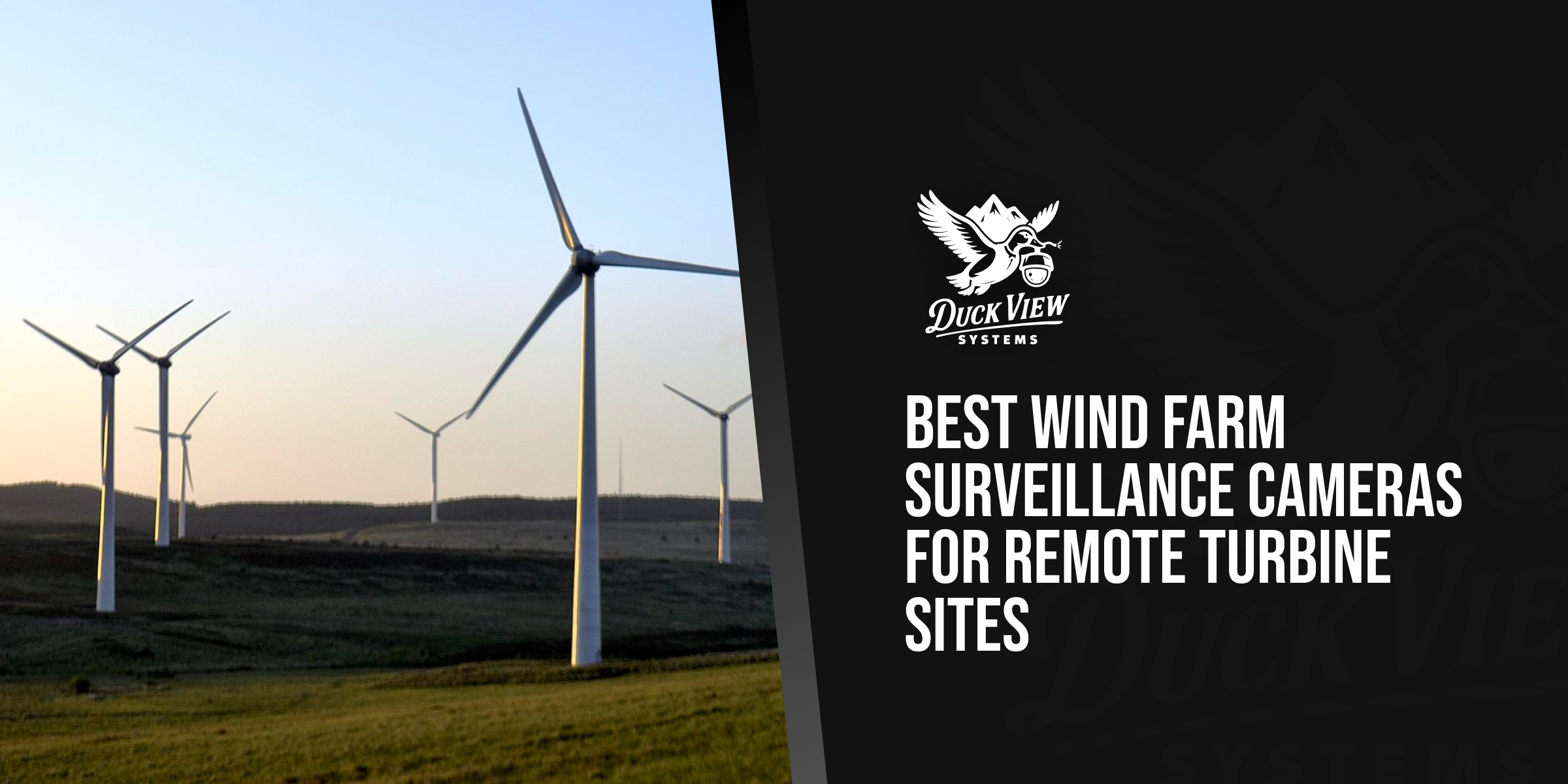
Wind farms stretch across miles of open terrain. Turbines stand in isolated clusters, connected by long access roads and surrounded by little more than grassland, cattle, and weather. Traditional security cameras were never designed for this environment.
Choosing the right wind farm surveillance cameras means understanding the unique demands of these sites and matching them with technology built to perform without infrastructure, without Wi-Fi, and without a permanent power source.
Read on to learn the camera types, connectivity options, and AI-powered features that actually work at wind turbine sites.
Why Standard Surveillance Cameras Fail at Wind Farms
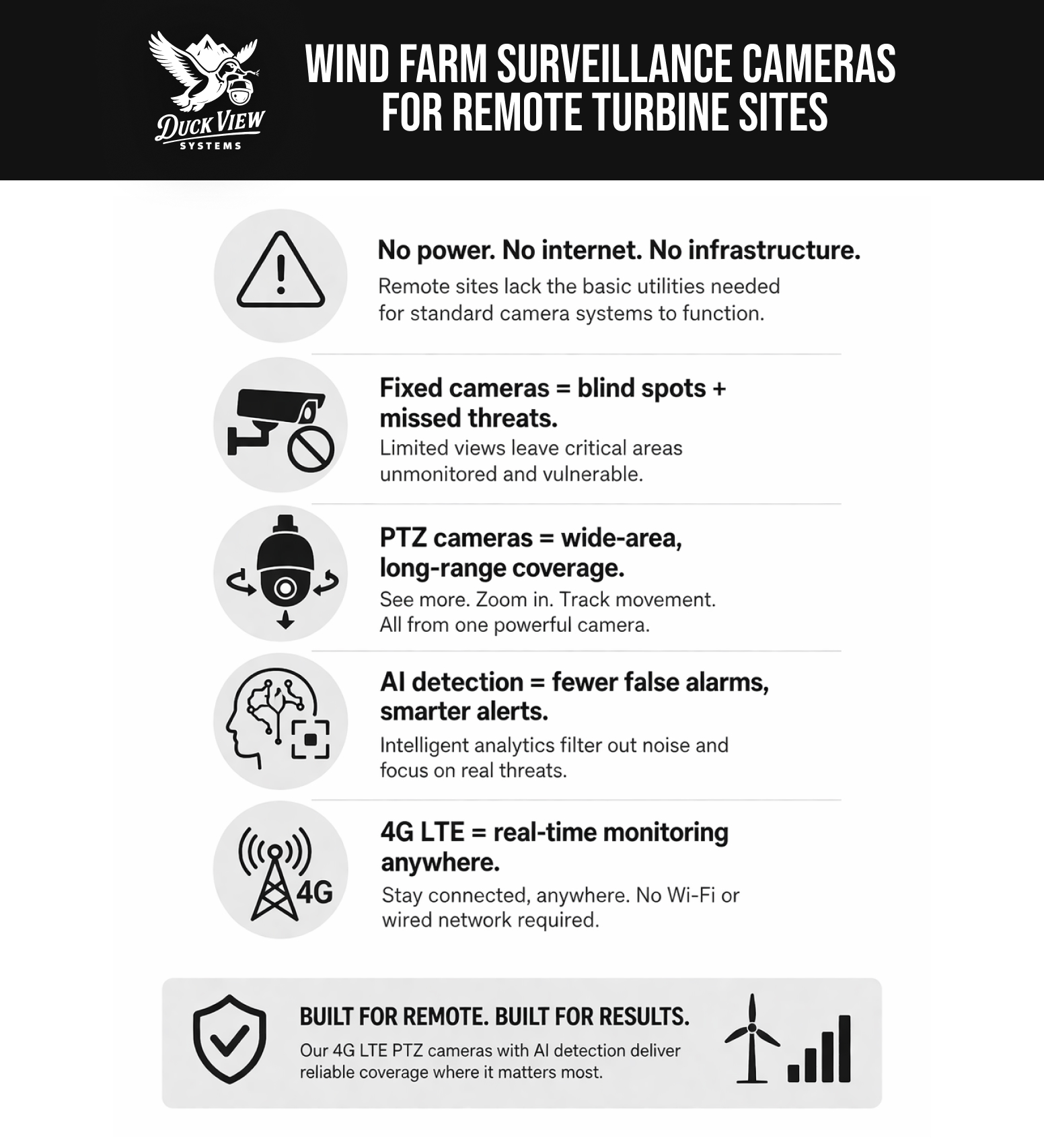
Most commercial security cameras assume three things: stable power, reliable internet, and a permanent mounting structure. Wind farms offer none of these. This is why specialized wind farm surveillance cameras are necessary.
Turbine sites are spread across vast acreages with no buildings to mount equipment on. There is no fiber-optic line running to a turbine pad. Grid power may only be available at the substation, miles from the areas that need monitoring most.
Fixed cameras bolted to a fence post at one corner of the site leave enormous blind spots. They cannot track a vehicle moving down an access road or zoom into a substation gate a quarter mile away. And without network connectivity, the footage sits on a local hard drive that nobody checks until after a theft has already occurred.
PTZ Cameras
360-Degree Coverage From a Single Unit
Pan-Tilt-Zoom (PTZ) cameras are the backbone of effective wind farm surveillance. A single PTZ camera mounted on an elevated mast can monitor a far larger area than multiple fixed cameras combined.
Here is what makes PTZ cameras ideal for turbine sites:
- 360° continuous pan covers every direction without repositioning
- Vertical tilt range allows monitoring from ground-level fences to elevated cable trays
- 25x optical zoom can identify a person or license plate at long distances
- Infrared night vision illuminates up to 500 ft in total darkness
Duck View’s mobile surveillance trailers mount a 4MP 25x Optical Zoom PTZ IP camera on a 20-foot telescoping mast. That elevated vantage point transforms a single camera into a wide-area monitoring tool capable of covering turbine clusters, access gates, and laydown yards from one position.
AI Detection
Eliminating False Alarms in Open Terrain
A camera without intelligence is just a recording device. At a wind farm, where cattle roam, wildlife crosses freely, and vegetation moves constantly in the wind, a motion-activated camera would trigger hundreds of false alerts per day.
AI-powered detection solves this problem by classifying what it sees. Instead of reacting to motion, the system identifies whether the object is a person, a vehicle, or an animal with over 95% accuracy.
How AI Detection Works at Wind Farm Sites
| Feature | What It Does |
|---|---|
| AI Perimeter Zones | Virtual boundaries drawn around substations, BESS compounds, or turbine pads that trigger alerts only when a person or vehicle enters |
| AI Patrol | Automated PTZ camera tours across predefined checkpoints on a scheduled route, generating event summary reports |
| Natural language search | Natural language search to find specific footage instantly, like “white truck near gate” |
| Virtual Guard | Live escalation to a trained monitoring professional who verifies threats and issues real-time voice warnings |
This AI layer is what separates passive recording from proactive security. Duck View units powered by the Alpha Vision platform detect, classify, and respond to threats autonomously, around the clock.
4G LTE Transmission: Connectivity Without Infrastructure
The biggest technical challenge at any wind farm is getting video off the camera and into the hands of someone who can act on it. Without Wi-Fi or Ethernet, the answer is cellular.
Duck View surveillance trailers include a built-in 4G/LTE cellular modem with multi-carrier support, making them ideal wind farm surveillance cameras. The system automatically locks onto the strongest available carrier signal, ensuring connectivity even in rural corridors where one network may have weak coverage.
What LTE Connectivity Enables
- Live remote viewing from any device, anywhere in the world
- Real-time AI alerts are pushed instantly to security teams when a threat is detected
- Cloud-based video backup through Alpha Vision Cloud for long-term evidence storage
- Two-way audio communication allowing live voice-down warnings to intruders on site
No satellite dish. No trenching for cable. No reliance on a single carrier. The unit connects itself the moment it powers on.
Solar Power: The Only Viable Power Source for Turbine Sites
Running power cables to a camera at a remote turbine pad is impractical and expensive. Generators require fuel deliveries and create noise that disrupts wildlife monitoring and nearby residences.
Solar-powered surveillance is the only solution that provides true energy independence at wind farm sites. Duck View units use high-efficiency solar panels paired with industrial-grade deep-cycle AGM batteries to operate continuously, day and night.
| Configuration | Solar Capacity | Battery Capacity | Use Case |
|---|---|---|---|
| Standard | 2x 450W panels | 400Ah | Sites with consistent sunlight |
| Extended | 4x 450W panels | 800Ah | Sites requiring multi-day autonomy through cloudy weather |
Zero fuel costs. Zero emissions. Zero noise. The surveillance system runs on the same clean energy philosophy as the wind farm itself.
Active Deterrents: Stopping Threats Before They Escalate
Detection alone is not enough when law enforcement response times to remote wind farm sites can exceed 30 minutes. The camera system needs to intervene immediately.
Duck View trailers include built-in active deterrents that engage automatically when the AI confirms a threat:
- High-intensity LED floodlights that illuminate the intrusion area
- Blue and red LED strobe lights for visible warning
- Weatherproof loudspeaker for pre-recorded warnings or live talk-down from a Virtual Guard operator
When an intruder hears their description called out over a loudspeaker in real time, they know they have been identified. That immediate, personalized response is what stops incidents before property is damaged or assets are stolen.
Matching Camera Placement to Wind Farm Assets
Different areas of a wind farm require different surveillance priorities. Here is where to position your cameras for maximum coverage:
- Substations and BESS compounds — highest asset value, permanent camera placement recommended
- Access gates and road entry points — capture every vehicle entering or leaving the site
- Laydown yards — protect stored materials and equipment during construction phases
- Turbine clusters — deter unauthorized climbing and vandalism at tower bases
- Cable trench routes — monitor exposed copper during installation
Duck View’s mobile surveillance trailers can be repositioned in under an hour by a single person, making it easy to shift coverage as construction progresses or operational priorities change.
Choosing the Right Wind Farm Surveillance Cameras
Wind farm surveillance cameras need to do more than record. They need to see in the dark, connect without Wi-Fi, run without grid power, distinguish a coyote from a copper thief, and respond to threats instantly.
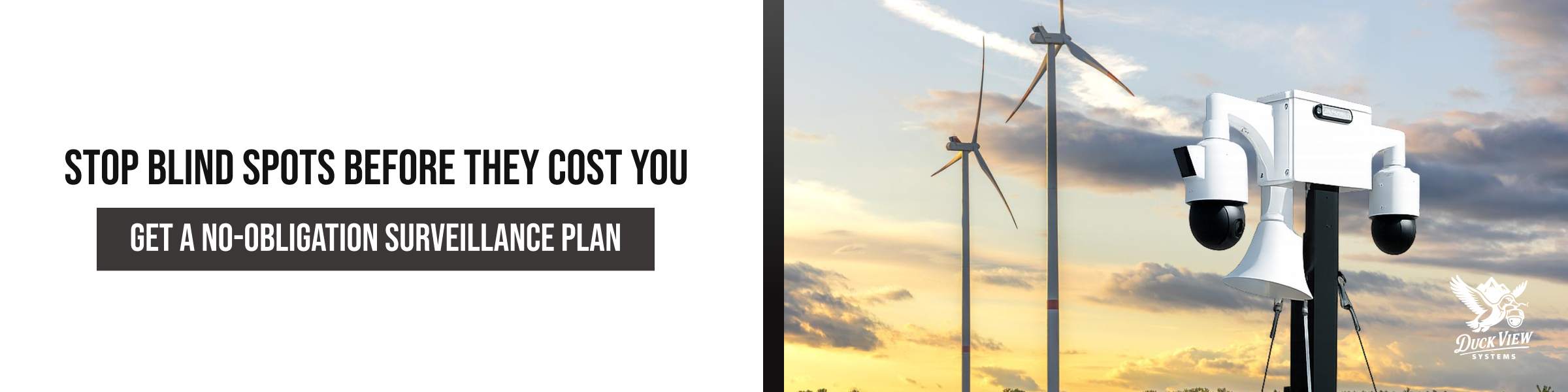
Duck View Systems’ AI-powered solar mobile surveillance trailers combine PTZ optics, AI-driven detection, 4G LTE connectivity, and active deterrents into a single self-contained unit that deploys anywhere on your site in under an hour.
Ready to secure your wind farm? Request a quote and get a surveillance plan tailored to your site.
Frequently Asked Questions About Wind Farm Surveillance Cameras
What type of cameras work best for wind turbine sites?
PTZ cameras with AI detection and 4G LTE connectivity are ideal. They cover 360°, filter false alarms from wildlife, and transmit footage without Wi-Fi or wired internet.
Can wind farm surveillance cameras operate without grid power?
Yes. Solar-powered mobile surveillance trailers run entirely off-grid using high-efficiency solar panels and deep-cycle batteries, providing continuous 24/7 monitoring at remote turbine locations.
How do wind farm surveillance cameras reduce false alarms?
AI-powered analytics distinguish between humans, vehicles, and animals with over 95% accuracy. The system only alerts on genuine threats, ignoring cattle, birds, and weather-related movement.
What areas should wind farm surveillance cameras cover first?
Prioritize substations, BESS compounds, and access gates. During construction, focus on laydown yards and cable trenching zones where copper theft risk is highest.
Can surveillance cameras be relocated as wind farm construction progresses?
Absolutely. Mobile surveillance trailers deploy in under an hour and can be towed to new positions whenever the work zone or threat profile shifts.
How far can wind farm surveillance cameras see at night?
PTZ cameras equipped with infrared illumination provide clear visibility up to 500 feet in complete darkness, enough to identify intruders approaching turbine pads or substation perimeters.