
A surveillance missing person search often requires fast, wide-area coverage across unfamiliar terrain, rural roads, trailheads, parking lots, and other locations where fixed cameras or wired infrastructure may not exist. Duck View Systems builds American-made, solar-powered mobile surveillance trailers that deploy in under an hour and provide elevated PTZ camera coverage, LTE connectivity, and AI-powered video analysis for temporary search operations.
Surveillance trailers can support missing person searches by providing a fixed, elevated view of a search area while Natural Language Search helps coordinators locate relevant footage using descriptions of people, clothing, vehicles, or other visible characteristics. Solar power, battery storage, and LTE connectivity also allow the unit to operate in remote locations without relying on on-site Wi-Fi or wired power. The trailer supplements physical search teams and official missing-person response systems rather than replacing them.
- Natural Language Search lets searchers type a plain description, such as “red jacket, no shoes,” and pull matching clips instantly.
- Mobile surveillance trailers provide elevated PTZ coverage and can deploy in under an hour without trenching or wired power.
- Multi-SIM cellular connectivity helps maintain uptime in remote search areas where one network is weak.
- Case Reporting compiles time-stamped footage into a shareable report for multi-agency search coordination.
- Duck View Systems units support AMBER Alert and time-critical search efforts without replacing official alert systems.
How Surveillance Trailers Support Missing Person Searches
Our mobile surveillance trailers support missing person searches by adding a mobile, AI-monitored vantage point wherever search coordinators need one, whether that is a trailhead, a rural county road, or a retail parking lot near the last confirmed sighting. Traditional patrol coverage thins out fast once a search radius grows past a few blocks, and officers on foot cannot hold a fixed, elevated view over hours of searching. We raise a 20-foot mast with PTZ camera coverage configured for the deployment, giving searchers a continuous, zoomable view of the area around a command post or a suspected route.
Traditional cameras can provide valuable live views and recorded footage, but reviewing hours of footage manually can slow a time-sensitive search. Duck View’s AI-powered features are designed to help search teams identify activity and retrieve relevant footage faster, while Sentry Mode can continuously scan multiple zones using autonomous PTZ movement and AI activity detection. This gives command staff another layer of continuous visual coverage without requiring an operator to manually steer the camera at every moment.
This kind of expanded visual coverage can complement official resources such as the Department of Justice’s National Missing and Unidentified Persons System, which provides a centralized database along with technology, investigative support, forensic services, and information-sharing resources for missing and unidentified person cases.
A command post benefits from that coverage in a specific way: instead of dispatching officers to walk a perimeter and report back, a coordinator can watch the same ground live from a single screen. Our solar array and battery system are designed to support overnight operation and, depending on configuration and power demand, extended periods of limited sunlight without relying on a generator. Weather resilience matters here too, since a search rarely pauses for a passing storm, and we build our trailers with rugged housing that keeps recording through wind, rain, and temperature swings.
Finding People Fast with Natural Language Search
Our Natural Language Search feature finds a missing person by letting searchers type a plain-language description instead of scrubbing hours of raw footage frame by frame. A coordinator can enter a phrase like “red jacket, no shoes” or “elderly man, blue cap, walking north,” and our platform returns matching clips from every connected trailer in seconds. This turns a search team’s most valuable resource, time, into something we help protect instead of consume.
The feature indexes people, vehicles, and objects as they are recorded, so a description entered an hour into a search still surfaces footage captured before the search began. For agencies coordinating with volunteers, media, or neighboring departments, we’ve built Natural Language Search to shorten the gap between a tip and a confirmed sighting.
Searching by Description to Locate a Missing Person
Search coordinators do not need technical training to use Natural Language Search effectively. A typed phrase describing clothing color, an approximate age, a direction of travel, or a vehicle type is enough for our system to surface matching clips. Because our platform reviews footage from every linked trailer at once, a description entered at a command post can return results from a unit positioned a mile away without anyone manually switching camera feeds.
To see Natural Language Search find a person by description in real time, book a demo with us before your next planned deployment or training exercise.
Consider a typical scenario: a search begins with a partial description from a 911 call, a jacket color, and a rough age range, nothing more specific. Under manual review, an analyst would need to scrub through every camera’s footage by hand, hour by hour, hoping to spot a match. With our Natural Language Search, that same partial description becomes a query our system runs against every trailer in the field at once, returning candidate clips in seconds instead of hours. As new details come in from witnesses, the coordinator simply re-runs the search with the updated description.
Deploying Units in a Search Operation

Deploying one of our surveillance trailers in a search operation follows a short, repeatable sequence we built for time pressure. The steps below take a unit from arrival to active monitoring:
- Position the trailer near the command post or the last confirmed location, then raise the 20-foot mast and outriggers.
- Confirm solar, battery, and multi-SIM cellular connectivity, so the unit stays online even where cell coverage is thin.
- Activate Sentry Mode so the cameras begin autonomous scanning of the surrounding perimeter while search teams move on foot.
- Enter a description of the missing person into Natural Language Search as soon as one is available, so incoming footage is tagged and searchable immediately.
- Monitor real-time alerts and compile relevant clips for search leadership or partner agencies as the operation continues.
Most of our units are field-ready within an hour of arrival, which matters when every additional hour narrows the odds of a fast recovery. That same sequence works whether the trailer is supporting a single-officer search along a rural road or a coordinated, multi-agency response with volunteers, K-9 units, and aircraft. We don’t see our trailers as a replacement for any of those resources; instead, we give them a shared, elevated view of the ground they are already covering, and a searchable record of everything the cameras capture along the way.
Covering Wide or Remote Search Areas
Search areas rarely sit next to existing infrastructure, and that is where off-grid deployment matters most. Our trailers run on solar power with battery backup, so they don’t need trenching, a generator delivery, or a nearby outlet. Multi-SIM cellular connectivity helps maintain uptime in remote search areas, adding network redundancy where one network is weak.
This combination lets us deploy a trailer the same day on a remote trailhead, a farm access road, or an open field, well before permanent power or Wi-Fi could ever reach the site. For departments considering overnight operation or performance during cloudy conditions, our guide to solar-powered surveillance trailers explains how the system uses solar generation and battery storage to support continued operation.
That reach matters as much as the coverage itself. A trailer that can only deploy where power and internet already exist is of little use once a search moves past the edge of town, and most missing person cases do exactly that. Because the system does not require trenching or wired power, teams can reposition a unit as the search area changes without waiting for a permanent infrastructure installation.
Why Elevated Camera Placement Matters During a Search
An elevated camera position helps search teams monitor more ground with fewer visual obstructions. We mount our cameras on a 20-foot mast, so a surveillance trailer can see over parked vehicles, roadside barriers, fencing, brush, and other obstacles that commonly block ground-level cameras. This wider perspective allows operators to identify movement across open spaces, trail intersections, parking lots, and access roads without constantly repositioning equipment.
Height also improves situational awareness during large search operations. Instead of focusing on a single pathway, operators can observe multiple approach routes simultaneously while coordinating with officers, volunteers, or K-9 teams working below. If a search area expands, the same elevated viewpoint keeps providing continuous visual coverage until we relocate the trailer.
Night operations benefit as well. Combined with PTZ cameras and infrared capability, the elevated position reduces blind spots that become more difficult to monitor after dark. We don’t see a camera as a replacement for physical searching, but maintaining a continuous overhead view helps command staff monitor search progress, identify areas requiring additional attention, and document activity throughout the operation.
What a Search-Ready Surveillance Trailer Includes
We build every search-ready surveillance trailer around verified hardware and a deployment profile built for speed and remote power: fast setup, wide coverage, and dependable connectivity in areas without existing infrastructure. The table below lists the specs search coordinators should confirm before a deployment.
| Spec | Verified Detail |
| Footprint/mast | 5-by-5-foot base; 20-foot mast; deployable outriggers |
| Cameras | Four camera feeds; configuration-dependent PTZ cameras with up to 25x optical zoom and night vision |
| Coverage per unit | Coverage varies by site layout, camera positioning, and configuration |
| Power/connectivity | Solar with battery backup; multi-SIM cellular connectivity; Starlink optional |
| Deploy time | Under an hour |
| Storage | High-resolution, time-stamped footage with automated incident documentation and exportable reports |
Beyond the base hardware, our AI Patrol feature adds automated, multi-zone scanning across a search perimeter without requiring someone to manually steer the camera, which frees searchers to focus on the ground instead of the feed. Together, these specs mean a single trailer can stand in for hours of manual scanning across a search radius that would otherwise take multiple officers to cover on foot.
The 20-foot mast is worth calling out on its own. At that height, a PTZ camera clears most fence lines, parked vehicles, and low brush that would block a ground-level view. That gives searchers a genuine sightline across open terrain, a parking area, or a tree line instead of a series of blind spots. Combined with up to 25x optical zoom, that elevation can help an operator examine a distant detail, such as a jacket color, vehicle characteristic, or other visible feature, without immediately repositioning personnel closer to the area.
Supporting AMBER Alerts and Time-Critical Cases
Our trailers support AMBER Alerts and other time-critical cases by adding a fast, wide-area vantage point alongside the official alert system, not by replacing it. When an AMBER Alert or another missing-child case is activated, every hour matters. A trailer positioned near a suspected route or a search perimeter can flag matching vehicles or pedestrian activity while broadcast alerts do their work across radio, television, and wireless emergency systems.
For additional missing-child resources, agencies can also reference the National Center for Missing & Exploited Children, which provides resources and information for missing children and supports the broader national response to missing-child cases.
Our Focus Mode feature lets an operator zoom in on a vehicle plate, a jacket color, or a distinguishing detail the moment the camera catches it, then hold that view for verification. Virtual Guard can add a live audio deterrent or a two-way audio check if the system flags unusual activity near a search perimeter, without requiring an officer to be physically present at every zone. None of this replaces AMBER Alert distribution or a department’s existing protocols; we designed it to add a monitored, time-stamped layer of coverage while those official channels run.
We want to be direct about what a trailer cannot do. It cannot walk a trail, interview a witness, or physically search a building, and we don’t think any of those tasks should be handed off to a camera. What it does well is hold a fixed, wide vantage point continuously, something no single officer or volunteer can do for an entire search without rotating out. Used together, officers and volunteers cover the ground while the trailer covers the sky-level view, and each strengthens the other instead of one substituting for the other.
Sharing Footage Across Agencies During a Search
Search operations frequently involve more than one agency, and we built Case Reporting for that handoff. The feature compiles time-stamped clips, notes, and event logs into a single shareable report, so a neighboring department, a search-and-rescue team, or a media liaison can review the same footage without requesting raw files or scrubbing a live feed themselves. This keeps the chain of documentation intact while the search is still active.
Multi-agency searches often stall on logistics as much as on the search itself: who has the footage, how it gets shared, and whether a partner agency’s format matches the requesting department’s system. A compiled, time-stamped report sidesteps most of that friction. We built it to be reviewed by anyone with access rather than exported and reformatted for each new recipient. That matters most in the early hours of a search, when coordination speed can matter as much as coverage.
Frequently Asked Questions About Search Surveillance
How does natural language search find a missing person?
Natural Language Search finds a missing person by matching a typed description, such as a clothing color or an approximate direction of travel, against footage already indexed by the system. Search coordinators can query every connected trailer at once instead of reviewing each camera’s footage individually, which can significantly reduce the amount of manual footage review required. Updated descriptions can be re-searched at any point as new witness details come in.
Can trailers be deployed quickly during a search?
Absolutely. Duck View Systems trailers are field-ready and typically deploy in under an hour, including raising the mast and confirming solar, battery, and LTE connectivity. Many searches can begin the same day the trailer arrives, since no trenching or wired power is required, and the same unit can be repositioned quickly if the search area shifts.
Do units work in remote areas without power?
Yes. Each trailer runs on solar power with a battery backup and connects through an onboard multi-SIM cellular modem, so it operates in remote search areas without existing power or Wi-Fi infrastructure. The system automatically switches carriers to maintain connectivity where one network is weak.
Can footage be shared with other agencies during a search?
Yes. Case Reporting compiles time-stamped footage, notes, and event logs into a shareable report that partner agencies, search-and-rescue teams, or command staff can review without accessing raw camera feeds directly. This supports multi-agency coordination while a search is still active.
Support Surveillance Missing Person Search Operations With Duck View Trailers
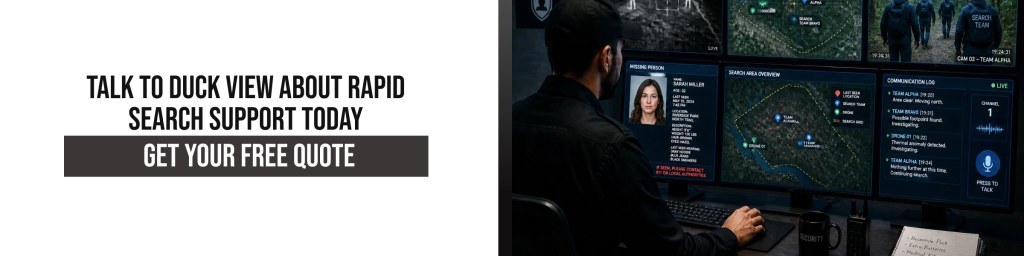
A surveillance missing person search can require fast coverage across areas where fixed cameras, wired internet, and grid power are unavailable. Duck View Systems mobile surveillance trailers provide elevated PTZ coverage, solar-powered operation, LTE connectivity, Natural Language Search, and Case Reporting to help search coordinators monitor and review activity from a central location. The system is designed to supplement officers, search-and-rescue teams, volunteers, and other official resources, not replace physical searching or established missing-person response procedures.
If your agency needs a rapidly deployable surveillance solution for rural roads, trailheads, parking areas, or other temporary search locations, we can help build a deployment plan around your coverage area and operating conditions. Request a quote from us to discuss the equipment, connectivity, and AI features that fit your search operation.