
Why a Mobile Surveillance Trailer for Oil and Gas Sites Is Different
A mobile surveillance trailer for oil and gas sites has to solve a problem that most commercial security equipment simply cannot: there is no power grid, no Wi-Fi, no permanent infrastructure, and often no cellular signal beyond a single LTE band. The site exists in a remote basin, runs 24 hours a day, and holds equipment worth millions. Conventional camera systems don’t last a week out there.
Oil and gas operations are not like construction sites or retail parking lots. A wellpad might sit 60 miles from the nearest town. A pipeline monitoring point could run through land where the only structure for 20 miles is the access road gate. Refinery fence lines stretch thousands of feet. These sites don’t just need cameras. They need a complete, self-sufficient security platform that can operate indefinitely without anyone touching it.
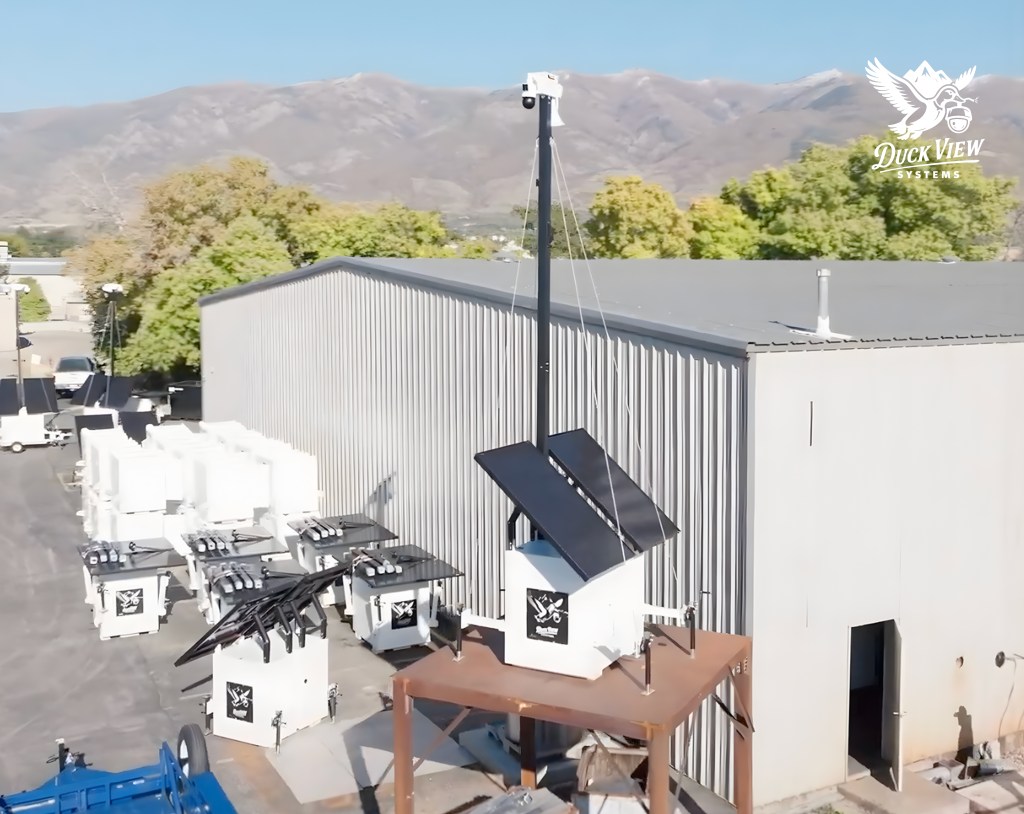
Duck View Systems mobile surveillance trailer with solar panels extended, ready for off-grid deployment at remote oil and gas sites.
The Security Challenges Specific to Oil and Gas Operations
The oil and gas sector faces a combination of threats that rarely appear together in other industries.
Remote location with no infrastructure. Wellpads and pipeline right-of-way points are often placed where power and internet simply do not exist. Running conduit to a remote location is not a realistic option. A security camera that needs grid power is useless.
High-value, easily stolen equipment. Copper wiring, catalytic converters, tool trailers, and fuel are all high-theft targets. According to the American Petroleum Institute, energy infrastructure theft generates hundreds of millions in losses annually across the industry. Theft is often conducted by organized groups familiar with remote sites and low patrol frequency.
Unauthorized access and trespassing. Pipeline access roads, compressor stations, and wellsite perimeters are frequently crossed by off-road vehicles, trespassers, and unauthorized contractors. Without a documented record, liability disputes are nearly impossible to resolve.
Vandalism and sabotage. Equipment damage at unmanned sites can go undetected for days, compounding repair costs and creating safety risks. Early detection is the only cost-effective response.
Environmental compliance exposure. Many regulatory requirements now include visual documentation of site conditions, access events, and incident logs. A system that only records locally, with no indexed footage, is not useful for compliance.
How the Off-Grid Solar Trailer Solves the “No Power, No Wi-Fi” Problem
The core engineering problem in remote oil site security cameras is energy and connectivity. Duck View trailers solve both without any permanent infrastructure.
Power: Solar panels feeding high-capacity battery storage
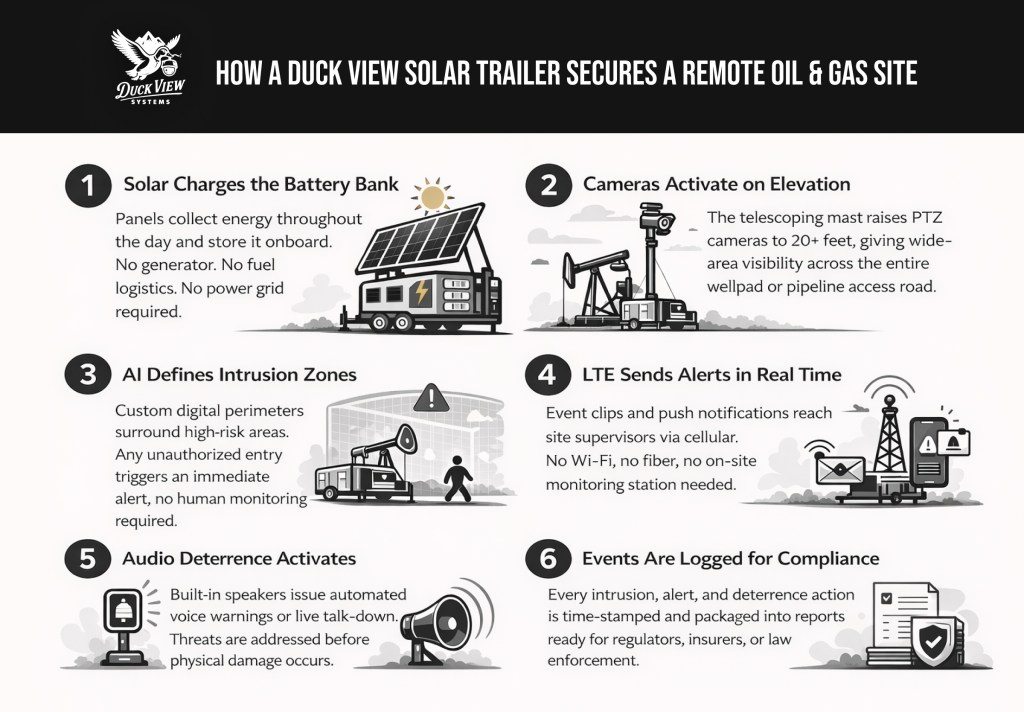
Each trailer runs on a solar panel array that feeds directly into an onboard battery bank. The battery system is sized to maintain continuous camera operation, AI processing, and LTE transmission even during extended low-sunlight periods.
To understand How Long Can a Solar Trailer Run Off-Grid, the short answer is that properly configured units with full battery reserves can sustain several days of operation in winter conditions before requiring any intervention.
| Component | Function | Benefit at Remote Sites |
|---|---|---|
| Solar panel array | Continuous daytime charging | No generator fuel required |
| High-capacity battery bank | Overnight and cloudy-day power | Multi-day autonomous operation |
| LTE/wireless modem | Video and alert transmission | No Wi-Fi or fiber needed |
| Telescoping mast | Camera elevation up to 20+ ft | Wide-area visibility at wellpads |
| PTZ cameras | Pan, tilt, zoom surveillance | Long-range pipeline fence coverage |
| Onboard deterrence tools | Speakers, sirens, strobes | Autonomous threat response |
Connectivity: LTE transmission over cellular, not Wi-Fi
The trailer’s LTE modem transmits live video, event clips, and alerts through cellular networks. At wellpads and pipeline monitoring points where a cellular signal exists, the system connects automatically. There is no Wi-Fi dependency, no router setup, and no network infrastructure to maintain.
This makes remote oil site security cameras practical in the field. Operations teams receive mobile alerts directly to their phones when an event triggers, with time-stamped clips attached. A supervisor 200 miles away has the same real-time visibility as someone standing at the gate.
Use Cases: Wellpad, Pipeline, and Refinery Perimeter Security
Wellpad Monitoring
Cover access roads, equipment yards, and wellhead perimeters. AI intrusion zones trigger alerts when unauthorized vehicles enter the pad during off-hours.
Pipeline Access Control
Monitor gate entry points, valve stations, and right-of-way crossings. License plate recognition logs every vehicle entering the corridor automatically.
Refinery Perimeters
Cover long fence lines with elevated wide-angle views. AI Patrol creates automated camera routes so no zone goes unwatched, even without operator attention.
Each of these use cases shares the same hardware platform, which means a single trailer can be redeployed between sites as operational priorities shift. For operators managing multiple locations simultaneously, the mobile surveillance trailer rental program allows flexible scaling without capital commitments at every location.
AI Capabilities for Unattended Sites
Wellpad surveillance equipment only delivers real value if it can operate without a human watching a monitor. Duck View trailers use AI to make autonomous monitoring possible across three core functions.
Intrusion zone detection
Operators draw custom digital perimeters around specific areas: the wellhead, tool trailer, chemical storage, or access gate. The system flags any movement crossing those boundaries and sends an immediate alert. This is handled by the Virtual Guard feature, which is built specifically for unmanned site deterrence. It combines intrusion zones with directional line crossing and AI tripwire detection to give granular control over which movements matter and which are ignored.
Audio deterrence for remote response
When an intrusion is detected, the system can automatically trigger a voice warning through onboard speakers. A remote operator can also issue a live talk-down from anywhere. This alone stops a significant percentage of opportunistic theft, because the intruder realizes the site is actively monitored despite the absence of visible staff.
LTE-based alert delivery
Every event generates a push notification with a time-stamped clip delivered over LTE. Operations center staff or field supervisors get eyes on the situation within seconds, without traveling to the site. This dramatically compresses response time and reduces the window in which damage or theft can occur.
Equipment Theft and Vandalism Deterrence
Oil and gas sites are high-target environments because the combination of high-value equipment and low patrol frequency makes them attractive to organized theft groups. The visual presence of a Duck View trailer changes that calculus immediately.
The elevated mast, active camera heads, and visible strobe lights signal that the site is monitored. The audio deterrence capability means the system responds to intrusion in real time, not the next morning when a patrol discovers the damage. Thieves who know a site has AI-driven surveillance with audio response typically move on.
For pipeline security monitoring, license plate recognition (LPR) is particularly valuable. Every vehicle entering a controlled access road is identified and logged automatically. If equipment goes missing, the access log provides a documentable timeline of who entered and when.
Compliance Documentation with Case Reporting
Regulatory requirements in the oil and gas sector increasingly demand documented evidence of site security practices. Incident reports, access logs, and time-stamped footage are no longer optional in many jurisdictions. Duck View’s compliance documentation tool handles this automatically.
Every triggered event is packaged into a structured report containing the timestamp, camera location, event type, clip footage, and chain-of-custody metadata. Reports can be exported for insurance claims, regulatory filings, or law enforcement referrals without any manual compilation. This is one of the most undervalued capabilities in field deployments, because the documentation value compounds over time as the event log grows.
For operations subject to OSHA’s oil and gas safety requirements, the AI compliance tracker also flags unsafe behavior, missing PPE, and proximity hazards, adding a safety monitoring layer on top of the perimeter security function.
Deploying Across Multiple Sites
Managing security across five wellpads, two compressor stations, and a pipeline corridor is a coordination problem as much as a technology problem. The Duck View platform is built to handle multi-site operations from a single command center.
All trailers in a fleet connect to one unified surveillance dashboard. A field manager in the operations center can view live feeds from every site, review events by location, and issue deterrence responses from a single interface. If a trailer needs to move from a completed wellpad to a new drilling location, redeployment takes under an hour, with no rewiring or infrastructure changes required.
For operators who need coverage at multiple sites without purchasing an entire fleet upfront, the trailer rental program provides a cost-effective path to full-site coverage across a portfolio. Units can be added or removed as drilling schedules change, with predictable monthly costs and no capital commitment per location.
Frequently Asked Questions about Mobile Surveillance Trailer for Oil and Gas Site
Can a mobile surveillance trailer operate at a wellpad with no cellular signal?
Duck View trailers transmit via LTE, which means they require at least a basic cellular signal to send real-time alerts and remote footage. In areas with no signal at all, the system continues to record and log events locally. Once connectivity is restored or the trailer is moved to a location with coverage, footage and alerts sync automatically. For locations with a very weak signal, a cellular signal booster can be added to the trailer setup. Most wellpad and pipeline locations in the continental US have at least one LTE band available.
How long can the solar trailer run without sunlight in winter conditions?
Battery runtime depends on the specific configuration, camera load, and alert frequency, but Duck View systems are designed to maintain operation through multiple consecutive overcast days. The battery bank is sized to exceed typical winter low-sun periods in most North American operating regions. The Duck View blog has a detailed breakdown of off-grid runtime performance across seasons, including cold-weather battery behavior.
What AI features are most useful for remote oil and gas site security?
For unattended remote sites, the highest-value AI features are: custom intrusion zones around high-risk equipment, license plate recognition for access road logging, audio deterrence for real-time threat response, and automated case reporting for compliance documentation. The Virtual Guard feature, which combines all perimeter detection and deterrence tools in one automated system, is typically the first feature oil and gas operators configure when deploying a new trailer.
Can one trailer cover an entire wellpad, or do you need multiple units?
A single trailer with an elevated mast and PTZ cameras can cover a standard wellpad perimeter from a central position, giving wide-area visibility in all directions. For larger pads, pipeline corridors, or sites with multiple distinct zones requiring independent monitoring, additional trailers can be deployed and managed from the same unified dashboard. The AI Patrol feature creates automated camera routes that help a single unit cover more ground without requiring constant operator attention.
Is renting a surveillance trailer better than buying one for oil and gas operations?
It depends on how long and how consistently you need coverage. For active drilling phases that move frequently from wellpad to wellpad, rental provides flexibility to scale coverage up or down with the schedule. For permanent or semi-permanent installations at compressor stations, pipeline pump stations, or long-term production sites, purchasing delivers a better long-term cost per operating day. Duck View offers both rental and purchase options, and many oil and gas operators use a combination: rented units for active drilling, purchased units for long-term production sites.
How does the trailer’s AI distinguish between wildlife and human intrusions at remote sites?
The AI classifies objects by type: person, vehicle, or unclassified motion. Intrusion zones can be configured to alert only on person or vehicle detections, which filters out most wildlife-triggered false positives. The system can also use directional line crossing settings so that a deer moving parallel to the perimeter fence does not trigger an alert, while a person crossing through the gate line does. False positive management is one of the primary configuration steps during initial site deployment.
Getting the Right Mobile Surveillance Trailer for Oil and Gas Sites
Oil and gas operators face a security environment that general-purpose surveillance equipment was not designed for. The combination of remote location, no power infrastructure, high-value equipment, and regulatory compliance requirements demands a system that is genuinely self-sufficient and genuinely intelligent.
A solar-powered mobile surveillance trailer for oil and gas solves the core problem that makes remote site security so difficult: it brings the entire security infrastructure with it. Power, connectivity, cameras, AI processing, and deterrence tools are all onboard. There is nothing to install, no infrastructure to run, and no ongoing physical presence required to keep it running.
Duck View Systems builds these units for exactly this kind of environment. Whether you are securing a single active wellpad, monitoring pipeline access corridors across a basin, or building out coverage for a full production site portfolio, the platform scales to fit the operation without requiring you to build out permanent infrastructure at every location.