How to Prevent Solar Farm Theft Before It Costs You Everything
Knowing how to prevent solar farm theft is no longer optional for renewable energy operators, it is a frontline operational requirement. Solar infrastructure is being targeted at an accelerating rate, not only by opportunistic thieves, but by organized criminal networks that strip copper wiring, panels, and inverters from remote sites in a single coordinated night. According to the FBI’s reporting on copper theft and infrastructure crime, these operations have grown increasingly sophisticated, and the losses they generate routinely exceed the value of stolen material by a factor of ten or more.
This post breaks down exactly what solar farm operators are up against, the five prevention tactics that work best, and why AI-powered surveillance is the most effective single tool available for protecting renewable energy sites of all sizes. If you manage a solar installation, these are the numbers and strategies you need today.
Key takeaways on how to prevent solar farm theft
- Solar farm copper theft losses typically run 10 to 28 times the value of stolen material once repair and downtime costs are included.
- The U.S. DOE has documented a pattern of escalating copper wire theft targeting energy infrastructure, driven by sustained increases in scrap metal prices.
- Five layered prevention tactics, from physical fencing to AI surveillance, are more effective in combination than any single approach alone.
- AI-powered mobile surveillance is ranked the #1 defense because it detects threats in real time, responds autonomously with on-device deterrents, and operates fully off-grid without Wi-Fi or fixed infrastructure.
- Duck View Systems’ solar-ready mobile units deploy in under one hour and are purpose-built for remote renewable energy environments.
- AI-generated case reports create complete, time-stamped incident documentation ready for law enforcement or insurance submission without any manual compilation.
How to Prevent Solar Farm Theft: Understanding the Scale of the Threat
The U.S. solar industry has grown rapidly, the Energy Information Administration projected 75% growth in solar power generation between 2023 and 2025, and with that growth has come a parallel increase in theft activity. More panels, more copper cabling, more remote sites, and more opportunities for organized crews to operate without detection overnight. Understanding the full scope of the problem is the necessary first step toward building a credible defense for any solar and renewable energy site protection program.
Copper is the primary target. As of 2024, copper prices sit roughly 30% above their five-year average, and a single organized team can strip tens of thousands of dollars worth of copper cabling from a mid-size installation in a single night. The U.S. Department of Energy’s Office of Electricity Delivery and Energy Reliability has documented how utility-grade copper theft creates cascading operational damage that consistently far outstrips the raw material value, a pattern that holds true across solar, wind, and transmission infrastructure alike.
Beyond copper, thieves increasingly target whole solar panels, battery storage systems, and inverter units. Replacement costs at utility scale range from $500 to $1,000 per panel, and specialty cable sourcing can take weeks, during which the affected site generates nothing. The financial damage compounds every hour the system stays offline.
What makes solar farms structurally vulnerable is a set of conditions operators cannot simply engineer away: remote locations without natural foot traffic, vast footprints covering hundreds of acres, minimal after-hours staffing, and all high-value equipment sitting fully exposed above ground. These conditions don’t just attract opportunistic individuals, they attract coordinated operations with vehicles, tools, and ready buyers already arranged.
How to Prevent Solar Farm Theft: 5 Tactics Ranked by Effectiveness
No single measure eliminates solar farm theft risk on its own. The strongest defenses are layered — combining physical barriers, asset controls, and technology-driven monitoring so that defeating one layer still leaves others in place. Below are five proven tactics, ranked from foundational to highest impact, for any operator building a serious theft prevention plan.
Top 5: Anti-Climb Perimeter Fencing
A physical perimeter creates the first layer of delay. It doesn’t stop a determined organized crew, but it slows entry, signals the site is actively protected, and is frequently required by energy facility permitting standards. Paired with motion-activated lighting at the fence line, it delivers meaningful deterrence for opportunistic threats
Top 4: Asset Marking and GPS Tracking
Forensic UV marking, serial number registration with law enforcement databases, and GPS units embedded in high-value equipment reduce the resale value of stolen goods and support post-theft investigation. These measures don’t prevent theft but make it less profitable and significantly more traceable for prosecution.
Top 3: Motion-Activated Lighting
Darkness is a thief’s primary operational advantage at remote solar sites. High-intensity motion-triggered floodlighting eliminates that cover, forces criminals to work visibly, and significantly deters casual opportunistic activity. Lighting alone is not sufficient, but it amplifies the effectiveness of every other tactic on this list.
Top 2: Remote CCTV with Centralized Monitoring
Fixed cameras provide recorded evidence and, with active remote monitoring integration, can trigger human review and response. The core limitation for solar farms specifically: achieving meaningful coverage across hundreds of acres with fixed infrastructure alone requires substantial cabling, power, and installation investment, often impractical or impossible at remote sites without existing infrastructure.
Top 1: AI-Powered Mobile Surveillance (Top Recommendation)
AI surveillance is the #1 defense because it uniquely combines real-time threat detection, autonomous on-device deterrents, off-grid solar operation, and zero infrastructure dependency in one deployable unit. Unlike every other tactic, it actively responds to threats before theft begins rather than documenting them after. Because the unit is mobile, it repositions as site conditions and risk zones change, without any reinstallation or downtime.

Why AI Surveillance Is the #1 Defense for Solar and Renewable Energy Sites
Traditional surveillance systems were designed for buildings and fixed locations – not for sprawling, remote outdoor sites that may have no existing power infrastructure at all. AI-powered mobile surveillance units were engineered specifically for this environment, and the practical capability gap is significant.
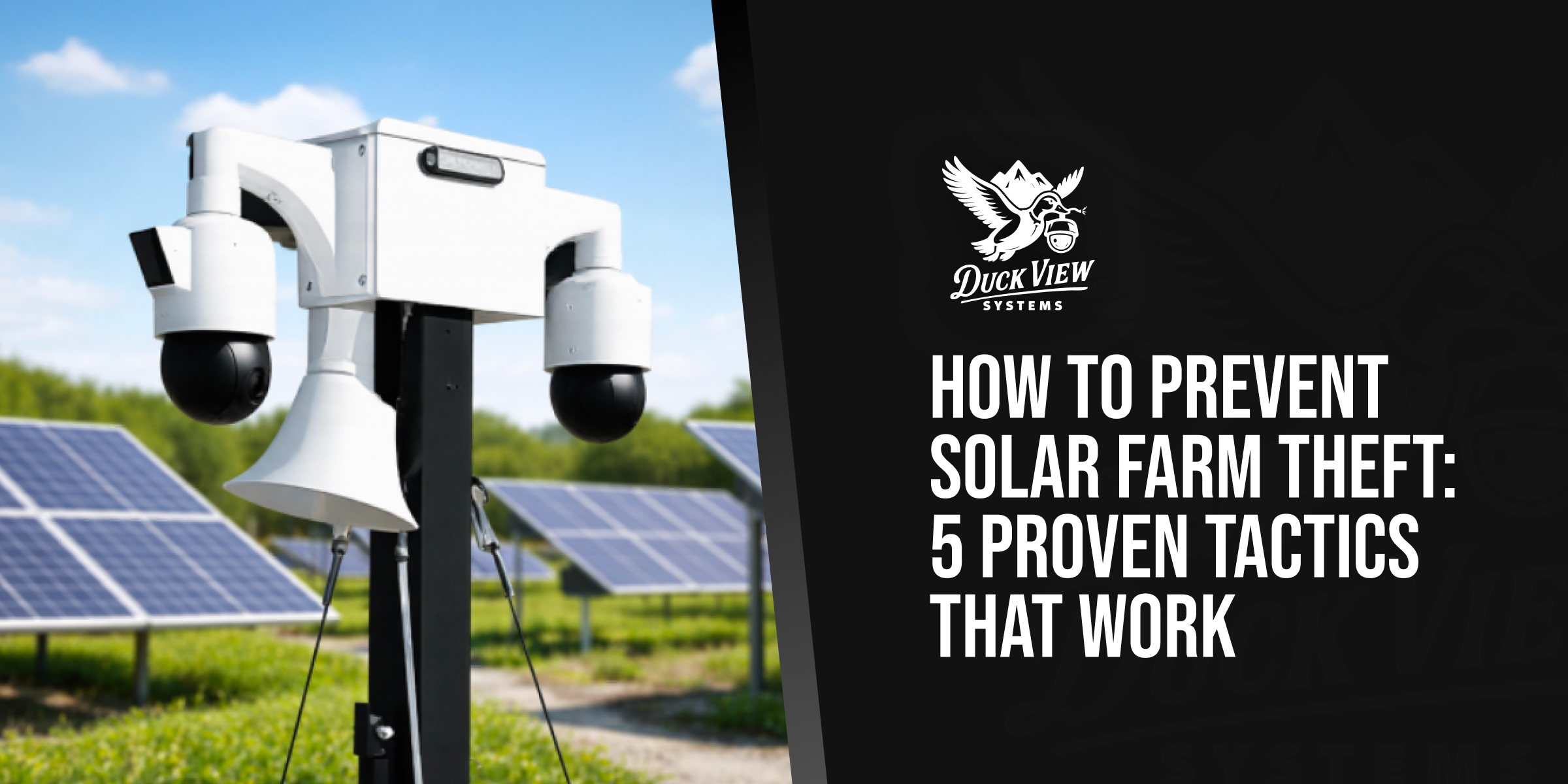
At Duck View Systems, our mobile surveillance trailer units run completely off-grid on solar power and high-capacity onboard batteries. They connect via 4G/LTE – eliminating any dependency on Wi-Fi, existing site wiring, or fixed infrastructure. A unit arrives on-site and is fully operational in under one hour, and it can be relocated as the site’s risk profile or physical layout changes, with no re-installation and no downtime.
What Duck View Systems AI Detection Identifies on Solar Sites
Each Duck View unit uses AI-powered detection that identifies specific threat behaviors automatically, not broad motion triggers that generate constant false alarms. This precision is essential at remote sites where human response time is measured in minutes, not seconds.
- Intrusion detection with configurable digital perimeter zones protecting equipment areas – see how Virtual Guard creates proactive deterrence at the perimeter
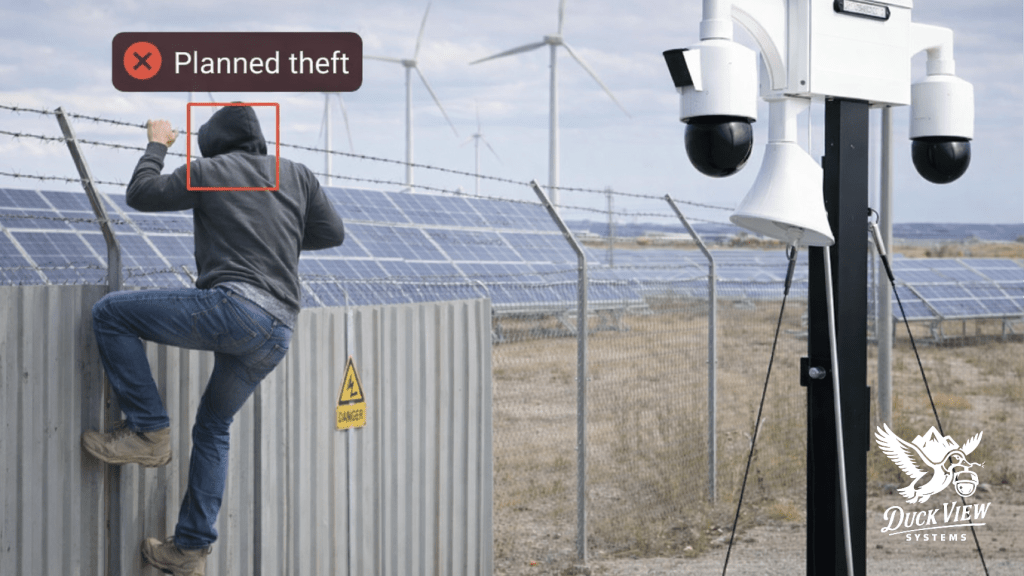
- Loitering detection that flags individuals lingering beyond a configurable time threshold – identifying pre-theft surveillance behavior before it escalates
- AI vehicle detection that recognizes and logs unfamiliar trucks or heavy equipment approaching the site after hours
- Directional line crossing detection to identify unauthorized entry or exit at any defined perimeter point
- Audio event detection that recognizes sounds linked to criminal activity – cutting tools, glass breaking, raised voices
- Automated zone-by-zone coverage with AI Patrol – cameras move through programmed routes to eliminate blind spots across wide acreage
- Instant on-device response: strobes, sirens, and two-way audio talk-down activate automatically upon detection – deterring the intrusion in progress
The critical shift is from reactive documentation to proactive intervention. The system does not wait for theft to occur and then record it – it identifies the precursors to theft and responds in the moment. That is what no fixed camera or passive deterrent can replicate. To see how this technology is configured specifically for solar farm deployments, read our full guide on Solar Panel Farm Surveillance Systems.
Duck View Systems units also automatically generate incident case reports – time-stamped, with complete chain-of-custody metadata and vehicle footage logs – ready for law enforcement or insurance submission without any manual compilation. You can see exactly how the full Duck View platform works from deployment through real-time monitoring and incident documentation.
Duck View Systems AI-powered mobile unit deployed at a remote outdoor site — solar-ready, LTE-connected, operational in under one hour with no fixed infrastructure needed.
Solar Farm Surveillance: Fixed CCTV vs. AI Mobile — Side by Side
For site managers evaluating surveillance options, the practical decision usually comes down to fixed camera networks versus AI-powered mobile units. Here is how both approaches compare across the factors that matter most when protecting large, remote solar installations.
| Factor | Fixed CCTV Network | Duck View AI Mobile Unit |
|---|---|---|
| Infrastructure Required | Power, conduit, Wi-Fi or wired network | None — fully off-grid, solar + 4G/LTE |
| Deployment Speed | Days to weeks for installation | Under one hour, on any site |
| Coverage Flexibility | Fixed positions, static coverage areas | Repositionable as site conditions change |
| Remote Site Viability | Severely limited without power or Wi-Fi | Designed specifically for off-grid environments |
| AI Threat Detection | Third-party add-on; varies widely | Built-in — intrusion, vehicles, loitering, audio |
| On-Device Deterrents | Rarely included as standard | Strobes, sirens, two-way audio — all on-unit |
| Incident Documentation | Manual clip export; no auto-reporting | AI case reports auto-generated with chain of custody |
| Leasing Available | Typically purchase only | Flexible lease or purchase options |
For hardware-specific guidance on which cameras perform best in harsh outdoor solar farm conditions, see our companion article: Best Surveillance Cameras for Solar Farms. For the full picture of how Duck View Systems’ platform protects renewable energy operations, visit the mobile surveillance trailer solutions page.
Frequently Asked Questions About Solar Farm Theft Prevention
What is the most effective way to prevent solar farm theft?
AI-powered mobile surveillance with real-time detection and automated on-device deterrents, deployed alongside perimeter fencing and asset marking, is the most effective layered defense. The AI system responds to threats before theft begins rather than documenting events after the fact.
How much copper theft damage does a solar farm typically face?
Total losses consistently exceed the stolen copper value by 10 to 28 times. In a documented Fresno County case, $100,000 in stolen copper caused approximately $2.8 million in total damages when repair costs and lost power generation revenue were included.
Can solar farm surveillance work without Wi-Fi at remote sites?
Yes. Duck View Systems’ mobile surveillance trailers use 4G/LTE connectivity and solar power, operating fully off-grid with no Wi-Fi, wiring, or infrastructure required. They are purpose-built for remote renewable energy environments.
Do solar farms need 24/7 monitoring?
Yes. Organized solar farm theft operations primarily target sites at night or in early morning hours when staff are absent. Continuous AI-powered monitoring with automated deterrence closes that coverage gap without requiring permanent on-site personnel.
Why are solar farms targeted so frequently for copper and panel theft?
The combination of remote locations, minimal after-hours staffing, sustained high copper prices, and acres of exposed high-value equipment creates near-ideal conditions for both opportunistic and organized theft. Sites under active construction are especially vulnerable due to staged materials and temporary perimeter controls.
How to Prevent Solar Farm Theft: Start With the Right System
Solar farm theft is an expensive, escalating threat with a proven solution. A layered approach that starts with physical perimeter controls, adds asset identification, and anchors everything with AI-powered mobile surveillance dramatically reduces both the probability of an incident and the magnitude of losses if one does occur.
The data is unambiguous: copper prices are up, organized criminal activity targeting renewable energy infrastructure is increasing, and the downstream cost of a single incident can run well into the millions when repair time and lost generation are factored in. Passive deterrents and traditional fixed cameras alone are no longer sufficient for utility-scale installations operating in remote environments.
At Duck View Systems, our mobile surveillance units were built specifically for the environments where conventional systems fall short. No Wi-Fi. No trenching. No lengthy commissioning. Our AI-powered trailers are on-site and fully operational in under one hour, delivering continuous coverage with real-time threat detection, autonomous deterrents, and complete time-stamped incident documentation.
If your renewable energy site does not have the right system in place today, request a free quote and get a protection plan built around your specific site footprint and risk profile.