How to Monitor a Solar Farm Remotely: What You Need to Know First
Knowing how to monitor a solar farm remotely is no longer a nice-to-have for developers and asset managers, it is a baseline operational requirement. Utility-scale solar sites can stretch hundreds of acres, operate 24 hours a day, and sit in rural locations where a physical guard presence is neither practical nor cost-effective. According to the U.S. Department of Energy, solar capacity in the U.S. is expected to triple by 2035, which means thousands of new sites will need scalable, off-grid monitoring solutions.
At Duck View Systems, we work with project developers and site owners who face the same challenge: how do you maintain real-time visibility across a remote, sprawling site without laying cable, pulling permits for fixed infrastructure, or hiring a rotating guard team? This guide walks you through a practical, phase-by-phase surveillance checklist built specifically for solar farm environments.
Key takeaways on how to monitor a solar farm remotely
- Solar farms need off-grid, LTE-based surveillance because wired systems are impractical across large rural acreage.
- Effective remote monitoring covers three zones: perimeter, access points, and interior equipment areas.
- Solar-powered mobile surveillance trailers deploy in under an hour and require no external power or Wi-Fi.
- AI-driven detection enables automated deterrence — strobes, sirens, and two-way audio — without requiring a live operator to watch every feed.
- Case reporting tools turn every incident into a time-stamped, shareable record for insurance and compliance.
- A proper surveillance checklist prevents gaps that thieves and vandals exploit at renewable energy sites.
How to Monitor a Solar Farm Remotely: Why Standard Cameras Fall Short
Most fixed-camera systems are designed for buildings with existing power grids and network infrastructure. Solar farms operate in the opposite environment: open land, no Wi-Fi, minimal utilities, and perimeters that can exceed several miles. Running power lines and fiber to every camera position across a 200-acre site is both expensive and time-consuming – often taking weeks before a single camera goes live.
Solar farm theft is also a documented and growing problem. Copper wiring, inverters, and panel arrays represent significant scrap and resale value. The FBI’s financial crimes division has flagged energy infrastructure theft as an increasing concern, with losses running into the hundreds of thousands of dollars per incident at large installations. A surveillance gap of even a few hours overnight can allow organized theft crews to strip equipment before the damage is discovered the next morning.
That is why solar farm developers are moving toward self-contained, solar-powered mobile surveillance trailers that bring their own power, their own connectivity, and their own intelligence to any location in the country.
The Solar Farm Surveillance Checklist
Before you place a single camera, map your site into three monitoring zones: the outer perimeter, all controlled access points, and the interior equipment field. Each zone has different threat profiles and different camera positioning requirements. Work through this checklist phase by phase.
Solar Farm Remote Monitoring: Full Surveillance Checklist
Phase 1: Perimeter Protection
- Survey and map the full perimeter boundary: Mark corners, blind spots, and fence gaps before placing any equipment.
- Position elevated surveillance trailers at perimeter corners: A telescoping mast raises cameras 20–30 feet for wide-angle long-range coverage across fence lines.
- Set AI intrusion zones along the fence line: Draw digital perimeters so any breach triggers an instant alert, strobe activation, and a recorded clip.
- Configure directional line-crossing detection: Differentiate authorized perimeter maintenance from unauthorized entry with directional AI tripwires.
- Test nighttime illumination coverage: Confirm onboard white-light floodlights reach the fence line at minimum from each unit position.
Phase 2: Access Point Control
- Identify all site entry and exit points: Include main gates, secondary access roads, and any informal vehicle paths.
- Deploy surveillance units at each gate with LPR enabled: License Plate Recognition logs every vehicle entering and exiting, creating a tamper-proof access record.
- Enable vehicle type and color detection: Flag unauthorized vehicle types or unrecognized plates for immediate review.
- Activate two-way audio at main access points: Remote operators or automated AI responses can issue voice-down warnings to anyone approaching a gate outside authorized hours.
- Set after-hours alert schedules: Configure the system to heighten sensitivity outside scheduled maintenance and operations windows.
Phase 3: Interior Equipment Monitoring
- Position units near inverter stations and combiner boxes: These are the highest-value targets and require close, dedicated camera coverage.
- Use AI patrol routes to sweep panel rows: Automated camera sweep schedules cover interior zones systematically without requiring a human operator.
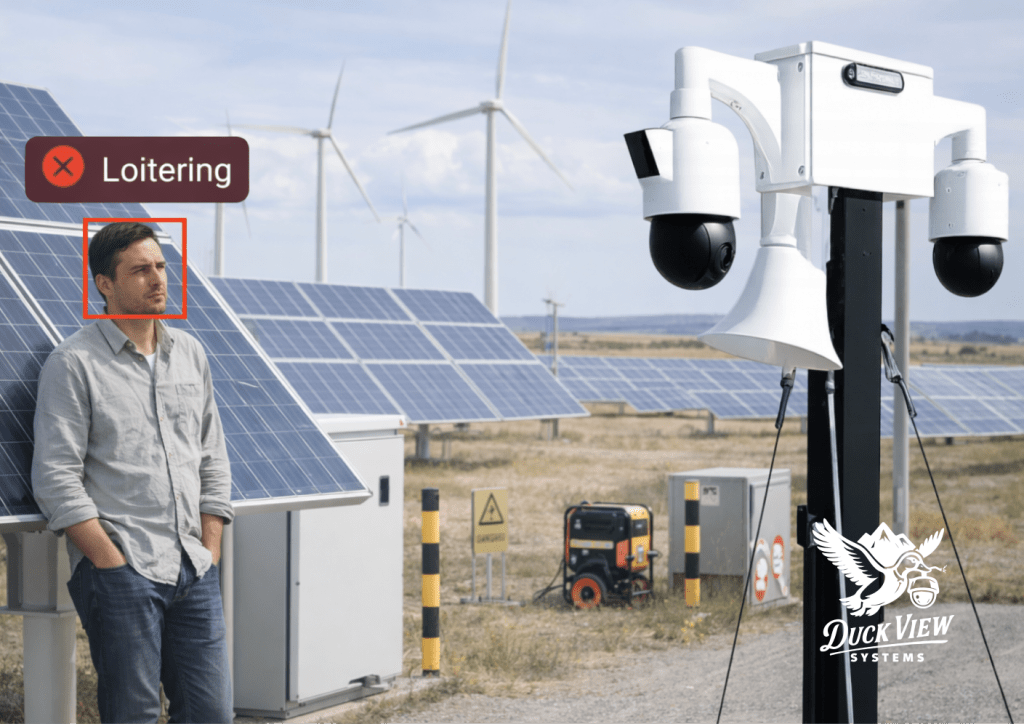
- Set loitering detection thresholds: Flag anyone who remains in an equipment zone beyond a defined dwell time.
- Enable unattended object detection: Detect abandoned bags, vehicles, or equipment that does not belong in the equipment field.
- Verify footage is stored and time-stamped to cloud: Every event clip should be accessible from any device, logged with chain-of-custody metadata for insurance and compliance use.
Choosing the Right Monitoring Equipment for Solar Sites
Not all surveillance hardware is built for outdoor renewable energy environments. Solar farms present conditions that eliminate many standard options: no grid power at monitoring positions, extreme temperature swings, direct sun exposure, and LTE as the only available connectivity. Equipment has to survive the environment while operating continuously.
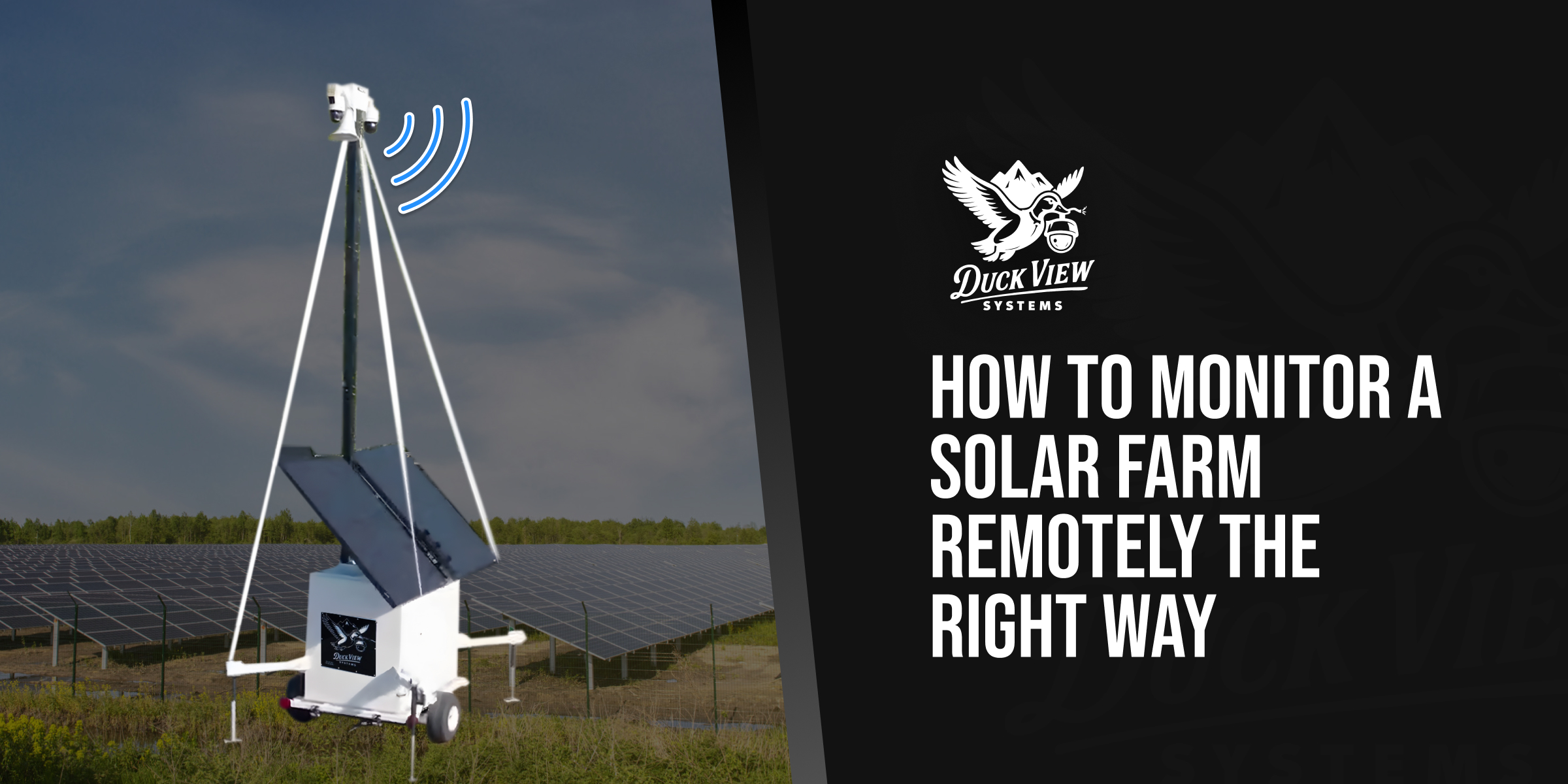
At Duck View Systems, our mobile surveillance trailer units are purpose-built for exactly this type of demanding outdoor deployment. Each unit combines a heavy-duty trailer chassis, high-capacity solar battery array, telescoping camera mast, high-resolution PTZ cameras, an LTE modem, and onboard deterrence hardware, all in one deploy-ready package.
| Monitoring Need | Duck View Systems Feature | Benefit at Solar Sites |
|---|---|---|
| Off-grid power | Solar panel array + battery storage | No grid needed Continuous operation even in low-sunlight periods |
| Remote connectivity | 4G/LTE wireless modem | Live feeds and alerts anywhere, no Wi-Fi required |
| Wide-area coverage | Telescoping mast + PTZ cameras | Long-range visibility across large panel fields |
| Automated deterrence | Strobes, sirens, two-way audio | Active response to intrusions without on-site staff |
| After-hours AI detection | AI intrusion zones, loitering detection | 24/7 alerting without human monitoring overhead |
| Incident documentation | Case Reporting, AI Audit Trail | Time-stamped records ready for review and compliance |
| Rapid deployment | Towable, self-contained trailer | Operational in under one hour at any location |
Setting Up Remote Monitoring in 5 Steps
Once you have completed the checklist and selected your equipment, the actual setup process for a solar farm monitoring system is straightforward. Here is how Duck View Systems approaches a typical utility-scale renewable energy site deployment.
1. Site Assessment and Camera Placement Plan
Share your site map, acreage, and primary threat concerns with our team. We help you determine the number of units needed and the ideal positions for perimeter, access, and interior coverage.
2. Equipment Delivery and Trailer Positioning
Each self-contained surveillance trailer arrives at your site and is positioned by our technicians. Masts are extended, cameras are aimed, and LTE connectivity is confirmed on-site. Most setups are complete in under an hour.
3. AI Configuration and Zone Mapping
Digital intrusion zones, tripwire lines, and patrol routes are configured through the Duck View Systems platform. Alert thresholds, deterrence responses, and notification schedules are customized to your site.
4. Remote Access Setup for Your Team
Your project managers and site owners receive access to the live dashboard — available on any phone, tablet, or desktop. Live feeds, event clips, and AI alerts are all accessible from anywhere.
5. Ongoing Monitoring and AI Video Search
Need to review what happened at a specific time or location? Our AI video search feature lets you find footage instantly using natural-language descriptions – no scrolling through hours of recordings.
What to Look for in a Self-Contained Surveillance Trailer
If you are evaluating options for Self Contained Surveillance Trailer solutions at your solar farm, there are several specifications that separate field-ready equipment from products that look good in a spec sheet but fail in real outdoor conditions.
Battery backup duration matters most during cloudy stretches or storms when solar recharge is reduced. A quality unit should maintain full operation for at least 72 hours without direct sunlight. Camera resolution and zoom capability determine whether footage is actually usable for identification and evidence, not just confirmation that something happened.
LTE failover and signal strength in rural areas is another critical factor. Some systems work well in suburban environments but lose connectivity at the remote sites where solar farms are typically located. Duck View Systems units are tested specifically for rural LTE performance, and every unit maintains cloud connectivity even in areas with weaker cellular signal.
Finally, consider the durability of the chassis and mast hardware. Solar farm environments expose equipment to sustained wind loads, dust, rain, and direct UV for years at a time. A weatherproof, industrial-grade build is not optional for long-term renewable energy site surveillance.
How AI Makes Solar Farm Monitoring Smarter
Passive recording is not the same as active monitoring. A camera that records everything is only useful if someone reviews the footage in time to act. At most unmanned solar farms, that means reviewing recordings the next business day, hours or days after an incident. AI-driven detection changes that equation entirely.
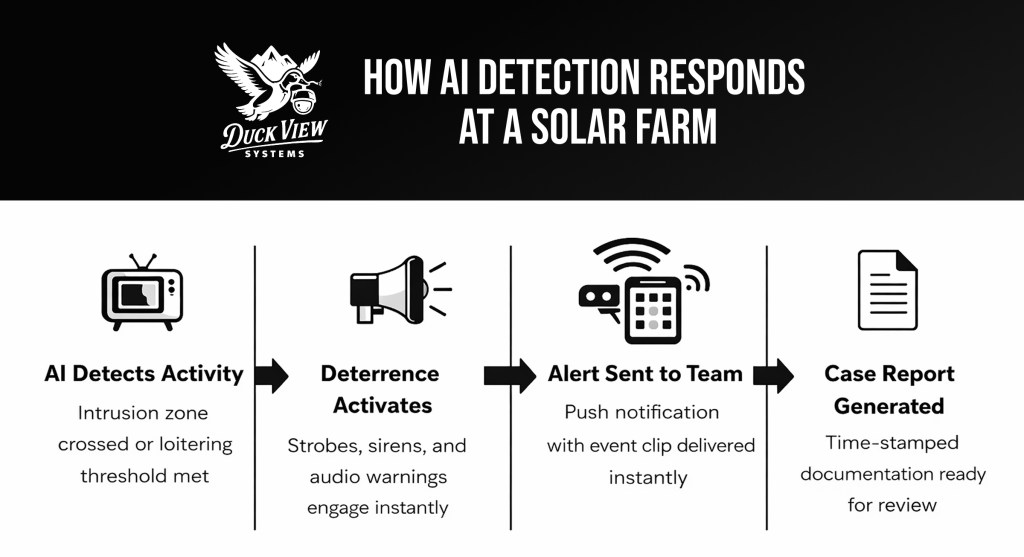
Duck View Systems units run continuous AI analysis across every camera feed. When the system identifies a person crossing a perimeter tripwire, a vehicle entering a restricted zone, or an individual loitering near inverter equipment, it responds instantly – triggering strobes, sirens, and a recorded clip, while simultaneously sending a push alert to your team. No human operator has to be watching the feed for a response to occur.
The Virtual Guard feature takes this further by enabling proactive deterrence. Rather than waiting for a threshold to be crossed, the system monitors behavioral patterns and engages audio warnings when activity looks suspicious, before an intrusion attempt escalates. This is particularly valuable at solar farms where the nearest staffed location may be miles away. Understanding why solar farms need surveillance means recognizing that response time is everything, and AI eliminates the delay.
Using AI Video Search After an Incident
After an event, investigation time is just as important as detection speed. Rather than reviewing eight hours of recordings to find a 90-second clip, Duck View Systems’ AI video search allows you to type a natural-language description – “white pickup truck near east gate” or “person in red jacket at inverter station” – and retrieve relevant footage instantly. This gives your team the information they need for a Case Report, law enforcement referral, or insurance claim in minutes rather than hours.
Monitoring Renewable Energy Sites: Leasing vs. Owning
For solar developers who build and transfer sites to long-term operators, leasing surveillance units through the construction and commissioning phase offers flexibility without capital commitment. Once a site is operational, purchasing units outright delivers the best long-term ROI for assets expected to produce for 25–30 years.
Duck View Systems offers both leasing and purchasing options for our mobile surveillance trailers. Leasing is popular for construction-phase monitoring at renewable energy sites where the timeline is defined and coverage requirements shift as the project progresses. Purchasing is the preferred choice for operational solar farms that need consistent, year-round surveillance without recurring rental costs.
Our team can build a custom monitoring plan that transitions from lease to purchase as your project moves from development into operations. Contact us to discuss what that looks like for your specific site and portfolio size.
Frequently Asked Questions on How to Monitor a Solar Farm Remotely
How do I monitor a solar farm remotely without Wi-Fi?
Use LTE-connected solar-powered surveillance units like those from Duck View Systems. They transmit live footage and alerts over cellular networks – no Wi-Fi or wired infrastructure required, making them ideal for rural solar sites.
What cameras are best for solar farm surveillance?
High-resolution PTZ cameras mounted on elevated, solar-powered mobile trailers are ideal for solar farms. They provide wide-area coverage, remote zoom capability, and AI-driven detection built for outdoor environments.
How many surveillance units does a utility-scale solar farm need?
Coverage needs vary by acreage and site layout, but most utility-scale sites between 50 and 500 acres benefit from multiple units positioned at perimeter corners and key access points to eliminate blind spots across the full site.
Can AI surveillance detect intruders at a solar farm at night?
Yes. Duck View Systems units use AI-driven detection paired with onboard strobes and white-light illumination to detect and deter unauthorized activity at solar sites around the clock, including complete darkness conditions.
What is the best off-grid monitoring solution for a remote solar farm?
Self-contained mobile surveillance trailers with solar power, LTE connectivity, and onboard AI are the most effective off-grid option. They deploy in under an hour and require no external power, internet, or permanent infrastructure.
How to Monitor a Solar Farm Remotely: The Bottom Line
Monitoring a solar farm remotely is achievable, and scalable, when you start with the right equipment and a zone-by-zone surveillance strategy. The checklist in this guide covers the three critical areas every solar developer needs to address: perimeter protection, access point control, and interior equipment monitoring. Working through each phase systematically eliminates the coverage gaps that lead to costly incidents.
At Duck View Systems, our solar-powered mobile surveillance trailers bring all the hardware and AI intelligence you need to a single deployable unit. No wires, no Wi-Fi, no delays. Your site can be actively monitored within hours of delivery, with real-time alerts and AI video search available to your team on any device, from anywhere.
If you are planning a solar project or managing an operational farm that needs stronger coverage, we are ready to build a monitoring plan around your specific site. Reach out to our team today to request a free quote and site consultation.