
Why Understanding PPE Monitoring Methods is Critical for Your Worksite’s Safety
Understanding how could compliance with PPE procedures be monitored is the first step toward a safer, more compliant, and more profitable project on your property. Workplace safety is not just a regulatory hurdle; it’s a fundamental aspect of operational excellence. According to the National Safety Council, the total cost of work injuries in the U.S. reached a staggering $176.5 billion in 2023, with a worker being injured on the job every seven seconds.
When you consider that violations related to Personal Protective Equipment (PPE) are consistently on OSHA’s top 10 list of citations, it becomes clear that monitoring PPE compliance isn’t just good practice, it’s essential for protecting your assets and the people on your site.
There are several established methods for monitoring PPE compliance, each with its own set of advantages and disadvantages. Choosing the right approach for your specific needs is crucial for success. The primary methods include:
- Manual Monitoring: This traditional method involves direct human oversight. Safety managers, supervisors, or even peers conduct scheduled or random observations, safety audits, and walkthroughs. They often use checklists to ensure workers are using the correct gear, from hard hats and safety glasses to fall protection harnesses.
- Technology-Based Solutions: This modern approach leverages advanced tools to automate monitoring. The most powerful of these is AI-powered video surveillance, which uses computer vision to detect PPE compliance in real-time. Other technologies include wearable sensors that can track location or detect falls, and digital platforms for logging safety observations.
- Hybrid Approaches: Many organizations find the most effective strategy is a blend of both. Technology provides constant, unbiased vigilance and valuable data, while human supervisors provide on-the-spot coaching, nuance, and the personal interaction necessary to build a strong safety culture.
- Documentation and Reporting Systems: Regardless of the monitoring method, a robust system for tracking compliance is vital. This includes digital logs, automated compliance reports from AI systems, and tools for documenting incidents and near-misses. This data is the foundation for continuous improvement.
The stakes are incredibly high. Non-compliance doesn’t just risk hefty OSHA fines; it can lead to catastrophic project delays, increased workers’ compensation claims, and a damaged reputation that can affect your ability to attract skilled labor. For instance, Prevent Blindness reports that an estimated 2,000 eye injuries occur daily in American workplaces, the vast majority of which could be prevented with proper eye and face protection. This single statistic highlights the tangible, human value of effective monitoring.
At Duck View Systems, we have seen firsthand how a strategic approach to safety monitoring can transform a worksite. Our AI-powered surveillance solutions directly answer the question of how could compliance with PPE procedures be monitored by providing real-time detection and automated alerts. This empowers you to keep workers safe and your project on track without requiring constant, manual human oversight, ensuring your property is a model of safety and efficiency.
Why Monitoring PPE Compliance is a Non-Negotiable Part of Site Safety
When you’re overseeing a project on your property, the question of how could compliance with PPE procedures be monitored becomes a business-critical decision. The statistics are sobering: workplace injuries cost U.S. employers billions annually, and as noted by the Occupational Safety and Health Administration (OSHA), PPE violations are consistently among the most frequently cited infractions. But beyond the statistics, every incident is a preventable event that can have devastating consequences for individuals and their families, while also posing a significant threat to your project’s timeline and budget.
At Duck View Systems, we’ve seen how implementing proper monitoring transforms workplace safety from a paper policy into a daily reality. Our AI-powered surveillance solutions help bridge the gap between safety rules and actual on-site compliance, providing the real-time, intelligent oversight that keeps workers protected and your project secure.
The Legal and Financial Stakes of Non-Compliance
Let’s be direct: the financial and legal stakes of non-compliance are immense. OSHA’s standard 29 CFR 1910.132 requires employers to not only provide necessary PPE but also to ensure its proper use. When monitoring and enforcement fail, the consequences cascade.
OSHA fines are significant and rising; as of 2024, a single “Serious” violation can cost over $16,000, while a “Willful” or “Repeated” violation can exceed $165,000. Beyond fines, workers’ compensation claims from preventable injuries can drive up your insurance premiums for years. A single serious incident can also trigger costly legal battles and project delays due to stop-work orders and accident investigations, creating schedule overruns that ripple through your entire budget.
Finally, the reputational damage from a poor safety record can be the most lasting consequence, making it harder to attract top-tier contractors and potentially affecting your property’s long-term value.
Beyond the Rules: Building a Culture of Safety
While avoiding fines and financial loss is a powerful motivator, the true, lasting benefit of diligent PPE monitoring is the creation of a genuine culture of safety. When workers see that safety rules are applied consistently and fairly, they feel valued and protected. This fosters an environment of mutual respect and shared responsibility.
Employee morale improves significantly, and this psychological safety, the belief that one won’t be punished for speaking up, creates a space where people are more likely to report hazards or near-misses. This proactive communication is invaluable for preventing future incidents.
This increased worker trust in leadership translates directly into tangible business benefits, including reduced employee turnover, as skilled workers will always prefer an employer who demonstrably prioritizes their well-being. This sense of shared responsibility becomes a self-reinforcing cycle, making the entire worksite more vigilant and productive. Our experience at Duck View Systems shows that properties with robust PPE monitoring don’t just have fewer accidents – they have more engaged, efficient, and loyal teams.
For more insights on fostering this environment, explore our guide on Construction Site Safety Best Practices. Ultimately, monitoring PPE compliance isn’t just about enforcing rules; it’s about demonstrating a commitment to ensuring everyone goes home safe at the end of the day.
Traditional vs. Modern: A Look at PPE Monitoring Methods
So, how could compliance with PPE procedures be monitored effectively in today’s complex work environments? The answer has evolved dramatically from a supervisor with a clipboard to artificial intelligence that can instantly detect a missing hard hat from a hundred yards away. Both traditional and modern approaches have their place, but understanding their respective strengths and weaknesses is the key to designing and implementing a safety program that truly works for your property.

Manual Monitoring: Audits, Observations, and Checklists
For decades, manual monitoring has been the standard. This method relies entirely on the human element – dedicated safety officers and site supervisors conducting direct observations, safety walks, and peer-to-peer checks. This approach is personal, allowing for immediate, on-the-spot coaching and positive reinforcement.
Most manual systems use standardized checklists, like the Personal Protective Equipment (PPE) Observational Tool provided by health departments, to ensure all essential gear is assessed, including hard hats, safety glasses, high-visibility clothing, gloves, and fall protection.
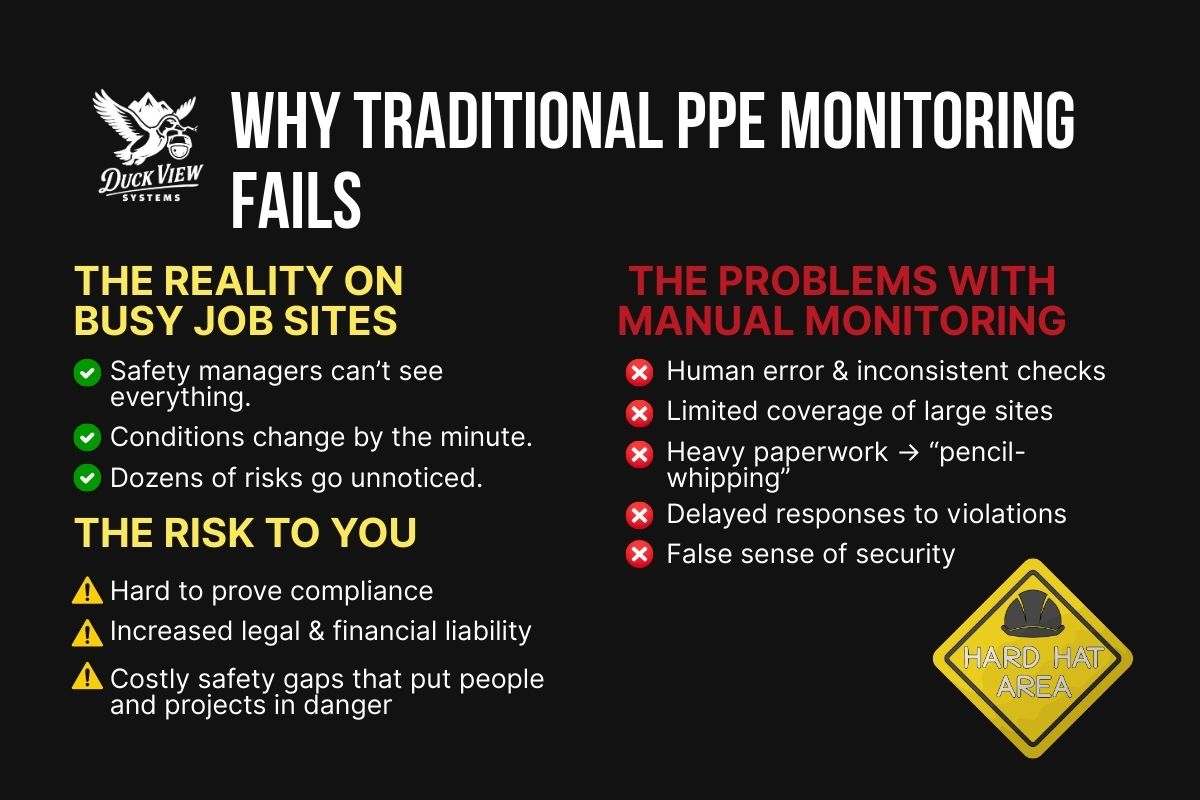
While manual checks are invaluable for direct engagement, their limitations have become increasingly apparent on modern job sites. They are inherently prone to human error and bias; a supervisor might unintentionally focus on one area while neglecting another, or be influenced by their relationship with certain workers. This method provides only limited, snapshot coverage, as one person cannot be everywhere at once.
It is also extremely time-consuming and resource-intensive. Furthermore, the documentation is often subjective and paper-based, making it difficult to aggregate data and identify long-term trends. The monitoring is almost always reactive, identifying a problem only when the observer happens to be in the right place at the right time.
The Rise of Technology in Safety Compliance
Technology is revolutionizing how could compliance with PPE procedures be monitored, augmenting human oversight with powerful tools that never get tired or distracted. While innovations like wearable tech and RFID tags offer some tracking capabilities, the real game-changer for site safety is computer vision and artificial intelligence.
This is where we at Duck View Systems focus our expertise. We develop AI-powered cameras that automatically and continuously detect PPE compliance issues across your entire property. Our AI Human Detection capability represents a fundamental shift from reactive spot-checks to proactive, persistent safety monitoring.
The advantages of AI-powered monitoring are transformative:
- Real-time Detection: The system identifies non-compliance the moment it occurs and sends immediate alerts to supervisors.
- Continuous 24/7 Monitoring: AI provides uninterrupted vigilance across multiple zones simultaneously, without breaks or lapses in attention.
- Objective, Unbiased Data: The system applies the same rules to everyone, eliminating human bias and ensuring fair, consistent enforcement.
- Comprehensive Coverage: A network of cameras can monitor vast areas far more effectively than a team of human observers.
- Advanced Data Analysis: AI automatically collects and analyzes compliance data, generating reports, heat maps, and trend lines to identify high-risk areas, times of day, or recurring issues.
This comprehensive approach to PPE Compliance Monitoring provides actionable insights that are impossible to achieve with manual methods alone. As noted in industry reports like this one from McKinsey, AI and data analytics are becoming essential for improving safety and productivity. In high-risk industries, these solutions are actively helping to prevent occupational injuries by identifying non-compliance the instant it happens, allowing for intervention before an accident can occur.
How Could Compliance with PPE Procedures Be Monitored? A Step-by-Step Framework
An effective PPE monitoring system isn’t just about installing cameras or handing out checklists. It requires a structured, multi-layered approach that integrates policy, training, and technology. This three-step framework scales from small residential projects to large commercial developments, ensuring that the question of how could compliance with PPE procedures be monitored is addressed systematically to keep everyone on your property safe.
Step 1: Establish a Strong Foundation with Clear Policies and Training
Before you can monitor for compliance, everyone must know what is expected of them and why it matters. This foundational step is non-negotiable and is the bedrock of any successful safety program.
- Conduct a Thorough Hazard Assessment: Systematically walk the entire site with your team leaders and even frontline workers to perform a Job Hazard Analysis (JHA). Identify all potential risks, from falling objects and electrical hazards to airborne particles and vehicle traffic. Workers in the field often spot risks that managers might overlook.
- Select the Right PPE for the Job: Based on your assessment, choose the appropriate PPE for each specific risk. Remember that comfort and fit are crucial; uncomfortable or ill-fitting gear is one of the top reasons for non-compliance. Involving employees in the selection process can significantly boost buy-in and subsequent usage.
- Provide Effective, Ongoing Training: Training dramatically improves compliance. Landmark research published in PubMed Central found that participants who were properly trained and fit-tested were 1.66 times more likely to adhere to PPE use. Your training must be practical and continuous, covering not just what PPE to use, but when, why, and how to properly wear, maintain, and inspect it. Use toolbox talks, hands-on demonstrations, and visual aids.
- Address Barriers to Compliance: Have honest, open conversations with your team about why rules might be broken. Common reasons include perceived time pressure, poorly fitting equipment, a simple lack of understanding, or a belief that the rules don’t apply to a specific task. Document your PPE policies clearly and make them easily accessible to everyone on site.
Step 2: Implement Your Chosen Monitoring Strategy
With a strong foundation in place, you can now execute your monitoring plan. The most effective strategies blend the strengths of human oversight with the power of technology.
- Schedule and Perform Audits: Maintain a schedule of regular safety audits and informal observations. Supervisors are still essential for catching nuances that a camera might miss and for providing immediate, personal coaching. These interactions are key to building trust and reinforcing the safety culture.
- Deploy Technology Strategically: Position technology, such as our Mobile Surveillance Units, to monitor high-risk areas, site entrances, and zones with specific PPE requirements. Our AI-powered systems allow you to define specific compliance zones (e.g., a “hard hat required” zone around scaffolding) and will automatically flag violations within those boundaries.
- Leverage Real-Time Alerts: The key to shifting from reactive to proactive safety is an effective alert system. When our AI detects non-compliance, such as a worker entering a designated area without a safety vest, it sends instant notifications with a video clip to supervisors’ phones or tablets. This allows for immediate intervention to correct the behavior and prevent a potential injury.
Step 3: Analyze Data and Drive Continuous Improvement
Monitoring is not a “set it and forget it” activity. The data you collect is a valuable asset that should be used to constantly refine and improve your safety program.
- Make Data-Driven Decisions: Use your incident reports, near-miss data, and AI-generated compliance reports to find patterns and root causes. Our systems can generate compliance heat maps, showing you exactly where and when compliance tends to drop. This allows you to target your improvement efforts with surgical precision, rather than guessing where the problems are.
- Track Key Performance Indicators (KPIs): Use a mix of leading and lagging indicators to measure progress. Lagging indicators (like incident rates) tell you about past performance. More importantly, track leading indicators like compliance percentage by zone, near-miss reporting rates, and training completion rates, which can help you predict and prevent future incidents.
- Integrate Employee Feedback: Create a continuous feedback loop. Hold regular safety meetings to share the data and compliance trends with your team. Ask for their input on why they think compliance is lower in certain areas. Anonymous suggestion systems can also be a powerful tool for identifying issues with PPE comfort, training gaps, or cultural challenges.
This cycle of Plan-Do-Check-Act, using data and feedback to make tangible changes, ensures your safety program evolves and remains effective at protecting your most valuable asset: your people.
Leveraging AI for Proactive PPE Compliance and Site Safety
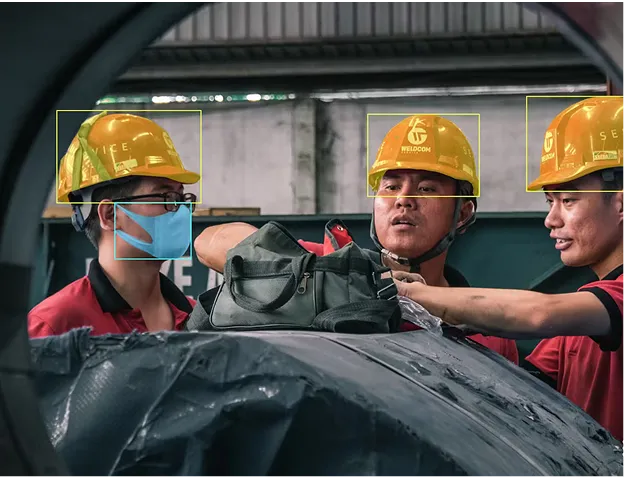
When considering how could compliance with PPE procedures be monitored in the most effective and efficient way possible, artificial intelligence is the definitive game-changer. At Duck View Systems, we have dedicated ourselves to harnessing AI to transform site safety from a reactive, after-the-fact process into a proactive system that actively prevents incidents before they happen. Unlike a human supervisor who can’t be everywhere at once, our AI-powered mobile surveillance units provide continuous, intelligent monitoring across your entire property.
This is the core of our philosophy: AI-Driven Prevention, Not Just Recording. We are not just capturing video; our systems are actively watching for and identifying safety violations as they occur.
Our proprietary AI Inspector feature functions as a team of tireless, digital safety officers that never get distracted or fatigued. When a worker enters a designated hard-hat zone without proper head protection, the system instantly recognizes the violation and sends real-time alerts directly to site supervisors. This allows for immediate intervention.
Furthermore, should you need to review an event, our Natural Language Search functionality makes investigations incredibly efficient. Instead of scrubbing through hours of footage, you can simply type a query like “person no safety vest near east gate Tuesday” to find the relevant high-resolution video clips in seconds.
From Raw Data to Actionable Insights
The true power of AI monitoring lies in its ability to translate raw video streams into structured, actionable information. Our systems go beyond simple alerts to precisely measure compliance rates over time, revealing patterns that would be impossible for a human observer to detect. For instance, your dashboard might reveal that Zone 3 has a 15% lower hard-hat compliance rate on weekday afternoons, prompting you to investigate if worker fatigue or a specific task is the root cause.
By tracking violations by time and location, our Intelligent Video Surveillance systems help you target toolbox talks, training efforts, and supervision where they’re needed most. The system also provides automated reporting for compliance documentation and allows you to use specific, anonymized visual examples to refine your training programs for maximum impact.
A Real-World Example: The AI-Powered Safety Officer
Imagine a busy multi-family construction site with one of our Mobile Surveillance Units positioned to overlook an area where a crane is operating. An AI-defined risk zone is established for the entire swing radius of the crane, with a rule requiring all personnel within that zone to wear high-visibility vests.
A subcontractor, focused on their task, walks into the zone to retrieve a tool, forgetting to put on their vest. Within seconds, our AI detects the presence of a person within the defined zone who is not wearing the required PPE. A real-time alert, complete with a short video clip of the violation, is sent to the site supervisor’s smartphone.
The supervisor, who was on the other side of the property, sees the alert and immediately radios the crane operator to pause, while another foreman on the ground is directed to intercept the worker. The worker is reminded of the policy, puts on their vest, and the situation is resolved safely. A potential struck-by incident is averted, and the entire preventative action takes less than two minutes.
Later, the high-resolution footage becomes a powerful, anonymous training tool for the next all-hands safety meeting, showing a real-world example of how a simple oversight was caught and corrected before it could become a tragedy. This is the power of proactive, intelligent safety monitoring in action.

Frequently Asked Questions about PPE Compliance Monitoring Solutions
We get many questions from property owners, developers, and project managers about implementing an effective PPE compliance program. Here are answers to some of the most common ones, based on our experience helping clients build safer, more secure worksites with our intelligent monitoring solutions.
What are the primary methods for monitoring employee compliance with PPE procedures?
When clients ask how could compliance with PPE procedures be monitored, we explain that the best strategies typically use a hybrid approach. The two main methods are manual observation and technology-driven monitoring. Manual observation involves supervisors or safety officers conducting safety walks and using checklists.
This is excellent for providing immediate, personal coaching and building relationships. Technology-driven monitoring, like our AI surveillance systems, provides continuous, unbiased 24/7 coverage over large areas and sends real-time alerts for non-compliance. The most effective strategy combines the broad, consistent coverage of AI with the nuanced, personal coaching of human oversight.
What are the legal requirements for monitoring PPE usage?
Legally, OSHA requires employers to not only provide necessary PPE at no cost to workers but also to ensure it is used correctly. This means you must have an effective system in place to enforce your PPE policies. While the law doesn’t mandate a specific monitoring method (like AI or manual audits), you are responsible for implementing a program that works.
Documented evidence from a system like ours, which provides time-stamped video clips and automated compliance reports, is invaluable for demonstrating due diligence and proving your commitment to safety in the event of an audit or incident.
How can organizations address common barriers to PPE compliance?
Non-compliance often stems from practical issues, not intentional disregard for safety. To effectively address these barriers, you should:
- Prioritize Comfort and Fit: Involve employees in the process of selecting PPE. Gear that is comfortable, fits well, and is suited for the specific task and weather conditions is far more likely to be worn correctly.
- Close Training Gaps: Go beyond simply stating the rules. Provide regular, hands-on training that explains the “why” behind each piece of PPE. Use real-world examples, like anonymized footage of near-misses captured by your monitoring system, to make the lessons memorable and impactful.
- Account for Time Pressure: A culture that prioritizes speed over safety will always lead to shortcuts. Build adequate time for safety procedures, like donning and doffing harnesses or inspecting equipment, directly into work schedules and project plans.
- Foster a Proactive Safety Culture: True compliance comes from a culture where everyone feels responsible for safety. This requires consistent leadership buy-in and fair, uniform enforcement. Objective AI monitoring helps by applying the same standards to everyone, which removes perceptions of bias and reinforces that safety is the top priority for every person on site.
Will AI monitoring create a ‘big brother’ environment on my property?
This is a common and understandable concern. We designed our systems to be a tool for prevention, not punishment. The goal is to stop an accident before it happens.
We encourage our clients to frame the system to their teams as a safety tool that works for them, like a digital guardian angel. The real-time alerts allow for immediate, positive coaching. Furthermore, the data collected can be used to identify systemic issues (like a need for better equipment or training) rather than focusing on individuals. It ensures fair, unbiased enforcement of rules that are designed to protect everyone.
How difficult is it to set up and use your surveillance units?
Our systems are designed for rapid deployment and ease of use. Our Mobile Surveillance Units are self-contained and can be set up in under an hour, making them ideal for dynamic construction environments. The user interface is intuitive, with a simple dashboard for viewing live feeds, receiving alerts, and accessing reports. You don’t need a dedicated IT team to manage it; the system is built to be managed by your existing site leadership.
Build a Safer Tomorrow with Smarter PPE Compliance Monitoring
Ultimately, understanding how could compliance with PPE procedures be monitored is your direct pathway to a safer, more efficient, and more successful project. By moving beyond outdated, reactive methods and embracing a modern, proactive approach, you can build a safety system that truly protects your people and your property. Combining a strong foundation of clear policies and consistent training with the power of smart technology allows you to create an environment where incidents are prevented, not just documented.
Integrating an intelligent solution like our AI-powered mobile surveillance units gives you a dedicated safety partner that works for you 24/7. Our AI Inspector detects issues in real-time, providing your supervisors with the information they need for on-the-spot coaching, while our analytics dashboard gives management the data required for continuous, strategic improvement. This powerful combination of human expertise and AI-driven technology creates a comprehensive safety net that removes the guesswork from compliance.
Duck View Systems provides the most advanced AI-powered surveillance solutions on the market, specifically designed to automate PPE monitoring and enhance overall site security. Whether you are managing a large-scale construction project, overseeing multiple properties, or simply want to ensure contractors on your site work safely, our technology adapts to your unique needs, providing unparalleled peace of mind.
Ready to build a safer, smarter worksite? Request a Quote today to learn how our technology can protect your team, your timeline, and your bottom line.