
Construction supervisors, retail facility managers, and storage yard operators across Utah and beyond often ask the same question before committing to a solar-powered security trailer: Do Mobile Surveillance Trailers Work Without Sunlight? It is a fair concern. Winter days in the Mountain West are short, fall storms can bring a week of overcast skies, and some sites sit in the shadow of buildings or hillsides for hours at a time. At Duck View Systems, we build American-made mobile surveillance trailers that pair a solar array with an industrial battery bank, so cameras, AI analytics, and LTE connectivity keep running long after the panels stop producing meaningful power. This guide breaks down how that solar-plus-battery system handles cloudy weather, what backup options exist if a stretch of low sunlight runs longer than expected, and how to size a unit correctly for your site’s climate and conditions.
Quick Answer: Yes. Mobile surveillance trailers pair a solar array with an industrial battery bank, so they keep recording, analyzing, and alerting through cloudy days, storms, and long winter nights, with a dual-SIM LTE modem that stays connected regardless of weather.
How Solar Power and Battery Storage Work Together on a Mobile Surveillance Trailer
Our mobile surveillance trailer generates power through a rooftop solar array, sends that energy through a charge controller, and stores the surplus in an onboard battery bank. The cameras, AI processor, and LTE modem draw power from the battery bank around the clock, not directly from the panels. The system runs the same way at 2 a.m. as it does at noon, because cloudy weather only changes how fast the battery recharges, not whether the unit stays powered.
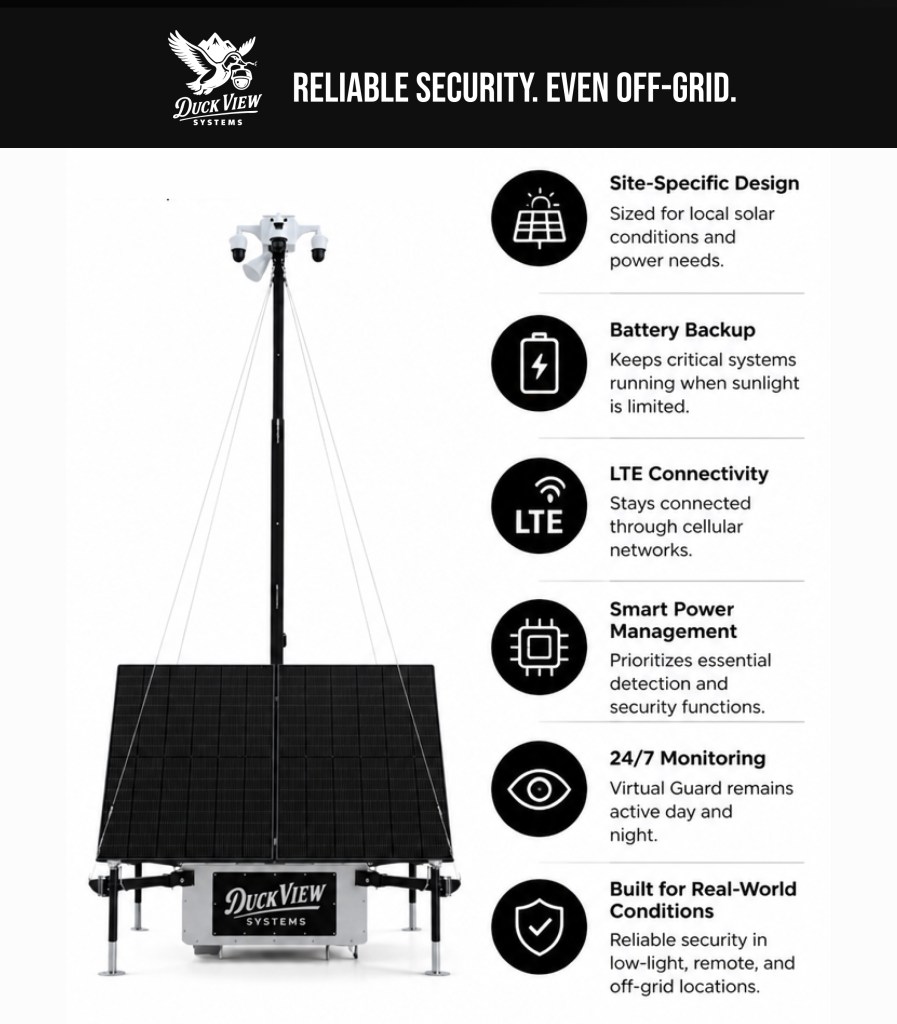
Solar cells absorb sunlight and convert that energy into an electrical charge, which then flows as current to power the system or recharge the battery bank. Cloud cover and haze reduce how much light reaches the panel, so output drops on overcast days, though it does not disappear entirely. A larger solar array and a properly sized battery bank are what keep a trailer running through these lower-output periods without interruption. For a deeper look at the hardware behind this process, our guide to how a solar-powered surveillance trailer generates and stores power covers the panel, controller, and battery layout in more detail.
This off-grid design is the same foundation behind every off-grid surveillance deployment we build, whether the site has grid power nearby or not. If you are new to the technology, our quick-start guide to solar security trailers walks through the basic components before you get into sizing decisions, and our full walkthrough of deployment from delivery to active monitoring is covered on our how it works page.
Solar Array and Battery Bank Sizing
The solar array and battery bank are sized together, not separately. A larger array recharges the battery bank faster on a sunny day, but the battery bank is what determines how long the system can run when the array is not producing much. AI processing, PTZ camera movement, audio deterrent activations, and LED strobe lights all draw from the same battery bank, so a site with frequent AI detections and audio responses uses more stored energy than a quiet site. Our team factors in your site’s typical activity level, latitude, and seasonal sun hours when recommending a configuration for a construction site, retail lot, or remote yard.
How Many Days Can a Surveillance Trailer Run Without Sunlight?

Our mobile surveillance trailer is built to run on stored battery power for multiple consecutive days without any solar input, with the exact runtime depending on the unit’s configuration and how much power the AI platform, cameras, and deterrents draw on a given day. Each system is designed to maintain continuous operation through overnight periods and extended stretches of cloudy weather.
This is exactly the role battery storage plays in any solar system. According to the U.S. Department of Energy, solar energy production can be affected by the season, time of day, cloud cover, haze, and obstructions such as shadows or snow. The DOE also notes that energy storage helps solar-powered systems continue contributing electricity when the sun is not shining by storing energy for later use. On a mobile surveillance trailer, that stored energy keeps the cameras recording, the AI platform analyzing footage, and the LTE modem transmitting alerts, all without waiting for the next sunny day.
| Factor | How It Affects Battery Autonomy |
| Battery bank capacity | Larger capacity extends runtime without solar input |
| AI detection activity | More detections and audio deterrent triggers increase power draw |
| PTZ camera movement | Frequent panning, tilting, and zooming uses more power than a static view |
| Season and latitude | Shorter winter days and lower sun angles reduce daily recharge |
| Multi-day cloud cover | Extended overcast stretches draw down reserves faster than a single cloudy day |
A single cloudy day is rarely a problem. The array still produces some charge, and the battery bank absorbs the difference between what the panels generate and what the system uses that day. The real test comes during extended stretches, such as a week of winter storms, when the array barely recharges the battery from one day to the next. That is the scenario our team plans for when sizing a unit for a site with long, overcast winters or heavy seasonal cloud cover.
What Happens When the Battery Bank Runs Low?
If the battery bank runs low after an extended stretch without meaningful solar input, the system shifts toward a lower-power operating mode before it would ever shut down, prioritizing AI detection, alerting, and LTE connectivity over less critical functions like continuous PTZ patrol or non-essential lighting.
This prioritization is intentional. The features that matter most during a security event, including AI detection of loitering, intrusion, and perimeter breaches, plus the audio deterrents and alert escalation handled by Virtual Guard, stay active even as the system conserves power elsewhere. The goal is to protect the core monitoring function for as long as possible while the battery bank waits for the next charging cycle.
Generator Backup and the Canvas Back Tower
For sites where solar alone may not be enough, we offer the Canvas Back Tower, which adds a methanol backup generator to the standard Mallard Tower configuration. The generator activates automatically when the battery bank drops below a set threshold, recharging the system without anyone needing to visit the site. Generator backup is also available as an add-on on the standard trailer, and it typically adds around $400 per month to the unit’s rental cost. For sites in heavily wooded areas, northern climates, or locations with consistently short winter days, a generator-equipped configuration removes most of the guesswork around battery autonomy.
If your site sits in a low-sunlight region, our team can recommend a battery and generator configuration matched to your typical weather, season, and detection activity. Request a quote from us and tell us about your site’s conditions.
Does Cloudy Weather Affect LTE Connectivity or AI Detection?
No. Cloudy weather does not affect the dual-SIM LTE modem or the AI detection platform, because both run on stored battery power and a cellular signal, and neither depends on sunlight to function.
The modem automatically connects to the strongest available carrier and switches between two major networks if one signal weakens, which has nothing to do with the weather overhead. The AI platform keeps analyzing every camera feed for loitering, intrusion, PPE compliance, fire and smoke, vandalism, and vehicle activity at the same speed regardless of cloud cover. This is part of why we describe our approach as real-time, not rewind: the system does not pause its analysis or wait for better lighting conditions to flag a perimeter breach or trigger an audio deterrent. AI Patrol keeps scanning preset zones on the same schedule, whether the sky is clear or gray.
Some remote sites have weak or inconsistent cellular coverage, rather than a cloudy-weather problem. For those locations, Starlink connectivity is available as an add-on, typically around $150 per month, giving the trailer a satellite backup link that runs independently of both sunlight and ground-based cell towers. A trailer with no Wi-Fi or wired internet on site can still stay connected through LTE, Starlink, or both.
Which Sites Are Hardest on a Solar-Powered Surveillance Trailer?
Heavy shade and short winter daylight hours are the two conditions that put the most strain on a solar-powered surveillance trailer, because both reduce the number of hours the array spends producing meaningful charge each day.
A site surrounded by tall buildings, dense tree cover, or a hillside that blocks morning or afternoon sun loses charging hours even on a clear day. Northern latitudes lose those same hours seasonally, with some winter days providing only a few usable hours of sunlight. Neither condition prevents our trailer from operating, but both reduce the margin between what the array recharges and what the system uses.
Sizing for Short Winter Days and Heavy Shade
Positioning matters as much as battery capacity. According to the U.S. Department of Energy, solar panels in the Northern Hemisphere generally produce the most energy when oriented toward the south. Fixed-tilt solar arrays are commonly installed at an angle based on local latitude to optimize annual solar energy production. Because solar output depends heavily on panel orientation and sun exposure, the same considerations apply when deploying a mobile surveillance trailer. Our deployment team adjusts panel angle and trailer placement to capture as much available light as the location allows. For sites where shade or short winter daylight is unavoidable, a larger battery bank or a generator add-on can help maintain reliable operation.
| Site Condition | Impact on Solar Charging | Common Mitigation |
| Heavy tree or building shade | Fewer daily charging hours, even on sunny days | Reposition the trailer or increase battery capacity |
| Short winter daylight hours | Lower total daily solar input across the season | Larger battery bank or generator add-on |
| Multi-day storms or overcast stretches | The battery bank discharges faster than it recharges | Generator backup or Starlink for connectivity redundancy |
| Panel angle mismatched to latitude | Reduced annual energy capture | Adjust panel tilt and orientation during deployment |
Solar-Powered Trailer vs. Plug-In Camera Systems in Low-Light Climates
Our solar-powered mobile surveillance trailer trades a small amount of weather-dependent charging capacity for complete deployment freedom, while a plug-in or pole-mounted camera system trades that freedom for a constant 110V power source that never runs low, regardless of weather.
| Factor | Solar-Powered Mobile Trailer | Plug-In / Pole-Mounted System |
| Power source | Solar array + battery bank | 110V wall or pole power |
| Weather dependency | Battery bank bridges low-sun periods | None; supply is constant |
| Deployment locations | Anywhere a truck can reach, including sites with no power | Requires existing 110V infrastructure |
| Mobility | Towable; relocates as the site changes | Fixed to the mounting location |
| Setup time | Under an hour | Varies; may require an electrician |
| Typical monthly cost | $1,400 to $2,300 | Starting at $825 |
For a site with reliable 110V power already in place, a pole-mounted system removes the battery question entirely and starts at a lower monthly cost. The trade-off is that a pole-mounted system stays where it is installed and depends on the building’s power staying on throughout outages. A construction site with no power yet, a storage yard in a remote location, or a site that will relocate within a few months is where the mobile trailer’s solar-plus-battery design earns its place. Many of our clients use both pole-mounted cameras on permanent structures and mobile trailers for areas that change from month to month. For a broader look at when each option fits, see our comparison of mobile surveillance trailers vs. fixed security cameras.
How Duck View Systems Builds for Cloudy-Weather Reliability
Each of our mobile surveillance trailers ships with the same solar-plus-battery foundation, regardless of the climate it is headed to, because reliability through bad weather is part of the base design rather than an upgrade.
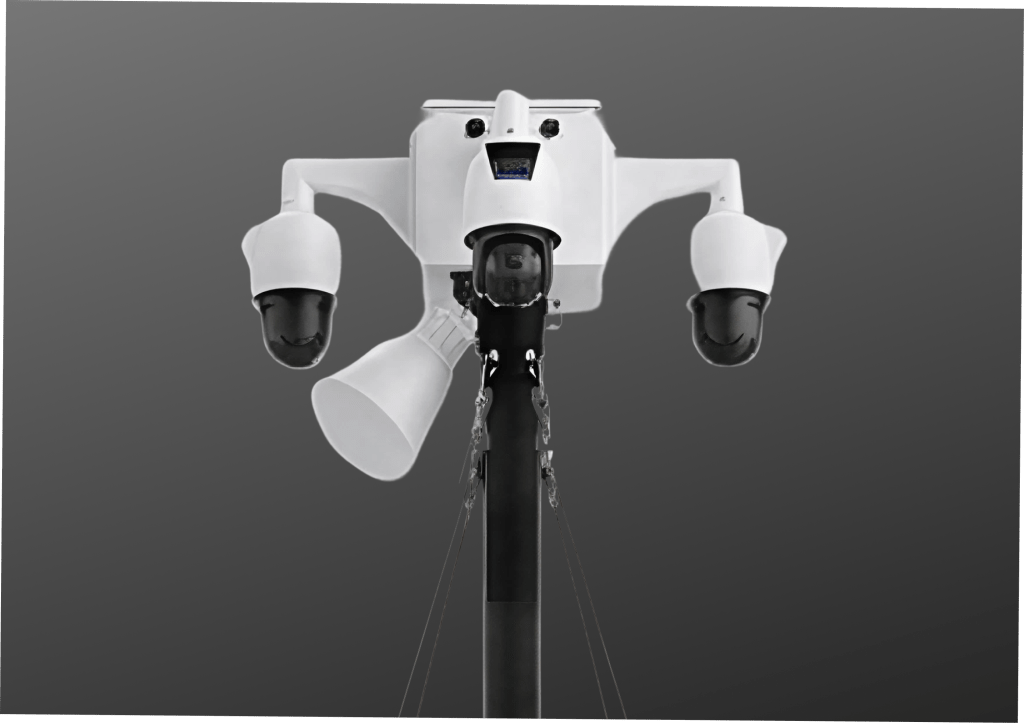
Each unit includes a 20-foot telescoping mast, two 360-degree PTZ cameras with 25x optical zoom, and four total camera feeds, all powered by the onboard solar array and battery bank. A dual-SIM cellular modem automatically switches between two major carriers, so connectivity does not depend on a single network or on clear skies. The AI platform runs the same detection set in any weather: loitering, intrusion, and perimeter breach, PPE compliance, fire and smoke, vandalism, and vehicle type and color.
Features like AI Patrol and Sentry Mode keep scanning a site’s zones around the clock, and Virtual Guard escalates alerts and triggers audio deterrents the moment the AI confirms a threat, all running on the same battery-backed power system described above. We also work through a network of integrator partners who help match a configuration to a site’s climate and risk profile, and every unit is manufactured in Kaysville, Utah.
Nate Salazar, Senior Director of Asset Protection and Safety at Sportsman’s Warehouse, has described us as a trusted partner that consistently demonstrates professionalism, reliability, and industry-leading AI expertise. He noted that the company’s work has frequently exceeded expectations and that our company has become an asset to the organization. For more on the range of climates and sites these units cover, see our overview of solar-powered surveillance across industries.

Frequently Asked Questions: Do Mobile Surveillance Trailers Work Without Sunlight
Can a mobile surveillance trailer work without sunlight or during cloudy weather?
Yes. Duck View Systems mobile surveillance trailers run on a battery bank that the solar array recharges whenever sunlight is available, so the system keeps operating through cloudy days, storms, and overnight hours without any sunlight at all.
How long does a surveillance trailer’s battery last without sun?
The battery bank is designed to keep the system running for multiple consecutive days without solar input, though the exact runtime depends on the unit’s configuration and how active the AI platform and deterrents are on a given site. Our surveillance trailers are engineered to maintain full operation through overnight periods, multi-day cloud cover, and extended stretches of limited sunlight using industrial-grade battery storage.
Does the LTE connection stop working during a storm or cloudy weather?
No. The dual-SIM LTE modem runs on battery power and connects through cellular networks, neither of which is affected by cloud cover, rain, or snow.
What happens if the battery bank runs all the way down?
Before that happens, the system shifts into a lower-power mode that prioritizes AI detection, alerting, and connectivity over less critical functions like continuous PTZ patrol. Units with a generator add-on, or the Canvas Back Tower’s built-in generator, recharge automatically before reaching that point.
Can I add a generator or satellite connectivity for extra backup power?
Yes. Generator backup is available as an add-on on the standard trailer or built into the Canvas Back Tower, and Starlink connectivity is available for sites with weak cellular coverage. Both options add to the monthly cost, and our team can walk through pricing for your configuration.
How do I know if my site gets enough sunlight for a solar-powered trailer?
Most sites do, including many with partial shade or short winter days, because the battery bank is sized to absorb day-to-day variation. For sites with heavy year-round shade, consistently short winter daylight, or a history of week-long overcast stretches, our team reviews the location and recommends a battery and generator configuration that fits.
Get a Power Configuration Built for Your Site’s Climate
Cloudy weather is not a reason to rule out a solar-powered mobile surveillance trailer. The combination of a solar array, an industrial battery bank, and a dual-SIM LTE modem keeps our unit recording, detecting, and alerting through overcast days, storms, and the shortest days of winter. For sites in consistently low-sunlight regions, a generator add-on or the Canvas Back Tower configuration removes most of the guesswork.
Request a Quote from us to get a power configuration matched to your site’s climate, or book a demo to see the AI platform and deterrent system in action.