Construction site monitoring costs vary widely because contractors are really choosing between three different delivery models: human guards, fixed camera systems, and mobile surveillance units. A general contractor budgeting for a six-month build faces different math than a developer securing a multi-year industrial site.
Quick Answer: Construction site monitoring costs range from about $1,400 to $2,300 a month for a mobile surveillance trailer, roughly $18,000 to $29,000 a month for a single contracted 24/7 guard post, and a significant upfront installation cost plus ongoing IT overhead for a fixed camera system. Site size, risk level, and whether you add live monitoring all shift the final number, so an accurate figure always starts with a site-specific quote.
What Drives Construction Site Monitoring Costs
Construction site monitoring costs are driven mainly by site size, project duration, and risk level. A tight urban lot with one entrance costs less to cover than a sprawling multi-acre site with several access points. Longer projects change the math too, since month-to-month rates run higher than a 12-month lease and short deployments can carry extra delivery or setup charges. Risk level matters just as much as size. A site storing copper wiring, generators, or other high-resale equipment justifies a heavier monitoring budget than a site with mostly poured concrete and lumber.
Site Size, Duration, and Risk Level
A construction site monitoring cost estimate should always start with three questions:
- How big is the perimeter?
- How long will the site stay active?
- What is actually sitting on it overnight?
Larger perimeters need more coverage points or a unit with a taller mast and wider field of view. Projects under 12 months typically favor month-to-month or short-term lease pricing, while multi-year builds can lock in lower rates. High-value equipment yards and material laydown areas raise the stakes enough that most site owners add live monitoring or audio deterrents rather than relying on passive recording alone.
The Cost of On-Site Guards
On-site guards cost the most of the three monitoring models once you account for round-the-clock coverage. The U.S. Bureau of Labor Statistics reports a national median annual wage for security guards, and that base wage alone adds up fast when a site needs continuous coverage across three shifts. Contracted billing rates from a security agency are higher than the raw wage, since they include agency overhead, supervision, and margin. A guard also covers exactly one position at a time, which leaves gaps at every other point on the perimeter.
Hourly and Overnight Guard Rates
The Bureau of Labor Statistics puts the median annual wage for security guards at $38,370 as of May 2024, which works out to roughly $18 to $20 an hour before any agency markup. Staffing a single post around the clock, seven days a week, takes about 4.2 full-time guards to cover every hour of the year. At that ratio, base wages alone land near $13,400 to $14,300 a month for one continuously staffed post, before supervision, overtime, holiday pay, or the contracted billing rate a security firm actually charges.
The contracted rate is what actually shows up on an invoice. AF Guards reports that unarmed security guards were billed between $25 and $40 an hour nationally in 2025 and 2026. Applied to the same 4.2 full-time-equivalent staffing model, that puts a single contracted 24/7 guard post at roughly $18,000 to $29,000 a month before any site-specific premium for high-crime areas or overnight differentials.
The Cost of Fixed Camera Systems
Fixed camera systems cost less per camera on paper but carry the highest hidden costs of the three models. A wired system needs conduit runs, trenching, an electrician, a network video recorder, and IT configuration before the first camera ever records footage. That installation work often takes days rather than hours, and every camera stays locked to the angle it was mounted at. Once a construction project moves into its next phase, a fixed camera installed for Phase 1 can become irrelevant, forcing the contractor to pay for a second installation instead of simply relocating a unit.
The Cost of Mobile Surveillance Units
Mobile surveillance units cost between $1,400 and $2,300 a month for a trailer or tower configuration, with most of our customers paying $1,650 to $2,000 a month. A pole-mounted camera system, built for sites with existing 110V power, starts at $825 a month. Neither figure includes optional add-ons like live monitoring, Starlink connectivity, or generator backup, so the exact number for your site depends on which of those you select and how long your lease runs.
What’s Included in a Mobile Surveillance Unit

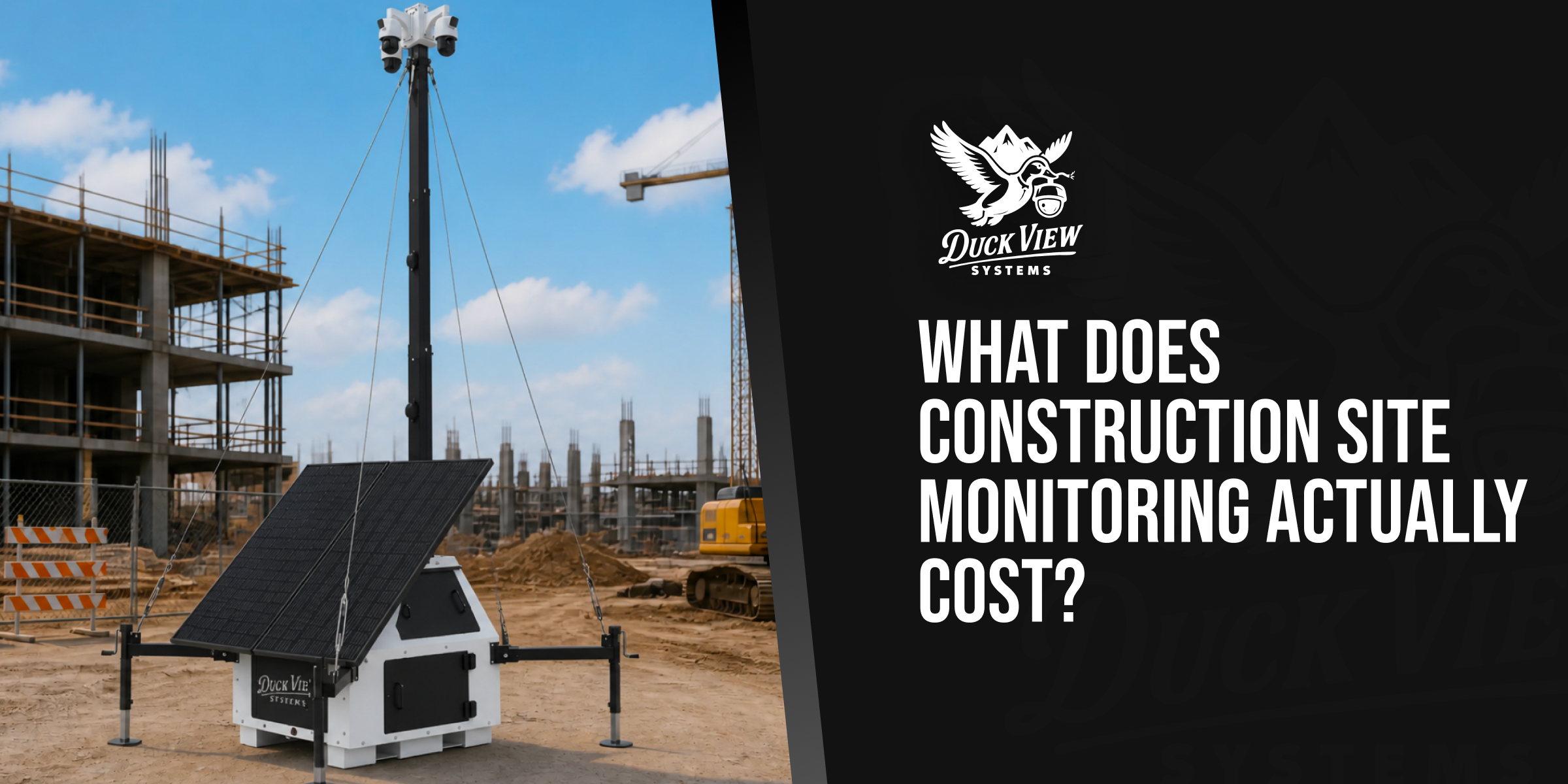
Every Duck View Systems unit ships with four camera feeds, including three 360-degree PTZ cameras with 25x optical zoom, a dual-SIM cellular modem that automatically switches carriers, an IP bullhorn speaker for audio deterrents, and a white and blue LED strobe for visible warning. The unit runs on solar power with an onboard battery bank and sits on a 5-foot by 5-foot footprint with a 20-foot mast, deploying in under an hour with zero trenching or wiring. You can see the exact cost to rent a mobile surveillance trailer for a full breakdown of what shifts the monthly figure up or down.
See the cost to rent a mobile surveillance trailer guide for the full pricing breakdown by configuration.
Add-ons increase the base monthly rate. None of these come included by default.
| Add-On | Approx. Monthly Cost | Applies To |
| Monitoring services | $400 to $500 per tower | Both trailer and pole-mounted systems |
| Starlink connectivity | About $150 per tower | Both trailer and pole-mounted systems |
| Generator backup | About $400 per tower | Trailer (or built into the Canvas Back Tower) |
| Delivery | Varies by location and lease length | Both trailer and pole-mounted systems |
Comparing Coverage Per Dollar
Comparing coverage per dollar means looking at continuous, wide-area coverage against a single fixed vantage point rather than comparing sticker prices alone. A guard covers one gate at a time and needs a full shift rotation to reach 24/7 coverage. A fixed camera covers one angle permanently, whatever that angle happens to be. A mobile surveillance unit with a 20-foot mast and three PTZ cameras covers a wide radius from a single position and can relocate as the site changes. Judged on a cost-per-acre-covered basis rather than a flat monthly number, mobile units generally win on active, changing job sites, while a guard still has one advantage neither camera system can match: the ability to physically intervene.
| Factor | Duck View Systems Mobile Unit | Security Guard | Fixed Camera System |
| Monthly cost | $1,400 to $2,300 | Approximately $18,000–20,000+ per month depending on location and contract terms | Higher upfront installation cost; ongoing operating costs are generally lower after installation |
| Coverage style | Wide-area, 360-degree PTZ from one mast | Single position at a time | Fixed angle, permanent placement |
| Relocates to the site | Yes, towable and redeployable | Yes, but limited by shift coverage | No, requires a new installation |
| Physical intervention | No, deters and alerts only | Yes, can physically respond | No, records only |
| Off-grid capable | Yes, solar and LTE | N/A | No, needs wired power and a network |
A guard can walk over and confront a trespasser, which no camera system can do. For sites that need that physical response capability alongside broad coverage, many contractors combine a single guard on gate duty with mobile surveillance covering the rest of the perimeter.
Hidden Costs of Under-Monitoring a Site
Under-monitoring a construction site creates hidden costs that dwarf whatever was saved on the monthly monitoring bill. Theft losses from stolen tools, copper wiring, and small equipment add up quickly, and insurance claims tied to jobsite theft or vandalism can raise future premiums.
Project delays caused by missing equipment or damaged materials push back completion dates, which carries its own financial penalty on most contracts. A site with no active monitoring also has no time-stamped evidence to support an insurance claim or a police report, which slows down recovery even when a theft is reported quickly.
Theft, Downtime, and Insurance
A single stolen generator or compressor rarely just costs the replacement price. Crews often sit idle waiting for a rental replacement to arrive, subcontractors reschedule around the gap, and the project timeline slips by days rather than hours. Insurance carriers factor jobsite security into their underwriting, and a site with no documented monitoring history can face a harder claims process after an incident, even when the loss itself is covered. None of this shows up on the monthly line item for security, but it shows up on the project’s final cost report.
Calculating Monitoring ROI
Calculating monitoring ROI means weighing the monthly cost of coverage against the losses and delays that coverage prevents. Start with your site’s realistic exposure: the resale value of equipment on-site, the cost of a delayed milestone, and the deductible on your contractor’s insurance policy. Then compare that exposure against the monthly cost of the monitoring option you are considering. A single averted equipment theft or vandalism incident often covers several months of mobile surveillance rental outright, and the ROI case gets stronger the longer a site remains active without incident.
According to the U.S. Small Business Administration, businesses evaluating equipment costs should weigh available cash against ongoing operating expenses before committing to a purchase, since a lease or rental preserves working capital that would otherwise go toward a large upfront outlay. That same logic applies directly to site monitoring: a monthly rental keeps monitoring costs as a predictable operating expense rather than a capital purchase, which matters most for shorter or single-phase projects.
Run the math on your own numbers before signing a contract. Add up the replacement cost of the equipment and materials staged on-site, the daily cost of a delayed milestone on your schedule, and your insurance deductible. Compare that total against a full project’s worth of monitoring rental. On most active job sites, the exposure side of that equation is larger than the monitoring cost by a wide margin, which is why monitoring increasingly shows up as a standard line item in project budgets rather than an optional extra.
Choosing Cost-Effective Jobsite Monitoring
Choosing cost-effective jobsite monitoring comes down to matching the delivery model to your site’s actual risk profile and timeline. A short, low-risk project with existing power may do fine with a pole-mounted camera system starting at $825 a month. A multi-phase, multi-acre site with valuable equipment on-site overnight is usually better served by one or more mobile surveillance trailers, sometimes paired with a single guard for physical response. Fixed camera systems make the most sense for a site that will operate in the same footprint for five years or more, where the upfront installation cost has time to pay for itself.
Matching a Monitoring Solution to Site Risk
Start by ranking your site’s risk factors: value of equipment left on-site, number of access points, history of theft or vandalism in the area, and how long the site will stay in its current configuration. High-risk, high-value sites justify the added monitoring add-on and audio deterrents. Lower-risk, shorter sites can run lean with base coverage and self-monitoring through the mobile dashboard. Whatever the mix, request a site-specific quote before finalizing a budget, since published ranges are a starting point rather than a final number.
You can also see how a mobile trailer stacks up directly against wired cameras in our mobile surveillance trailer vs fixed security cameras comparison, or review our full published monthly pricing for every configuration we offer.
Why Site Owners Choose Duck View Systems
Site owners choose Duck View Systems because we manufacture every unit in Kaysville, Utah, and control quality from design through delivery. Our units deploy in under an hour on solar power and LTE, with no trenching, no wiring, and no waiting on permits. Nate Salazar, Senior Director of Asset Protection and Safety at Sportsman’s Warehouse, describes Duck View Systems as a trusted partner with industry-leading AI expertise that has frequently exceeded his team’s expectations. We also partner with local integrators to extend support across the region, though our direct relationship with site owners like you remains the focus of this guide.
Features like Sentry Mode and Case Reporting turn a monthly monitoring cost into documented, audit-ready evidence, and our construction progress monitoring tools add project oversight value on top of security coverage.

Frequently Asked Questions
How much does construction site monitoring cost per month?
Construction site monitoring cost runs from about $825 a month for a pole-mounted camera system to $1,400 to $2,300 a month for a mobile surveillance trailer, with most customers paying $1,650 to $2,000 a month. A single 24/7 guard post costs significantly more, typically $16,500 or more a month once wages and contracted billing rates are included.
Is surveillance cheaper than hiring security guards?
Yes, in most cases. A mobile surveillance trailer’s monthly cost is a fraction of what a single round-the-clock guard post costs, and one unit covers a wider area than a guard standing at one position. Guards do retain the ability to physically intervene, which is why some sites combine a single guard with mobile surveillance rather than choosing one or the other.
What affects the price of construction site monitoring?
Site size, project duration, and risk level are the biggest factors. Larger perimeters, high-value equipment, and shorter lease terms all push the price up, while longer contracts and smaller, lower-risk sites bring it down. Add-ons like live monitoring, Starlink connectivity, and generator backup increase the total beyond the base unit price.
Does a fixed camera system cost less than a mobile surveillance trailer?
Not usually, once installation is factored in. A fixed system needs trenching, conduit, an electrician, and a network video recorder before it records a single frame, and that cost only applies to one location. A mobile surveillance trailer has a predictable monthly rate and can relocate to a new area of the site with no additional installation charge.
Is monitoring included in the base price of a mobile surveillance trailer?
No. Live monitoring is an optional add-on that typically costs $400 to $500 per tower per month and is not included by default in either the trailer or pole-mounted pricing. Self-monitoring through the mobile dashboard is included in the base rate.
How do I get an exact quote for my construction site?
Duck View Systems units are quote-based because the exact price depends on site-specific variables like acreage, lease length, and add-ons. Request a quote from us for a number built around your specific project.
Get Your Construction Site Monitoring Cost Quote Today
Construction site monitoring cost depends on your site’s size, duration, and risk, and the only way to get an exact number is with a quote built around those specifics. Our published ranges give you a realistic starting point, and our team can walk you through which configuration fits your project.
Request a quote from us to get a site-specific number, or book a demo to see a unit in action first.